
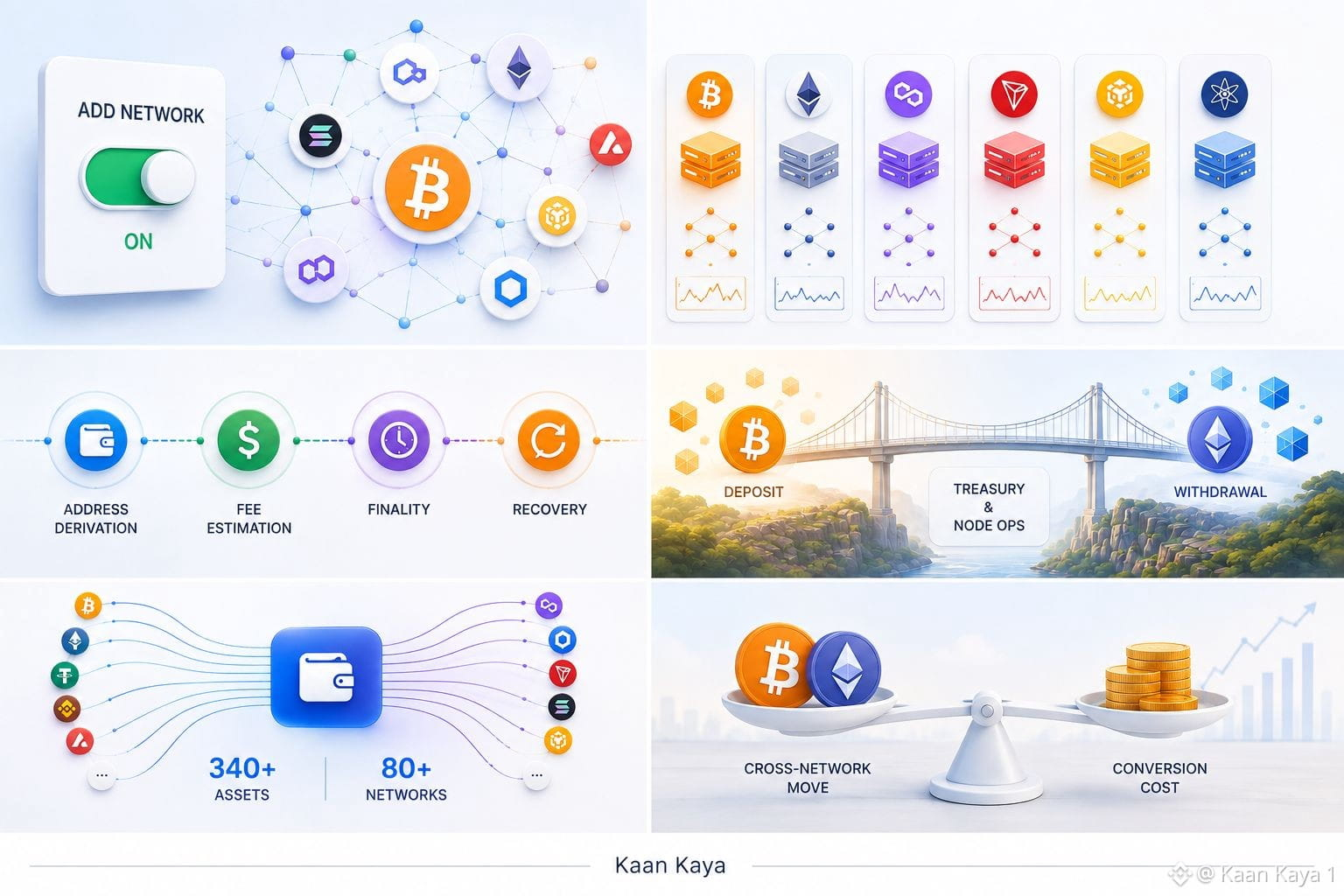
Why "Multi-Chain Support" Is Never One Feature 😕 Adding a network to a $BTC product looks like flipping a config flag. I watched an engineering team learn otherwise mid-sprint 😅 "Multi-chain support" reads as one feature, while in practice, it's a separate integration per chain – its own node, mempool behavior, and reorg rules. Component by component: address derivation differs by curve and format, fee estimation is per-chain and time-varying, finality is probabilistic on some networks and near-instant on others, and a stuck transaction needs its own recovery procedure. It compounds hardest at the cross-chain step: reconciling a deposit on one network against a withdrawal on another means holding liquidity on both sides and absorbing the conversion – a treasury and node-ops burden. That's the layer something like WhiteBIT Wallet-as-a-Service could sit under: it spans 340+ assets across 80+ networks with routing that lets funds arrive on one chain and leave on another, so teams integrate once instead of re-solving finality per network. https://institutional.whitebit.com/crypto-wallets-for-business?utm_source=coinmarketcap&utm_medium=waasskk&utm_campaign=post Address generation and key management are handled separately for each chain, and cross-network routing takes the place of rebuilding the integration for every new chain. The residual cost never disappears – a cross-network move still carries a conversion cost. Is your team pricing that in, or finding out during the first reconciliation? Disclaimer: This is not financial or investment advice. Do your own research before making any decisions. Use at your own risk. #BTC Price Analysis# #Bitcoin Price Prediction: What is Bitcoins next move?#

Veröffentlichen
Haftungsausschluss: Enthält Meinungen von Drittanbietern. Keine Beratung. Binance AI wird ohne Gewähr bereitgestellt. Siehe AGB.