


Key Highlights
Pi Network has begun rolling out Protocol 27 on Testnet following the successful completion of Protocol 26.1 on Mainnet — with the Mainnet upgrade target set for September 15, 2026.
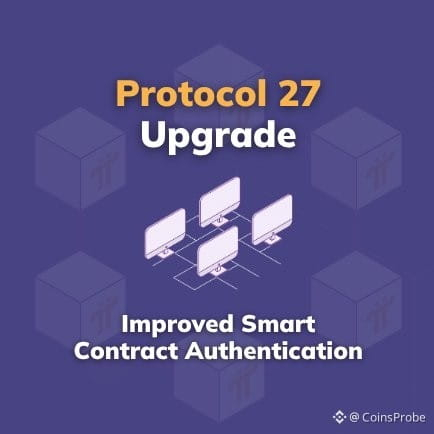
Protocol 27 introduces more flexible and secure smart contract authentication — enabling advanced transaction authorization for accounts and applications and expanding Pi's smart contract capabilities.
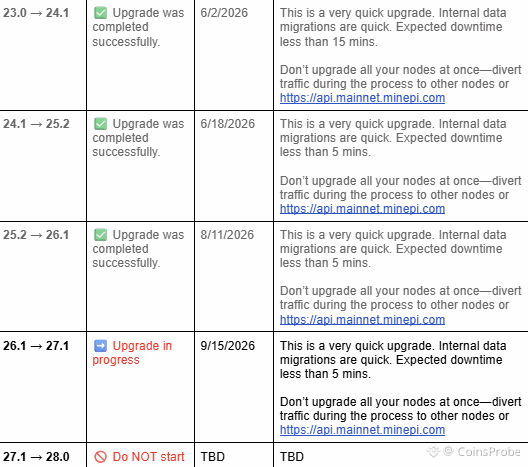
Protocol 28.0 has been officially added to the upgrade roadmap (status: Do Not Start / TBD) — confirming that Pi's development cycle extends actively beyond the current upgrade sequence.
Pi Network is continuing its mandatory sequential protocol upgrade path with the announcement of Protocol 27’s Testnet rollout — the next step in a methodical infrastructure build-out that has been progressing through 2026. The Core Team has set September 15, 2026 as the Mainnet target for Protocol 27, giving Node operators a clear deadline while simultaneously extending the roadmap to include Protocol 28.0 — a signal that development remains active well beyond the current upgrade cycle.
As covered in our Pi Network Node 0.6.2 update and Protocol 26.1 completion recap, the network completed Protocol 26.1 successfully in mid-August 2026 — setting the stage for the 27.1 upgrade now underway on Testnet.

Upgrade Path of Pi Nodes/Source: Minepi
What Protocol 27 Introduces
The @PiCoreTeam official announcement describes Protocol 27’s core function:
“Protocol 27 introduces more flexible and secure smart contract authentication capabilities, enabling more advanced ways for accounts and applications to authorize transactions. The upgrade continues Pi’s broader work to incorporate newer protocol features and expand the network’s smart contract capabilities.”
Pi Node Protocol 27 Upgrade/Source: Minepi
Smart Contract Authentication — What This Means
The central technical advancement in Protocol 27 is an expansion of how accounts and applications can authorize transactions within Pi’s smart contract environment. This is an infrastructure-level change rather than a consumer-facing feature — it expands the programmable toolkit available to developers building on Pi’s blockchain.
More flexible authentication capabilities mean:
Advanced transaction authorization: Developers can implement more sophisticated permission structures for how accounts and applications approve and execute transactions — enabling use cases that require multi-party authorization, conditional execution, or more complex access control logic.
Improved security architecture: More granular authentication controls reduce the attack surface for smart contract exploits — a critical consideration as Pi’s SoloHost ecosystem and utility layer continue expanding.
Expanded smart contract functionality: The upgrade builds on the smart contract capabilities introduced in earlier protocol versions — adding the authentication layer that enables more complex decentralized application logic on Pi’s network.
This upgrade is directly relevant to the ecosystem infrastructure that has been building through 2026. As covered in our SoloHost, Pi Sign-in, and PiVerify explainer, Pi’s utility layer has been expanding across compute, identity, and verification services — each of which benefits directly from more flexible and secure smart contract authentication at the protocol level.
The September 15 Deadline — What Node Operators Need to Know
The Core Team has set September 15, 2026 as the mandatory deadline for all nodes to complete the upgrade to version 27.1. This follows Pi’s established upgrade methodology — sequential, mandatory, and with clear deadlines to ensure network-wide consistency before the next step begins.
Key operational guidance from the Core Team for the 27.1 upgrade:
Follow the sequential path only: Nodes must follow the official upgrade sequence. Skipping versions or upgrading out of order is not permitted and can create network compatibility issues.
Do not upgrade all nodes simultaneously: The Core Team explicitly advises against upgrading the full node infrastructure at once — a staggered approach minimizes disruption and allows for issue identification before the full network transitions.
Divert traffic during the upgrade process: Node operators should divert traffic during the actual upgrade execution to minimize disruption to ongoing network activity and SoloHost applications running on their infrastructure.
Monitor official channels: All upgrade instructions, timing signals, and status updates will come through official Pi Network channels — Node operators should not rely on third-party sources for upgrade timing.
Protocol 28.0 Added to the Roadmap — What It Signals
The most forward-looking element of today’s announcement is not Protocol 27 itself — it is the addition of Protocol 28.0 to the official upgrade roadmap.
Protocol 28.0 is currently listed as “Do Not Start / TBD” — meaning it has no active start date and Node operators should not attempt to begin any 28.0 upgrade activity. Its inclusion on the roadmap at this stage serves a different purpose: it confirms that Pi’s development roadmap extends actively beyond the 27.1 cycle that is currently in progress.
Pi Node Upgrade Roadmap/Source: Minepi
This matters for the broader Pi ecosystem narrative. A network that is publishing its next protocol version on the roadmap while the current version is still in Testnet is signaling that the development pipeline is ahead of — or at minimum aligned with — the deployment timeline. Protocol 28’s presence on the roadmap is an architectural signal that the Core Team’s technical development is not bottlenecked at the current upgrade but is actively planning further capability expansions.
As covered in our Pi Network utility-based pricing and App Studio development update, Pi’s 2026 roadmap has been consistently oriented toward expanding utility infrastructure — from SoloHost and distributed computing to smart contract capabilities and identity services. Protocol 27 and the planned Protocol 28 are the foundational protocol-layer upgrades that enable that utility expansion to continue building on a progressively more capable blockchain.
The Full Pi Node Upgrade Path — Context for Protocol 27
Pi Network’s protocol upgrade sequence follows a mandatory linear path — each version must be completed network-wide before the next begins. The complete current sequence is:
19.1 → 19.6 → 19.9 → 20.2 → 21.2 → 22.1 → 23.0 → 24.1 → 25.2 → 26.1 → 27.1 → 28.0
Protocol 27.1 — currently in Testnet — is the second-to-last step in the currently announced sequence. Protocol 28.0 is the final announced upgrade. The completion of this full sequence will represent the conclusion of Pi’s 2025–2026 upgrade cycle, with whatever new protocol announcements follow defining the next phase of network development.
What This Means for Pioneers and the Broader Ecosystem
For Node operators: The immediate action is clear — prepare for the 27.1 upgrade with a September 15, 2026 completion deadline. Monitor official Pi channels for the signal to begin the Mainnet upgrade (currently in Testnet phase), follow the sequential path, and plan for staggered upgrade execution with traffic diversion during the process.
For developers building on Pi: Protocol 27’s smart contract authentication improvements expand the toolkit available for building more sophisticated applications on Pi’s blockchain. SoloHost developers and those building identity or compute applications will have access to more flexible authorization logic once 27.1 reaches Mainnet.
For the broader Pioneer community: The combination of Protocol 27’s smart contract advancement and the roadmap extension to Protocol 28 demonstrates that Pi’s infrastructure development is both on schedule and looking ahead. The steady cadence of completed upgrades — from 23.0 through 26.1 to the upcoming 27.1 — reflects a development pace that has been consistent without being rushed.
Bottom Line
Pi Network’s Protocol 27 Testnet launch is exactly what the sequential upgrade methodology predicts: a methodical, step-by-step progression through increasingly capable protocol versions, with clear deadlines and explicit roadmap visibility. The September 15, 2026 Mainnet target for 27.1 gives Node operators a specific planning horizon, while the addition of Protocol 28.0 to the roadmap confirms that the development pipeline extends beyond the current cycle.
Protocol 27’s focus on flexible and secure smart contract authentication is the right capability to be adding at this stage of Pi’s development — it provides the foundational authorization infrastructure that more complex decentralized applications, SoloHost services, and identity verification tools require to operate securely at scale.
For Node operators: the September 15 deadline is the immediate priority — prepare now, follow the sequential path, and monitor official channels for the Mainnet upgrade signal.
Disclaimer: The views and analysis presented in this article are for informational purposes only and reflect the author’s perspective, not financial advice. Technical patterns and indicators discussed are subject to market volatility and may or may not yield the anticipated results. Investors are advised to exercise caution, conduct independent research, and make decisions aligned with their individual risk tolerance.