
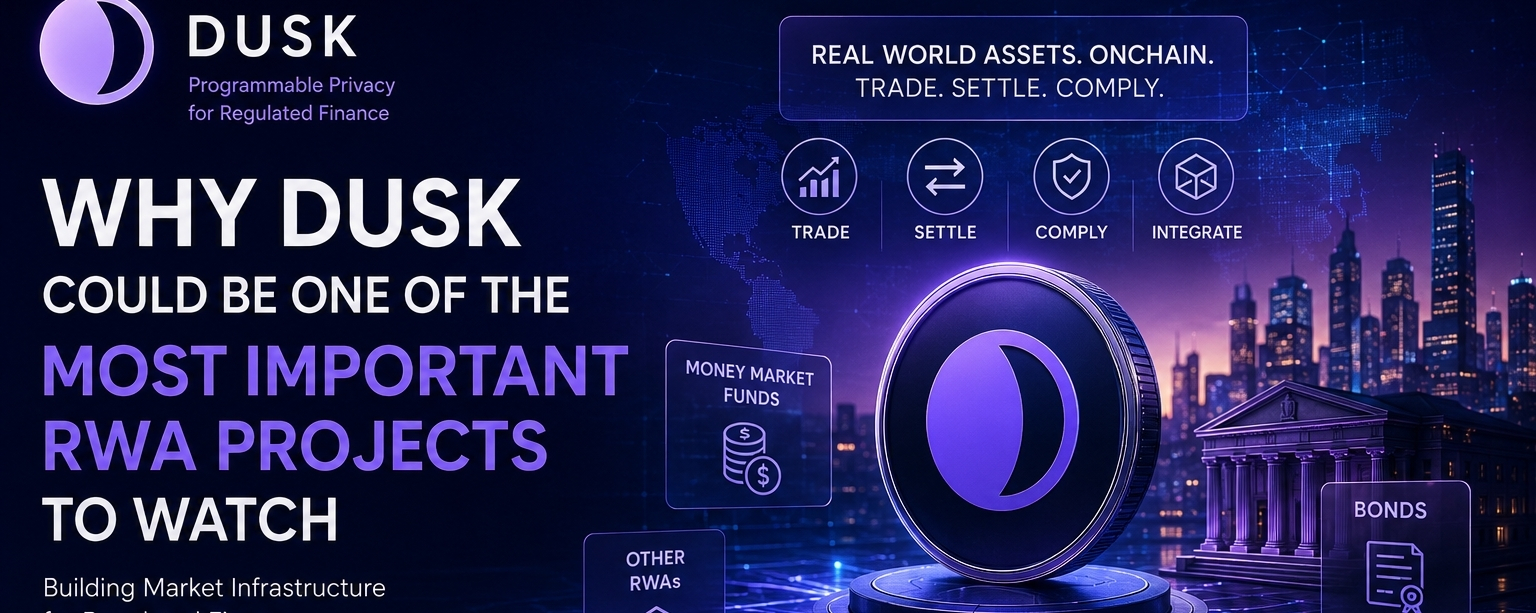
The Real-World Asset (RWA) narrative is becoming one of the strongest sectors in crypto. Every week, more institutions explore how traditional financial assets can move onto blockchain networks.
But here's the question I keep asking:
Is tokenization alone enough?
After researching Dusk, I don't think it is.
Tokenization Is Just the First Step
Many blockchain projects focus on creating digital versions of traditional assets like bonds, ETFs, money market funds, and other financial instruments.
That's valuable.
But if these assets simply become blockchain tokens without being easy to trade, transfer, settle, or integrate into financial applications, then very little has actually changed.
The real value comes from what happens after tokenization.
What Makes Dusk Different?
Dusk isn't trying to become just another blockchain.
Its vision is to provide market infrastructure for regulated finance.
Instead of asking, "Can we tokenize this asset?", Dusk asks:
"Can this asset actually function inside a real financial market?"
That means supporting:
Trading
Settlement
Compliance
Asset transfers
Lifecycle management
all within one blockchain ecosystem.
Why This Matters
Imagine buying a tokenized bond.
As an investor, you don't care which blockchain powers the transaction.
You care about:
Secure ownership
Fast settlement
Easy transfers
Regulatory compliance
The ability to use the asset elsewhere
If blockchain can provide all of that seamlessly, then users don't even need to think about the underlying technology.
That's when blockchain becomes real infrastructure instead of just another database.
The Bigger Opportunity
As institutions continue exploring blockchain adoption, projects that combine compliance with efficiency may become increasingly important.
Dusk focuses on programmable privacy and regulated finance—two areas that could play a key role if tokenized assets continue to grow.
Of course, every crypto project carries risks, and there is no guarantee of adoption or investment success.
Final Thoughts
For me, the biggest shift in thinking is this:
The most important question isn't:
"How many assets are tokenized?"
It's:
"Can people actually use those assets once they're onchain?"
If the answer is yes, tokenization becomes much more than a technological upgrade.
It becomes the foundation of a new financial infrastructure.
What do you think? Will RWA infrastructure become crypto's next major growth sector?
This article is for educational purposes only and should not be considered financial advice. Always do your own research (DYOR).