#dusk $DUSK @Dusk When you hear “privacy coin,” do you think of Monero or Zcash?
I did. But the comparison gets more interesting once you ask what “privacy” is supposed to achieve.
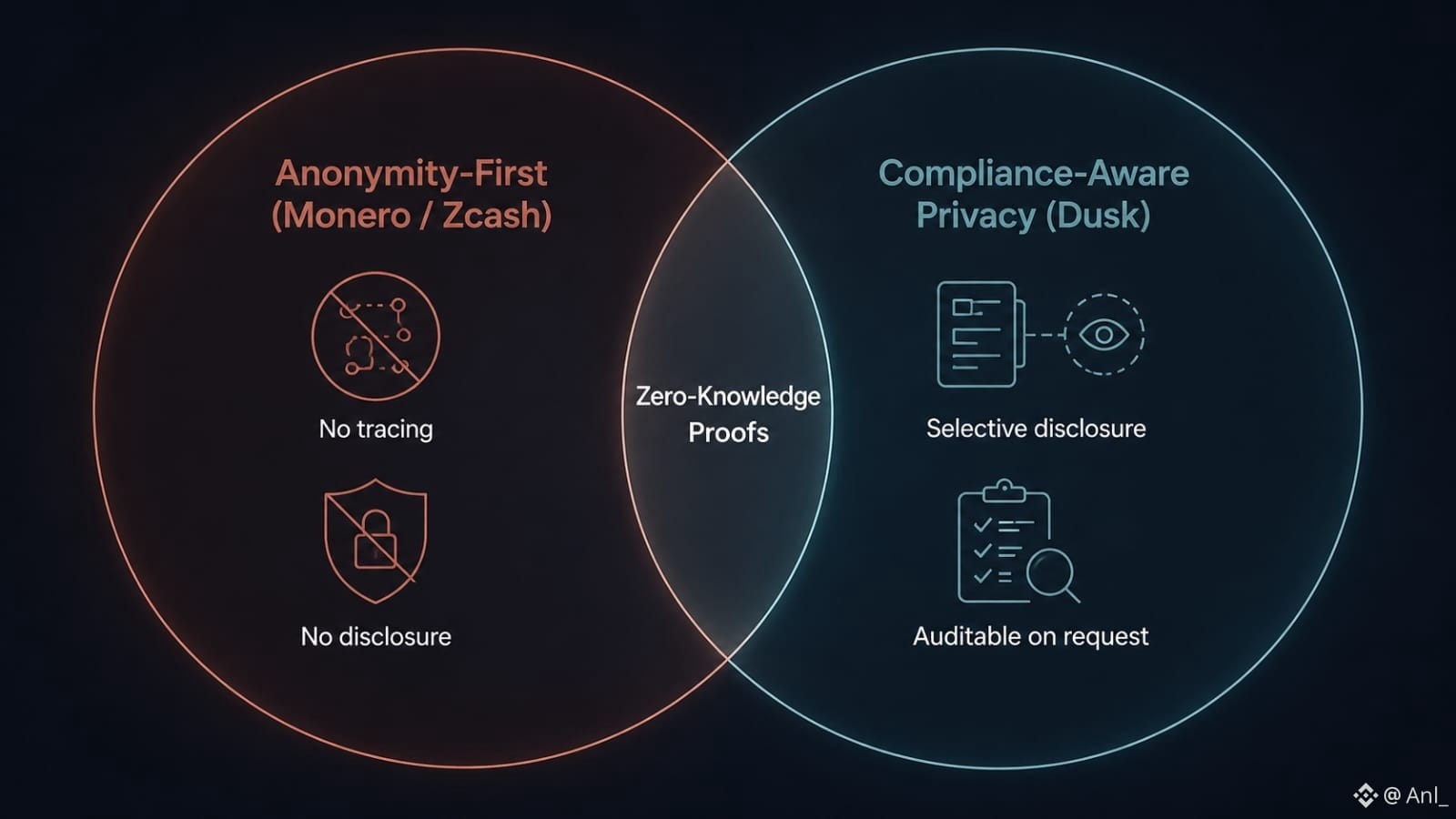
Monero takes the hard line: privacy is mandatory. Sender, receiver and amount are hidden by default. Zcash is more flexible, with shielded transactions and viewing keys that can selectively reveal information.
Dusk pushes that second philosophy directly into regulated finance.
The idea is privacy with selective disclosure: your financial activity does not need to be public, but an authorized party — an auditor, supervisor or institution — can receive the specific evidence it needs without seeing everything else.
I can see why institutions would prefer this.
Banks, issuers and regulated markets need confidentiality, but they also cannot operate in a system where compliance becomes impossible to prove.
The controversy is obvious too.
For a crypto-native privacy advocate, “authorized visibility” can sound less like privacy and more like a controlled backdoor. If someone can be given access, the argument becomes about who controls that access and under what rules.
Then there is adoption.
Regulatory pressure on anonymity-focused assets is no longer theoretical. Kraken removed Monero for EEA clients, explicitly citing regulatory changes.
That makes Dusk's compromise look more commercially survivable: hide information from the public while still allowing regulated verification.
But “more adoptable” does not automatically mean “better privacy.”
Maybe pure anonymity protects the principle better but struggles with institutional access. Maybe selective disclosure sacrifices ideological purity to make privacy usable inside the financial system.
And that leaves the uncomfortable question:
If privacy can still be shown to “someone,” is it really privacy — or just regulated visibility?
I did. But the comparison gets more interesting once you ask what “privacy” is supposed to achieve.
Monero takes the hard line: privacy is mandatory. Sender, receiver and amount are hidden by default. Zcash is more flexible, with shielded transactions and viewing keys that can selectively reveal information.
Dusk pushes that second philosophy directly into regulated finance.
The idea is privacy with selective disclosure: your financial activity does not need to be public, but an authorized party — an auditor, supervisor or institution — can receive the specific evidence it needs without seeing everything else.
I can see why institutions would prefer this.
Banks, issuers and regulated markets need confidentiality, but they also cannot operate in a system where compliance becomes impossible to prove.
The controversy is obvious too.
For a crypto-native privacy advocate, “authorized visibility” can sound less like privacy and more like a controlled backdoor. If someone can be given access, the argument becomes about who controls that access and under what rules.
Then there is adoption.
Regulatory pressure on anonymity-focused assets is no longer theoretical. Kraken removed Monero for EEA clients, explicitly citing regulatory changes.
That makes Dusk's compromise look more commercially survivable: hide information from the public while still allowing regulated verification.
But “more adoptable” does not automatically mean “better privacy.”
Maybe pure anonymity protects the principle better but struggles with institutional access. Maybe selective disclosure sacrifices ideological purity to make privacy usable inside the financial system.
And that leaves the uncomfortable question:
If privacy can still be shown to “someone,” is it really privacy — or just regulated visibility?