
Tron dominates stablecoin settlement with hundreds of billions in volume. But @Plasma is about to hit them where it hurts with pBTC Bridge, launching in 2026.
What Makes pBTC Different
Most Bitcoin bridges suck. WBTC is custodial through BitGo, which means trusting a single entity with your Bitcoin. RenBTC had protocol risks and high fees. tBTC is trust-minimized but complicated with shallow liquidity.
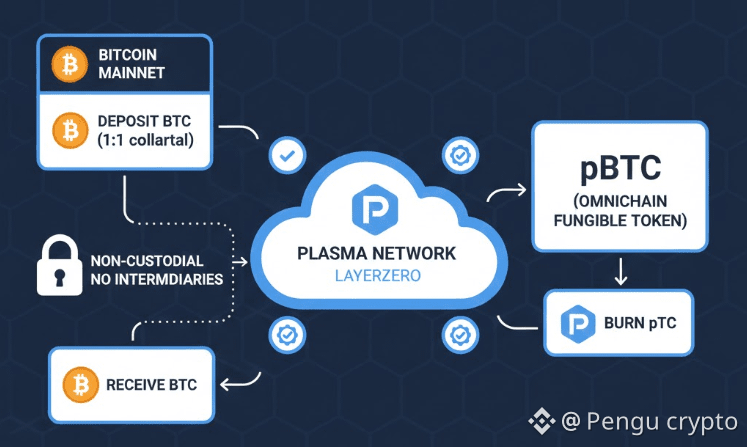
Plasma's pBTC uses LayerZero's Omnichain Fungible Token standard for a non-custodial, 1:1 Bitcoin-backed token. You deposit BTC on the Bitcoin mainnet. Decentralized verifiers confirm it and mint pBTC on Plasma. When you want out, burn pBTC and get your Bitcoin back. No custodian. No middleman controlling your funds.
Why This Matters for Stablecoins
pBTC works like an ERC-20 token on Plasma's EVM-compatible chain. That means Bitcoin can now be collateral for DeFi lending on Aave and Fluid, used in swaps on CoWSwap, or even pay transaction fees through custom gas. You can borrow stablecoins against your Bitcoin without leaving the Plasma ecosystem.
This connects $900 billion in Bitcoin liquidity with Plasma's $7 billion in stablecoin deposits. Cross-asset bridge rails where BTC and stablecoins finally work together seamlessly.
The Attack on Legacy Systems
Tron has massive USDT volume but their Bitcoin bridges rely on wrapped tokens with custodial risks and high fees. Plasma offers non-custodial bridging with zero slippage on large volumes through StableFlow, which went live in January.
Plasma already has the second-highest TVL on Aave and Pendle. Deep DeFi infrastructure that Tron can't match. pBTC Bridge fills the last gap by bringing Bitcoin into this stablecoin-native environment.
With institutional backing from Founders Fund, Tether, plus partnerships across 100+ platforms, Plasma is building the venue where Bitcoin and stablecoins intersect. If pBTC delivers on its promise in 2026, legacy bridges and even Tron's dominance might not last much longer.
