I assumed a fixed-rate loan on TermMax meant one number: whatever you borrowed, that's the fixed amount you eventually hand back. That's not the whole picture.
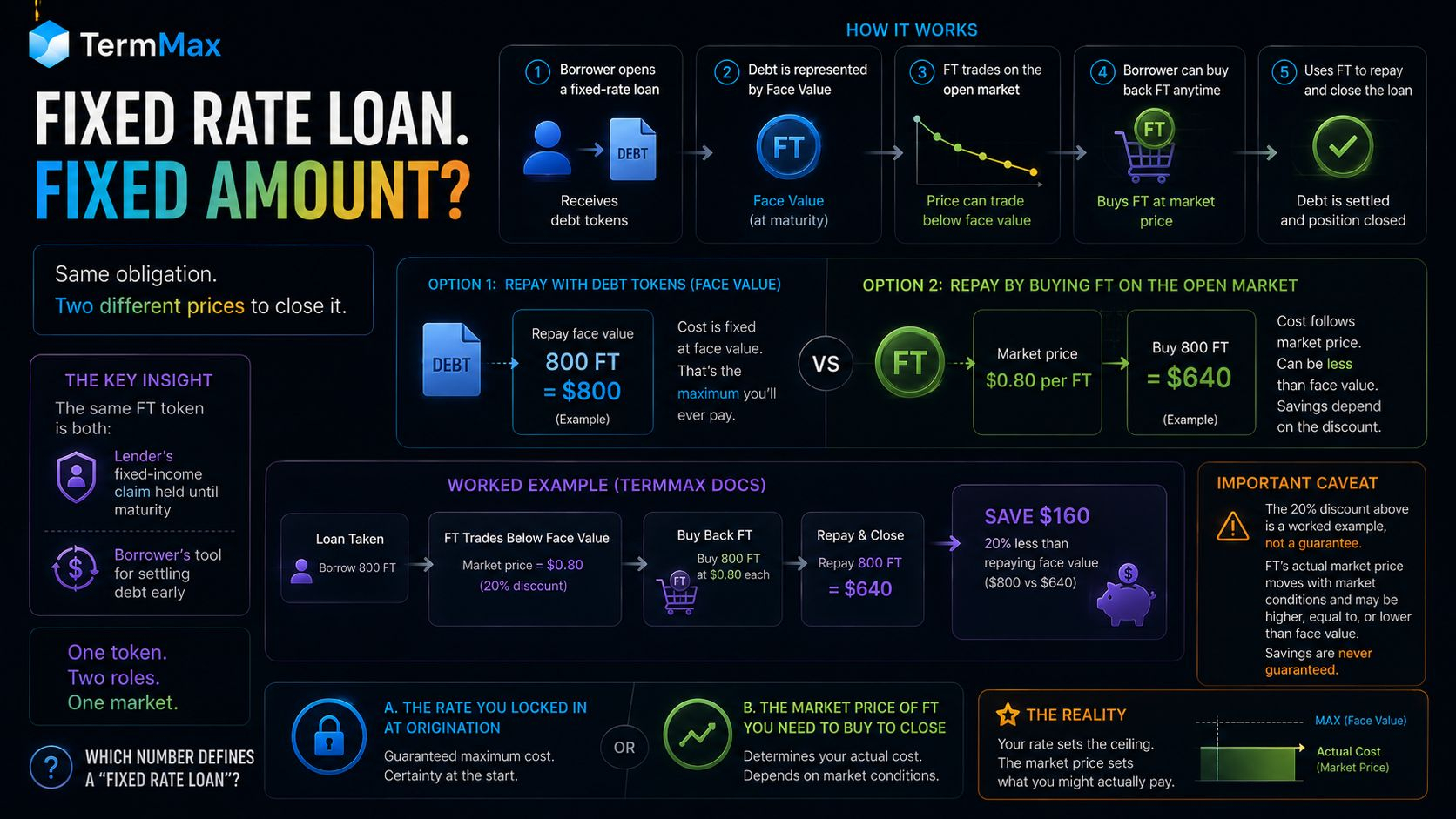
Here's the mechanic. When a borrower takes a loan, they receive debt tokens and can repay by returning that exact face value. But TermMax also lets them buy back FT, the token representing that same debt, from the open market instead. FT can trade below face value before maturity, and TermMax's worked example illustrates how that can lower the repayment cost. In that example, a borrower who owes 800 FT can buy them back at $0.80 each and settle the debt for $640, instead of repaying $800 directly. Same obligation, two different prices to close it.
That's not a rounding difference. It's a 20% gap between the contractual repayment amount and what closing the position can actually cost, depending on where FT happens to be trading that day.
Here's what that reveals: the same FT token is simultaneously the lender's fixed-income claim held until maturity, and the borrower's tool for settling debt early. The debt isn't a number that sits still between origination and maturity. It can have a market price before maturity, and that market price can move independently of the rate quoted at origination.
One caveat worth naming: TermMax's own documentation uses this 20% figure as a worked example, not a guaranteed market condition. FT's actual discount moves with market conditions and won't always be that wide.
So which number should actually define a "fixed-rate loan": the rate you locked in at origination, or the market price of the instrument you'd need to buy to close it?
#termmax @TermMax
Here's the mechanic. When a borrower takes a loan, they receive debt tokens and can repay by returning that exact face value. But TermMax also lets them buy back FT, the token representing that same debt, from the open market instead. FT can trade below face value before maturity, and TermMax's worked example illustrates how that can lower the repayment cost. In that example, a borrower who owes 800 FT can buy them back at $0.80 each and settle the debt for $640, instead of repaying $800 directly. Same obligation, two different prices to close it.
That's not a rounding difference. It's a 20% gap between the contractual repayment amount and what closing the position can actually cost, depending on where FT happens to be trading that day.
Here's what that reveals: the same FT token is simultaneously the lender's fixed-income claim held until maturity, and the borrower's tool for settling debt early. The debt isn't a number that sits still between origination and maturity. It can have a market price before maturity, and that market price can move independently of the rate quoted at origination.
One caveat worth naming: TermMax's own documentation uses this 20% figure as a worked example, not a guaranteed market condition. FT's actual discount moves with market conditions and won't always be that wide.
So which number should actually define a "fixed-rate loan": the rate you locked in at origination, or the market price of the instrument you'd need to buy to close it?
#termmax @TermMax