
#dusk $DUSK @Dusk ......Ich habe mir Dusk’ älteren ZK-Code angesehen und dann eine neuere Änderung gefunden, die das Ganze deutlich interessanter macht: Das Beweissystem wird nicht nur stärker, sondern auch schlanker.....
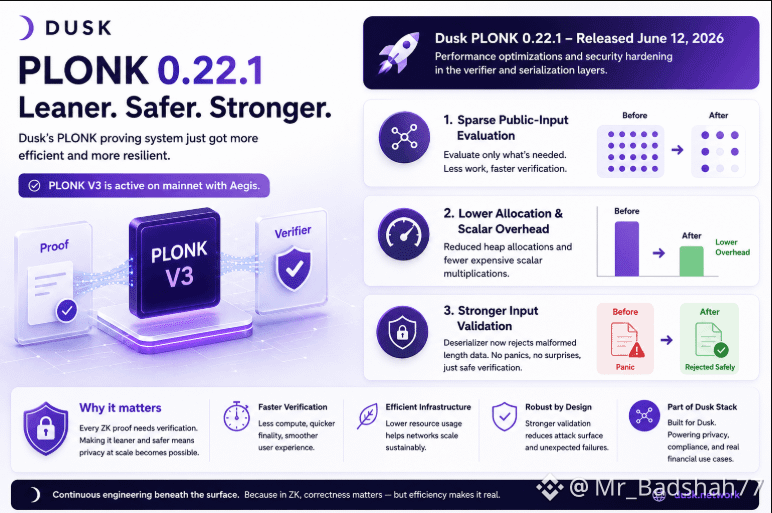
June’s dusk-plonk 0.22.1-Release hat den Verifier selbst weiter gestrafft. Public Inputs werden jetzt sparsamer behandelt, die Heap-Allokation wurde reduziert, und ein Teil des Overheads bei Skalarmultiplikationen wurde aus der Proof-Verifikation herausgeschnitten. Außerdem hat es die Proof-Deserialisierung robuster gemacht: Fehlgebildete Längenangaben werden jetzt abgewiesen, statt einen Panic auszulösen.
Denk an einen Sicherheits-Checkpunkt.....
Du machst den Checkpunkt besser, indem du nicht jede Person jede Tasche auspacken lässt. Du prüfst genau das, was zählt, vermeidest unnötige Arbeit und weist offensichtlich kaputte Eingaben zurück, bevor sie tiefer in das System gelangen.
So ähnlich hat mich das hier angesprochen.....
Dusk’ PLONK-Stack ist sein ZK-Beweissystem über BLS12-381, und PLONK V3 wurde mit dem Aegis-Network-Upgrade aktiv. Diese Verbesserungen am Verifier treiben also keine isolierte Kryptografie-Experiment herum. Sie gehören zum Stack, den Dusk aktiv unter seiner Privacy-Architektur pflegt.
Warte, lass mich kurz zurückgehen.....
Menschen sprechen normalerweise über ZK, als wäre der schwierige Teil einfach nur: „Kannst du es beweisen?“
Für ein echtes Netzwerk gibt es aber noch eine andere Frage:...
Wie viel Arbeit muss das System jedes Mal leisten, wenn es diese Proof verifiziert?
Genau darauf kommt es mir bei diesem Update an. Weniger Allokationen und weniger Overhead bei Skalarmultiplikationen verändern nicht die große Schlagzeile als Feature. Sie verbessern die Mechanik darunter....
Der Trade-off ist: Optimierung auf dieser Ebene kann kryptografischen Code schwerer nachvollziehbar machen, daher zählen Performance-Gewinne nur, wenn Korrektheit und das Härtung der Eingaben intakt bleiben.
Ich interessiere mich dabei immer noch mehr für die Richtung als für irgendeine einzelne Benchmark-Zahl: @dusk behandelt ZK-Verifikation als Infrastruktur, die kontinuierliches Engineering braucht – nicht als Häkchen, das man einmal setzt....
Wenn Privacy Teil des Finanz-Stacks wird, sollte dann die Effizienz der Proof-Verifikation nicht fast genauso wichtig sein wie das Privacy-Primitive selbst?
June’s dusk-plonk 0.22.1-Release hat den Verifier selbst weiter gestrafft. Public Inputs werden jetzt sparsamer behandelt, die Heap-Allokation wurde reduziert, und ein Teil des Overheads bei Skalarmultiplikationen wurde aus der Proof-Verifikation herausgeschnitten. Außerdem hat es die Proof-Deserialisierung robuster gemacht: Fehlgebildete Längenangaben werden jetzt abgewiesen, statt einen Panic auszulösen.
Denk an einen Sicherheits-Checkpunkt.....
Du machst den Checkpunkt besser, indem du nicht jede Person jede Tasche auspacken lässt. Du prüfst genau das, was zählt, vermeidest unnötige Arbeit und weist offensichtlich kaputte Eingaben zurück, bevor sie tiefer in das System gelangen.
So ähnlich hat mich das hier angesprochen.....
Dusk’ PLONK-Stack ist sein ZK-Beweissystem über BLS12-381, und PLONK V3 wurde mit dem Aegis-Network-Upgrade aktiv. Diese Verbesserungen am Verifier treiben also keine isolierte Kryptografie-Experiment herum. Sie gehören zum Stack, den Dusk aktiv unter seiner Privacy-Architektur pflegt.
Warte, lass mich kurz zurückgehen.....
Menschen sprechen normalerweise über ZK, als wäre der schwierige Teil einfach nur: „Kannst du es beweisen?“
Für ein echtes Netzwerk gibt es aber noch eine andere Frage:...
Wie viel Arbeit muss das System jedes Mal leisten, wenn es diese Proof verifiziert?
Genau darauf kommt es mir bei diesem Update an. Weniger Allokationen und weniger Overhead bei Skalarmultiplikationen verändern nicht die große Schlagzeile als Feature. Sie verbessern die Mechanik darunter....
Der Trade-off ist: Optimierung auf dieser Ebene kann kryptografischen Code schwerer nachvollziehbar machen, daher zählen Performance-Gewinne nur, wenn Korrektheit und das Härtung der Eingaben intakt bleiben.
Ich interessiere mich dabei immer noch mehr für die Richtung als für irgendeine einzelne Benchmark-Zahl: @dusk behandelt ZK-Verifikation als Infrastruktur, die kontinuierliches Engineering braucht – nicht als Häkchen, das man einmal setzt....
Wenn Privacy Teil des Finanz-Stacks wird, sollte dann die Effizienz der Proof-Verifikation nicht fast genauso wichtig sein wie das Privacy-Primitive selbst?