#dusk $DUSK @Dusk
RWA Is More Than Tokenization
I used to think the RWA problem was pretty straightforward:
→ Take a real world asset
→ Put it on chain
→ Make it tradable
But looking deeper into Dusk changed how I see it.
The interesting question isn’t just “Can this asset exist on chain?”
It’s → “How much of its actual lifecycle can happen on chain?”
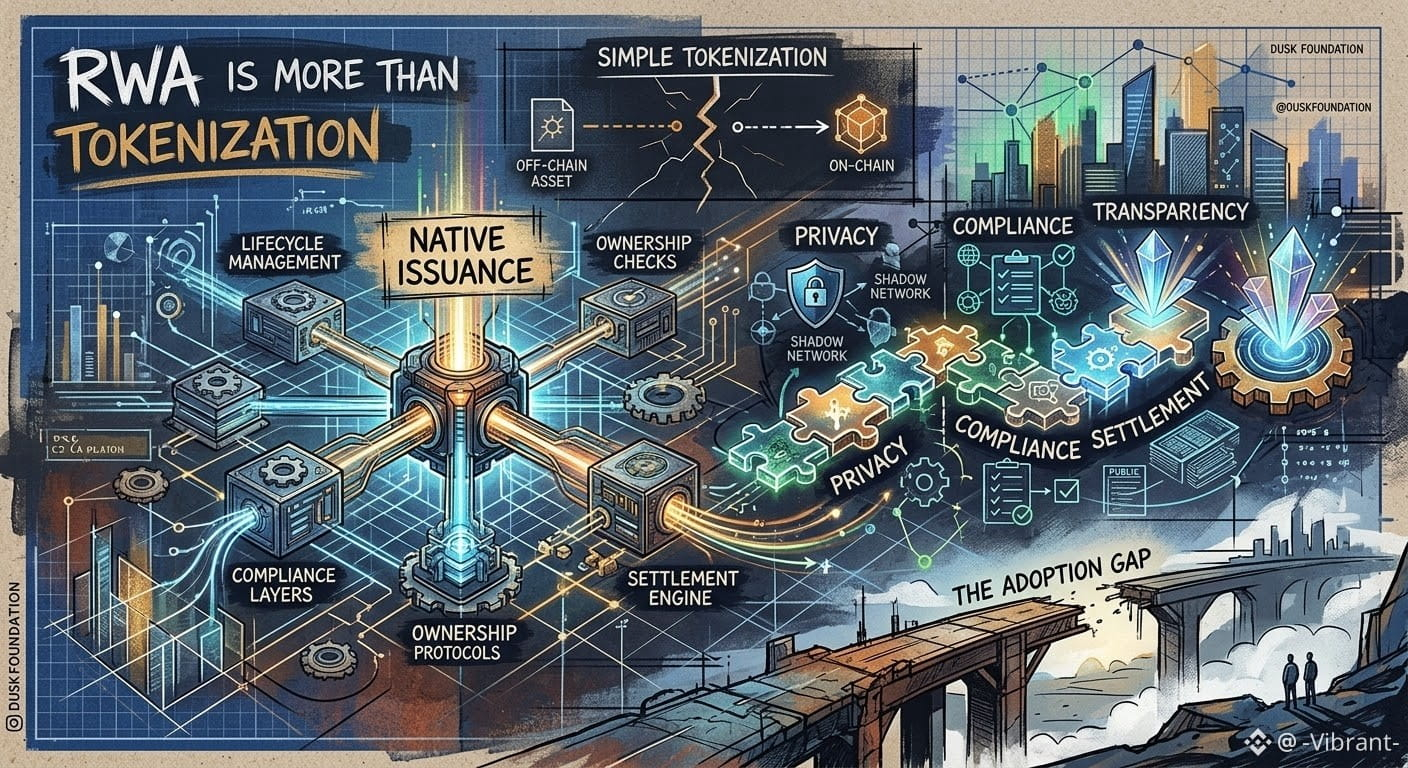
That’s where Dusk’s distinction between tokenization and native issuance gets interesting.
With simple tokenization, the asset may live on a blockchain while ownership checks, issuance, transfers, compliance, and settlement still depend heavily on systems outside it.
Native issuance points toward a different model → where more of those processes can be built into the on chain environment itself.
Then there’s privacy.
For regulated assets, making everything public isn’t realistic. But hiding everything isn’t either.
So the real challenge becomes:
privacy → compliance → transparency → settlement
…and getting those pieces to work together without turning the system into either a public database or a black box.
I’m still cautious. Infrastructure can prove what’s possible, but adoption is a completely different test.
That gap is probably the part of Dusk I’m most interested in watching.
RWA Is More Than Tokenization
I used to think the RWA problem was pretty straightforward:
→ Take a real world asset
→ Put it on chain
→ Make it tradable
But looking deeper into Dusk changed how I see it.
The interesting question isn’t just “Can this asset exist on chain?”
It’s → “How much of its actual lifecycle can happen on chain?”
That’s where Dusk’s distinction between tokenization and native issuance gets interesting.
With simple tokenization, the asset may live on a blockchain while ownership checks, issuance, transfers, compliance, and settlement still depend heavily on systems outside it.
Native issuance points toward a different model → where more of those processes can be built into the on chain environment itself.
Then there’s privacy.
For regulated assets, making everything public isn’t realistic. But hiding everything isn’t either.
So the real challenge becomes:
privacy → compliance → transparency → settlement
…and getting those pieces to work together without turning the system into either a public database or a black box.
I’m still cautious. Infrastructure can prove what’s possible, but adoption is a completely different test.
That gap is probably the part of Dusk I’m most interested in watching.