
#termmax @TermMax .........Was passiert mit Kreditgebern, wenn die Liquidation einen TermMax-Kredit nicht vollständig zurückzahlen kann?
Darüber habe ich nachgedacht, während ich mir @TermMax angesehen habe.
In den meisten Kreditvergabesystemen ist die Liquidation der Punkt, an dem die Sicherheiten verkauft werden, um die Schulden abzudecken.
Aber was passiert, wenn das Liquidationsfenster endet und der Kredit immer noch nicht vollständig zurückerhalten wurde?
Genau da wird der Physische-Lieferungs-Mechanismus von TermMax interessant.
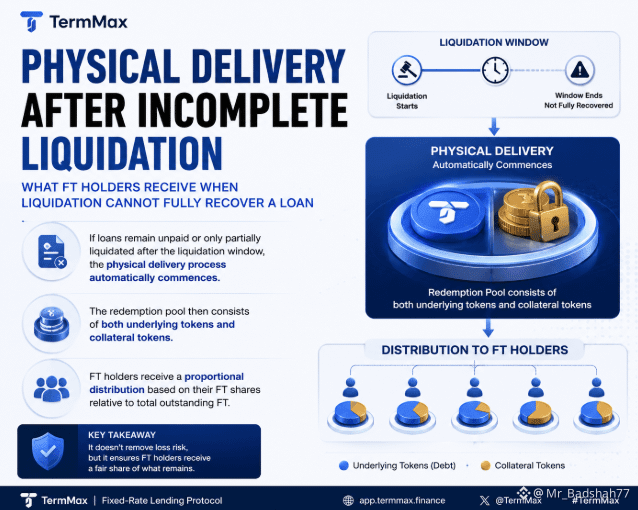
Wenn die Liquidation nur einen Teil der ausstehenden Schuld zurückerwirtschaftet, kann der Prozess automatisch in die Physische Lieferung übergehen.
Statt FT-Inhabern mit einer ungelösten Forderung zurückzulassen, kann der Redemption-Pool sowohl die zugrunde liegenden Schuld-Token als auch die Sicherheiten-Token enthalten.
FT-Inhaber erhalten dann einen proportionalen Anteil an diesem Pool – basierend auf ihrem FT-Anteil im Verhältnis zum gesamten ausstehenden FT.
Der Zielkonflikt ist also ziemlich klar:
Vollständige Liquidation = Schuld wird durch den Verkauf der Sicherheiten zurückerhalten.
Unvollständige Liquidation = verbleibende Vermögenswerte werden proportional an FT-Inhaber geliefert.
Es beseitigt nicht das Verlustrisiko.
Aber es verändert, was passiert, wenn der normale Liquidationsprozess nicht ausreicht, um die Position zu schließen.
Würdest du lieber:
1. Automatische physische Lieferung der verbleibenden Vermögenswerte
2. Ein Liquidation-nur-Modell
3. Es hängt von der Art der Sicherheit ab?
Darüber habe ich nachgedacht, während ich mir @TermMax angesehen habe.
In den meisten Kreditvergabesystemen ist die Liquidation der Punkt, an dem die Sicherheiten verkauft werden, um die Schulden abzudecken.
Aber was passiert, wenn das Liquidationsfenster endet und der Kredit immer noch nicht vollständig zurückerhalten wurde?
Genau da wird der Physische-Lieferungs-Mechanismus von TermMax interessant.
Wenn die Liquidation nur einen Teil der ausstehenden Schuld zurückerwirtschaftet, kann der Prozess automatisch in die Physische Lieferung übergehen.
Statt FT-Inhabern mit einer ungelösten Forderung zurückzulassen, kann der Redemption-Pool sowohl die zugrunde liegenden Schuld-Token als auch die Sicherheiten-Token enthalten.
FT-Inhaber erhalten dann einen proportionalen Anteil an diesem Pool – basierend auf ihrem FT-Anteil im Verhältnis zum gesamten ausstehenden FT.
Der Zielkonflikt ist also ziemlich klar:
Vollständige Liquidation = Schuld wird durch den Verkauf der Sicherheiten zurückerhalten.
Unvollständige Liquidation = verbleibende Vermögenswerte werden proportional an FT-Inhaber geliefert.
Es beseitigt nicht das Verlustrisiko.
Aber es verändert, was passiert, wenn der normale Liquidationsprozess nicht ausreicht, um die Position zu schließen.
Würdest du lieber:
1. Automatische physische Lieferung der verbleibenden Vermögenswerte
2. Ein Liquidation-nur-Modell
3. Es hängt von der Art der Sicherheit ab?