

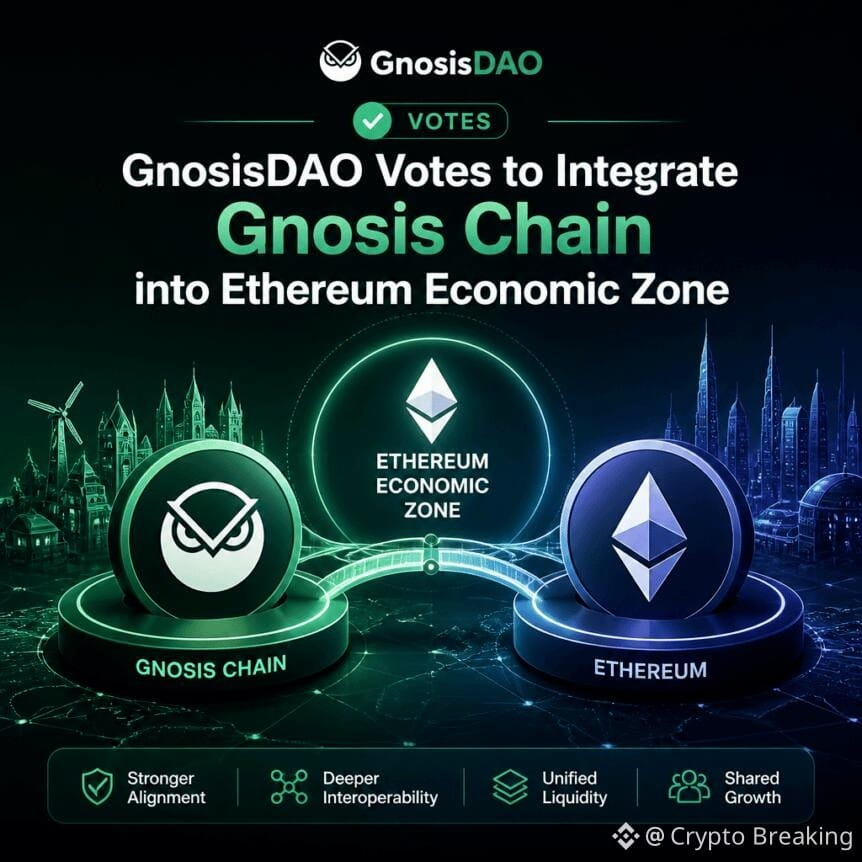
GnosisDAO has voted to approve a major upgrade for Gnosis Chain: the network will transition from operating as a standalone layer-1 to becoming a ZK-proven “Ethereum Economic Zone” (EEZ) rollup aligned with Ethereum. The decision is intended to move Gnosis Chain’s transaction settlement to Ethereum while still running its smart contracts in an environment designed to improve how users and applications interact with Ethereum-native liquidity and assets.
In the governance vote, Gnosis Chain reported that GIP-153 passed with 123,158 GNO in support, 115 against, and 151 abstaining across 54 voters. The proposal’s turnout totaled 123,425 GNO, surpassing the 75,000 GNO quorum requirement. Gnosis Chain now says an initial launch is targeted for late 2026 or early 2027, contingent on the EEZ technology being ready.
Key takeaways
GnosisDAO approved GIP-153 to transition Gnosis Chain from layer-1 to an EEZ rollup that settles transactions on Ethereum.
The vote cleared the 75,000 GNO quorum with 123,425 GNO in turnout, signaling broad governance support despite a low “no” count.
Under the proposal, Gnosis Chain’s validator set would be retired, shifting settlement responsibility to Ethereum validators.
Gnosis Chain-native contracts would gain tighter access to Ethereum assets and liquidity, including the ability to call Ethereum and use results within the same transaction.
The EEZ concept is aimed at reducing fragmentation across Ethereum’s growing rollup landscape, potentially lowering reliance on bridges.
What GIP-153 changes for Gnosis Chain
The approved proposal, GIP-153, outlines a fundamental architectural shift. Instead of settling transactions on its own chain as a layer-1, Gnosis Chain would settle transactions on Ethereum, making it effectively an Ethereum layer-2 that depends on Ethereum’s validator set for settlement finality.
In the same proposal framework, Gnosis Chain’s existing validator set would be retired, aligning core settlement with Ethereum while preserving the network’s application layer. Gnosis Chain also said it would retain its “existing applications, balances and xDAI gas token,” suggesting a continuity plan for users and developers even as the underlying consensus and settlement model changes.
A key promise of the EEZ approach is improved on-chain interoperability for smart contracts. The proposal states that Gnosis Chain-native smart contracts would be able to call Ethereum and use that information in the same transaction—an ability it claims is not currently available on existing layer-2 systems.
Why the EEZ framework is being pursued
At a broader level, the EEZ concept is designed to address a structural issue in Ethereum scaling: fragmentation. As Ethereum’s rollup ecosystem has expanded, liquidity and usage have increasingly become siloed across separate networks. Different rollups can also limit how easily contracts from one environment can synchronously coordinate with contracts on another.
According to the coverage referenced in the original report, the EEZ framework was developed by Gnosis and ZisK, with funding from the Ethereum Foundation. The stated objective is to unify Ethereum-aligned rollups so that smart contracts across different participating networks can execute synchronously—without requiring bridging mechanisms.
This matters for investors and builders because bridges and cross-chain messaging have become recurring points of failure in the broader ecosystem. The EEZ plan attempts to reduce one major source of operational and security risk while improving how assets and logic can interact across rollups.
Timing is also a central uncertainty. Gnosis Chain’s rollout target—late 2026 or early 2027—explicitly depends on the underlying EEZ technology being sufficiently developed. That means market participants may want to track technical milestones and readiness signals long before deployment.
Buterin’s critique and the rollup security trade-off
The push for an EEZ-aligned design comes amid ongoing debate about how layer-2s fit into Ethereum’s long-term architecture. Ethereum co-founder Vitalik Buterin previously argued that some assumptions behind the original L2 vision no longer hold up. In a Feb. 3 X post, Buterin wrote that “the original vision of L2s and their role in Ethereum no longer makes sense, and we need a new path,” pointing to potential weaknesses including centralized sequencers and trusted bridging mechanisms.
Those concerns align with the EEZ pitch: move settlement closer to Ethereum’s security model and reduce bridge dependence while enabling more direct execution pathways for cross-network smart contract interactions.
Rollup adoption remains substantial. Data referenced from L2Beat indicates that 22 Ethereum rollups are listed as securing $27.82 billion, while the platform tracks $34.88 billion in total value secured when including validiums, optimiums, and other scaling networks. As that footprint grows, the industry pressure for smoother composability and reduced fragmentation is likely to intensify.
Standard Chartered: fewer bridges, more composability
Standard Chartered’s digital assets research team has also weighed in on what an EEZ could change operationally and economically. In a May 28 report shared with Cointelegraph, Geoffrey Kendrick—global head of digital assets research—said the EEZ could reduce reliance on blockchain bridges and increase the usability of assets in EVM environments.
Kendrick wrote that “the EEZ will have the benefit of reducing the need for bridges (where hacks tend to occur) and increasing the usability of assets in EVM chains.” He added that these factors are “likely to lead to greater activity in the Ethereum ecosystem.”
From an application standpoint, Kendrick also highlighted the potential for stronger composability. The idea is that smart contracts across participating networks could interact within the same transaction, enabling richer cross-asset and cross-contract workflows without the fragmentation that can arise when operations span multiple independent rollups.
What to watch as the transition approaches
With GnosisDAO’s approval now in place, the key question for the market is execution: whether EEZ technology progresses on schedule and whether Gnosis Chain can migrate while maintaining continuity for users and developer tooling. As the late-2026/early-2027 target draws closer, attention will likely shift to implementation details—especially how Ethereum settlement, synchronous execution, and bridge reduction are delivered in practice.
This article was originally published as GnosisDAO Votes to Integrate Gnosis Chain into Ethereum Economic Zone on Crypto Breaking News – your trusted source for crypto news, Bitcoin news, and blockchain updates.