

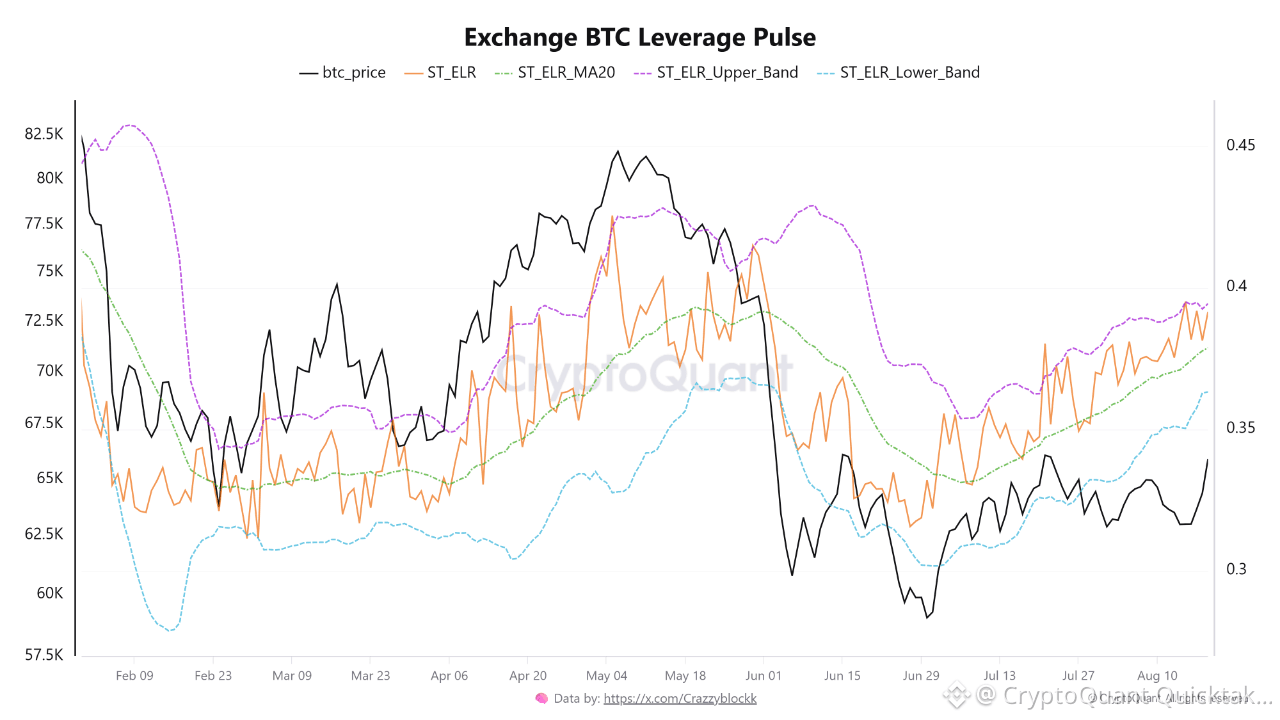
BTC leverage is approaching the upper boundary of its recent range, but the model has not yet entered a high-risk regime.
The Exchange Leverage Pulse measures BTC Open Interest on exchanges relative to exchange stablecoin reserves. This matters because OI represents the amount of derivative positioning being carried, while stablecoin reserves provide a proxy for the liquid capital available around exchanges. When positioning grows faster than this reserve base, the market becomes more dependent on leverage and liquidity to maintain its structure.
The latest ST_ELR is 0.3915, compared with a 20-day mean of 0.3788. Its Z-score is 1.63, placing it only about 0.7% below the current upper band at 0.3944.
The underlying change is more important than the absolute number. Over the last 30 days, BTC exchange OI increased 8.8%, while stablecoin reserves declined 3.5%. This pushed ST_ELR 12.7% higher.
The model has already briefly entered its high-risk regime twice recently, on July 21 and August 15, when ST_ELR moved above its +2σ upper boundary. It subsequently cooled, but the metric has continued to operate at elevated levels.
This is not a standalone bearish signal. A high leverage environment can persist while BTC continues higher. The signal is about the amount of leverage being carried relative to the available exchange reserve base.
The key now is whether ST_ELR breaks and sustains above the upper band. If it does while BTC continues higher, leverage expansion is becoming increasingly stretched. If BTC weakens while ST_ELR remains elevated, the same positioning can become a source of forced deleveraging.
The market isn't necessarily overleveraged yet. It's getting closer to the point where leverage starts to matter a lot more.
Written by Crazzyblockk