#dusk $DUSK @Dusk
Wow $RICE and $BTW is flying in the sky, just missed the chance, feeling sad ☹️ but now back to work
While most discussions around Dusk focus on privacy, I think the more interesting question is governance.
Selective disclosure sounds simple in theory: reveal information only to authorized parties while keeping everything else confidential.
But as institutional adoption grows, the challenge shifts.
The question is no longer whether cryptography can protect data.
It's who decides what should be disclosed, to whom, and under which conditions.
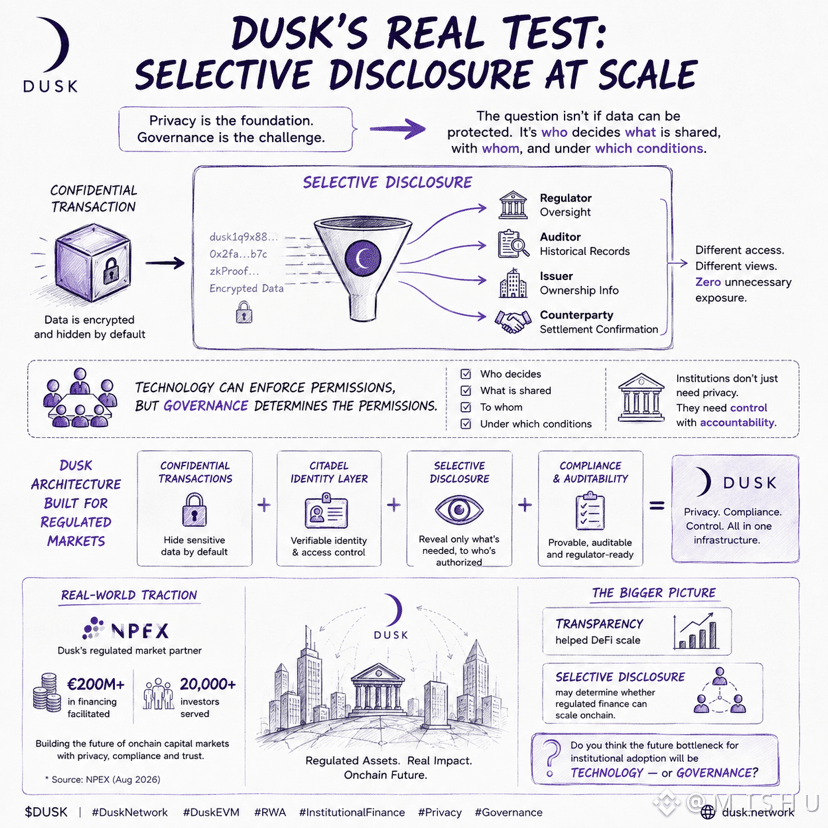
A regulator may require oversight. An auditor may need historical records. An issuer may need ownership information. A counterparty may need settlement confirmation. Each participant has different requirements, yet none should receive unrestricted access.
This is what makes Dusk's approach so interesting.
Its architecture combines confidential transactions, identity infrastructure through Citadel, and selective disclosure mechanisms designed for regulated markets. The technology can enforce permissions, but governance determines the permissions themselves.
That's why I believe Dusk's real test isn't privacy at scale.
It's selective disclosure at scale.
NPEX, Dusk's regulated market partner, has already facilitated more than €200M in financing and serves 20,000+ investors. As regulated assets move onchain, balancing privacy, compliance, and disclosure may become one of the defining challenges of institutional blockchain adoption.
Transparency helped DeFi scale.
Selective disclosure may determine whether regulated finance can scale onchain.
Let me have dinner today , but you guyz think ..😀
Do you think the future bottleneck for institutional blockchain adoption will be technology or governance?
Wow $RICE and $BTW is flying in the sky, just missed the chance, feeling sad ☹️ but now back to work
While most discussions around Dusk focus on privacy, I think the more interesting question is governance.
Selective disclosure sounds simple in theory: reveal information only to authorized parties while keeping everything else confidential.
But as institutional adoption grows, the challenge shifts.
The question is no longer whether cryptography can protect data.
It's who decides what should be disclosed, to whom, and under which conditions.
A regulator may require oversight. An auditor may need historical records. An issuer may need ownership information. A counterparty may need settlement confirmation. Each participant has different requirements, yet none should receive unrestricted access.
This is what makes Dusk's approach so interesting.
Its architecture combines confidential transactions, identity infrastructure through Citadel, and selective disclosure mechanisms designed for regulated markets. The technology can enforce permissions, but governance determines the permissions themselves.
That's why I believe Dusk's real test isn't privacy at scale.
It's selective disclosure at scale.
NPEX, Dusk's regulated market partner, has already facilitated more than €200M in financing and serves 20,000+ investors. As regulated assets move onchain, balancing privacy, compliance, and disclosure may become one of the defining challenges of institutional blockchain adoption.
Transparency helped DeFi scale.
Selective disclosure may determine whether regulated finance can scale onchain.
Let me have dinner today , but you guyz think ..😀
Do you think the future bottleneck for institutional blockchain adoption will be technology or governance?