
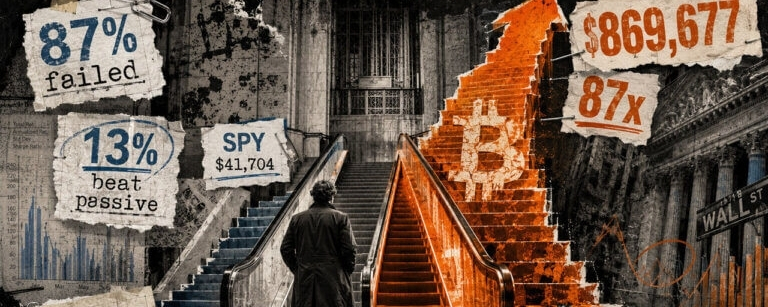
Bitcoin compounded at 56.3% annually from 2016 to 2026, leaving the same starting investment in SPY with roughly $828,000 less wealth.
Bitcoin returned 87 times over a decade, while only 13% of actively managed US large-cap equity funds beat comparable passive funds' benchmarks through June 30, according to Morningstar data reported by The Wall Street Journal.
That rate rose to 27% over the latest 12 months, and Wall Street has argued that AI-driven dispersion and higher interest rates should give stock pickers more room to outperform.
Bitcoin closed at $673.34 on June 30, 2016, and closed at $58,558.86 on June 30, 2026. This means a $10,000 position in the top crypto will grow to about $869,677.
Investors spent years deciding whether professional stock selection could earn enough excess return to justify its fees. A separate allocation to Bitcoin generated a far larger dollar outcome for holders who endured its volatility.
Bitcoin adds an asset-allocation dimension to that debate, with the decade’s largest difference in this comparison coming from exposure to another asset class. Manager selection inside US equities operated within a much narrower range of outcomes.
The bear case keeps benchmark concentration near current extremes. Passive funds would continue increasing their exposure to winners as market values climb. Active managers with tighter diversification limits could keep falling behind whenever a few mega-cap names account for an outsized share of index returns.
Another deep drawdown for Bitcoin could erase years of gains for buyers who enter near a cycle peak. The 2017 and 2021 collapses show how much endurance the historical return required.
Investors who held Bitcoin through two drawdowns near 80% finished the decade with roughly $828,000 more than the equivalent SPY position. That outcome puts the scale of portfolio allocation beside the narrower fight over who can pick stocks well enough to beat an index.