Most chains chasing RWAs are solving the wrong bottleneck.
They optimize throughput, fees, finality. Meanwhile the actual gate is a filing cabinet in Amsterdam.
To move a real security onchain in the EU, someone in the chain has to hold the right licences. Not "be compliant" in a vague sense hold specific authorizations from a named regulator. Look at what that means in practice.
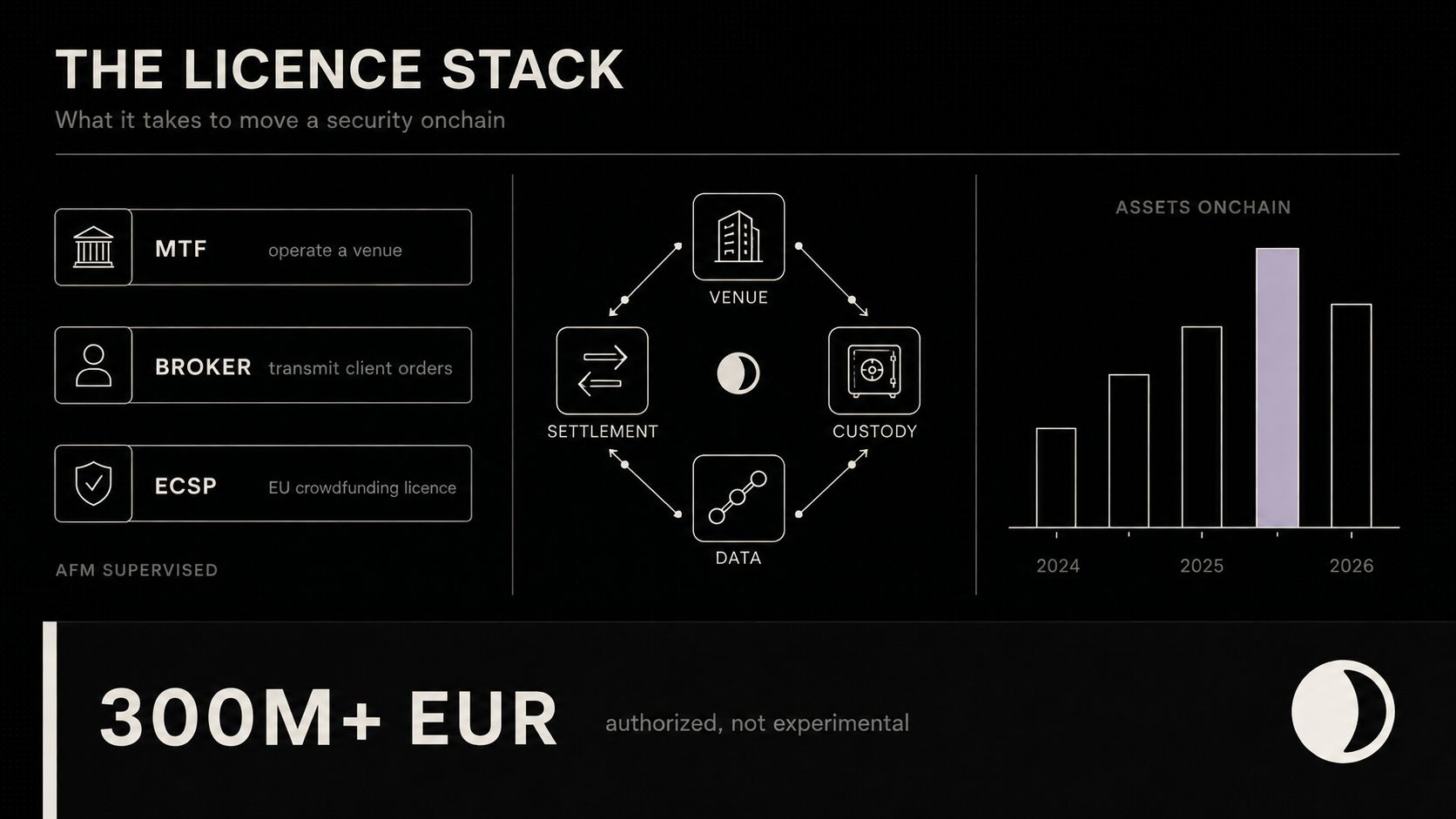
NPEX holds three:
· MTF - permission to operate a multilateral trading facility, a venue where third parties trade securities
· Broker - permission to receive and transmit client orders
· ECSP - the EU crowdfunding services licence under Regulation 2020/1503
All three under AFM supervision, the Dutch financial markets authority. That's the stack that lets 300M+ EUR of assets move onchain via @Dusk - not a testnet, an authorized venue.
Now layer the rest:
· Chainlink - oracle infrastructure, so onchain contracts read prices and data from outside sources without a trusted middleman
· EURQ - a euro-denominated settlement asset, because a securities trade settled in a volatile token isn't a settled trade
· Cordial Systems - institutional custody, the piece auditors ask about first
· 21X - an EU-regulated venue under the DLT Pilot Regime
Notice the shape. Each partner fills a slot a regulator will ask about: who runs the venue, who holds the asset, what settles the leg, where the data comes from.
This is the part crypto Twitter finds boring and institutions find decisive. A chain can have perfect tech and still be unusable, because no licensed entity can legally touch it.
Dusk's bet is that compliance belongs in the protocol layer - programmable privacy, selective disclosure, deterministic settlement so licensed venues plug in rather than build workarounds.
My question for the room: do you think the winning RWA chain will be the fastest one, or the one with the deepest bench of licensed partners? I lean hard toward the second. Convince me otherwise
$DUSK #dusk
They optimize throughput, fees, finality. Meanwhile the actual gate is a filing cabinet in Amsterdam.
To move a real security onchain in the EU, someone in the chain has to hold the right licences. Not "be compliant" in a vague sense hold specific authorizations from a named regulator. Look at what that means in practice.
NPEX holds three:
· MTF - permission to operate a multilateral trading facility, a venue where third parties trade securities
· Broker - permission to receive and transmit client orders
· ECSP - the EU crowdfunding services licence under Regulation 2020/1503
All three under AFM supervision, the Dutch financial markets authority. That's the stack that lets 300M+ EUR of assets move onchain via @Dusk - not a testnet, an authorized venue.
Now layer the rest:
· Chainlink - oracle infrastructure, so onchain contracts read prices and data from outside sources without a trusted middleman
· EURQ - a euro-denominated settlement asset, because a securities trade settled in a volatile token isn't a settled trade
· Cordial Systems - institutional custody, the piece auditors ask about first
· 21X - an EU-regulated venue under the DLT Pilot Regime
Notice the shape. Each partner fills a slot a regulator will ask about: who runs the venue, who holds the asset, what settles the leg, where the data comes from.
This is the part crypto Twitter finds boring and institutions find decisive. A chain can have perfect tech and still be unusable, because no licensed entity can legally touch it.
Dusk's bet is that compliance belongs in the protocol layer - programmable privacy, selective disclosure, deterministic settlement so licensed venues plug in rather than build workarounds.
My question for the room: do you think the winning RWA chain will be the fastest one, or the one with the deepest bench of licensed partners? I lean hard toward the second. Convince me otherwise
$DUSK #dusk