

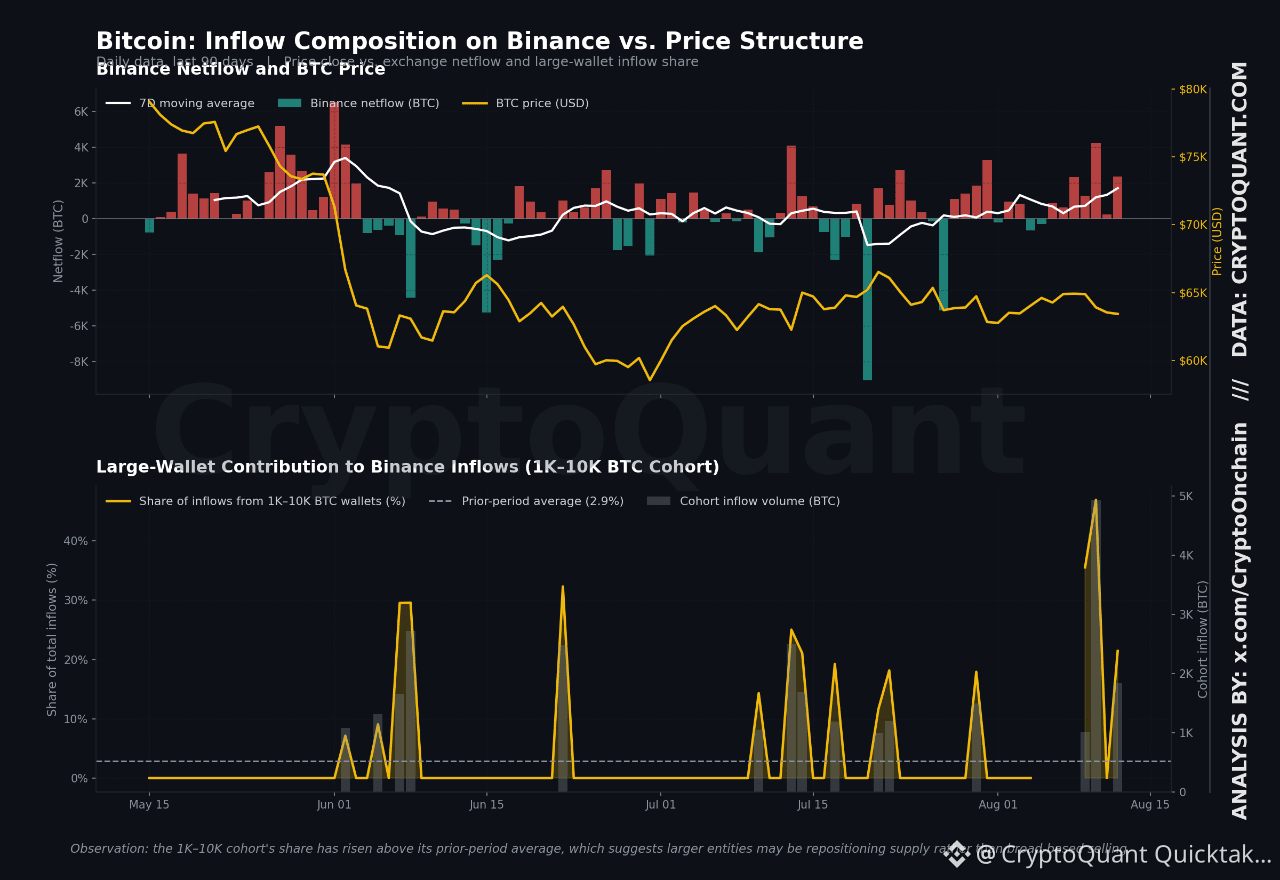
Bitcoin closed at $63,422 on August 12, drifting toward the lower half of its range after failing to hold near $64,900. Price is unremarkable, but the composition and destination of exchange inflows have shifted.
The clearest change is wallet-size attribution. Binance inflows from entities holding 1,000–10,000 BTC averaged 1,946 BTC daily last week, up roughly 793% versus the 90-day baseline. More importantly, this cohort now represents nearly 26% of total Binance inflows, versus a low single-digit share through most of the quarter. Coins aged 1–3 months have also reappeared after being largely absent, suggesting recently accumulated supply is being repositioned.
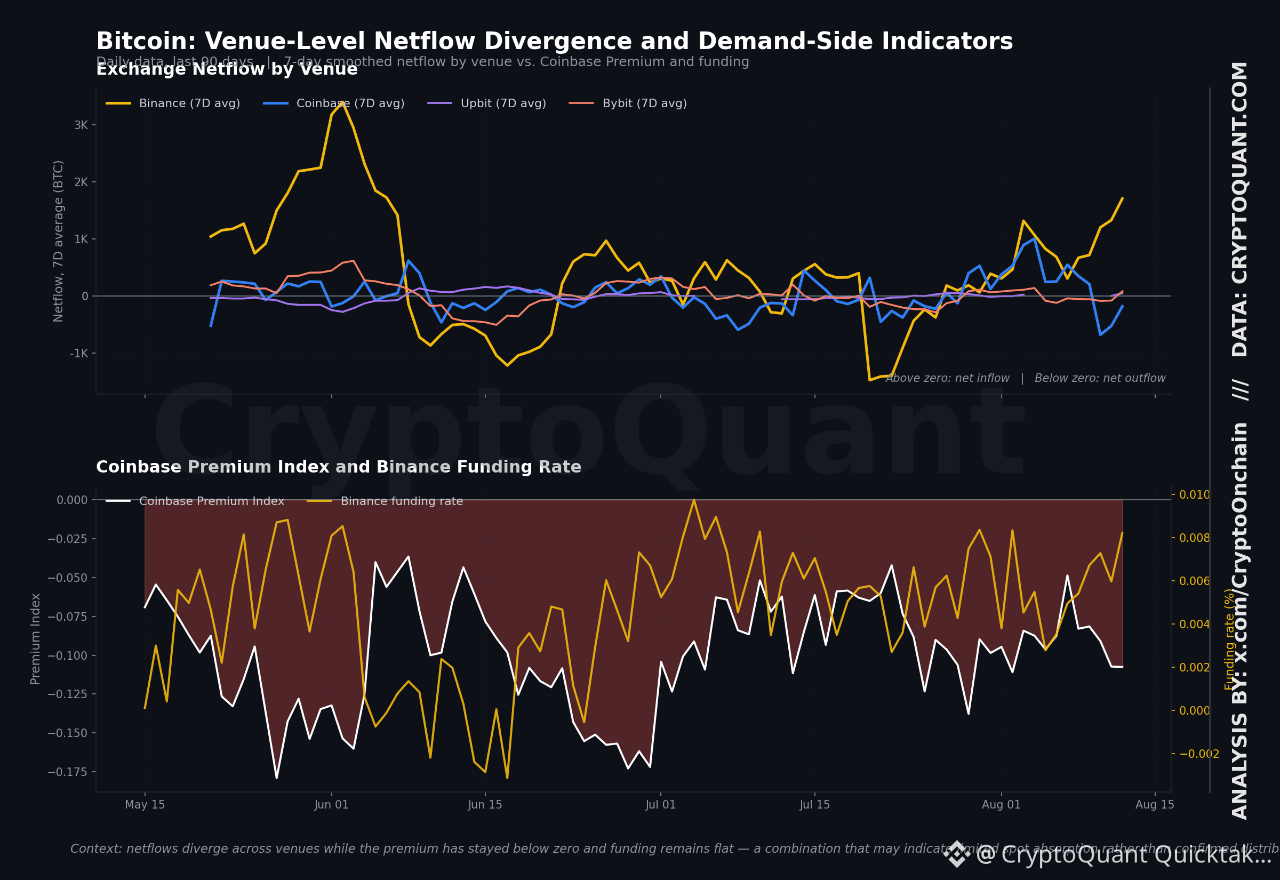
Venue behavior diverges. Binance netflow averaged +1,706 BTC daily (+107% WoW, +294% versus the quarterly baseline), with five consecutive inflow days. Coinbase moved the opposite way at -181 BTC, negative against both monthly and quarterly baselines. Upbit and Bybit rose 612% and 156% versus their 90-day averages, pushing aggregate netflow up 241%.
Two supporting signals: the miner shutdown indicator is flagged and miner-to-Binance transfers are up around 211% versus baseline, consistent with margin pressure. Spending from 18-month-to-2-year holders remains elevated (+149%, roughly $136M) despite cooling 46% this week.
Demand indicators stay weak. The Coinbase Premium held negative across all fourteen sessions, near its weakest at -0.11, while Binance funding remains flat at 0.00–0.01.
Taken together, large-wallet and recently acquired supply is concentrating offshore while Coinbase inventory is withdrawn rather than replenished, with neither premiums nor leverage showing an absorbing bid. Historically this configuration has aligned with distribution into a passive market and extended ranging rather than immediate directional resolution. Whether the 1k–10k inflow share normalizes or the premium turns positive may offer the clearest confirmation.
Written by CryptoOnchain