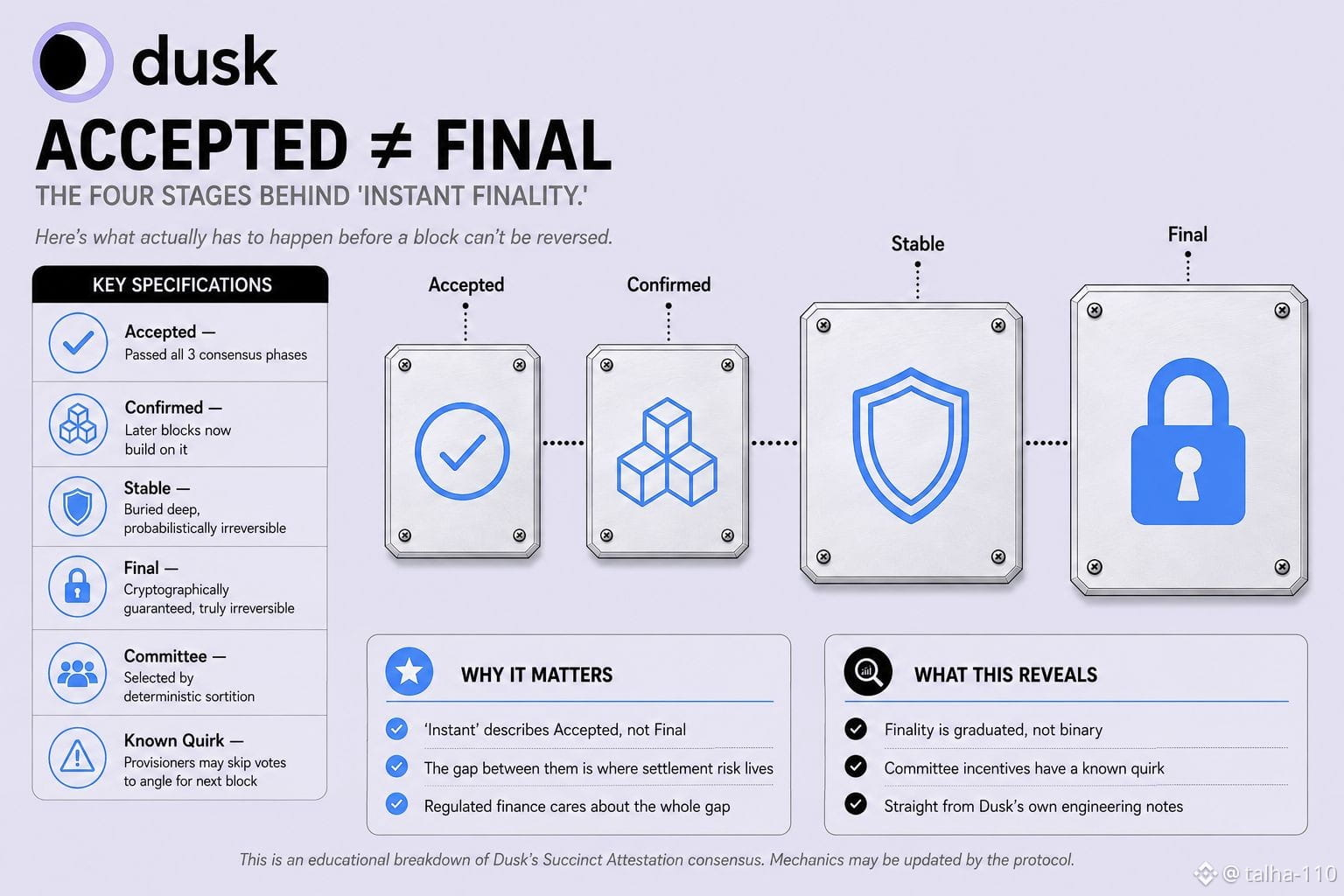
At first I assumed Dusk's "deterministic finality" pitch meant a block is simply final or not, binary, the moment it's produced. Reading the network's own finality states, that framing oversimplifies what's actually happening. A block on Dusk passes through four distinct stages before it's truly locked in, Accepted once it clears the current round's three consensus phases, Confirmed once later blocks build on top of it, Stable once it's buried deep enough to be probabilistically irreversible, and only then Final, the point where reversal becomes cryptographically guaranteed impossible rather than just extremely unlikely. So "instant finality" is doing a lot of work in that phrase. The block is Accepted fast, genuinely fast, that part of the pitch holds. But Accepted and Final aren't the same guarantee, and the gap between them is exactly where a regulated financial settlement would care most. There's a second layer to this most people gloss over too. Consensus runs through committees selected by deterministic sortition, and if a provisioner ends up selected for a voting committee in one round while also being the block generator for the next one, they're incentivized to just skip their vote, hoping to get picked as proposer next instead. Dusk's own engineering writeup treats this as an expected behavior pattern, not a hypothetical, and the fix is exclusion from that committee if it happens. So the settlement layer that's marketed as deterministic and instant is actually a graduated process with a known incentive quirk baked into its committee selection, both true, both quietly more complicated than the one-line pitch.
$DUSK #dusk @Dusk
$DUSK #dusk @Dusk