

Most blockchains look fine on paper. They talk about speed, throughput, and decentralization. But payments don’t happen on paper. They happen when someone is in a hurry, confused, or just trying to move money without thinking too much. That’s where many systems quietly fail.
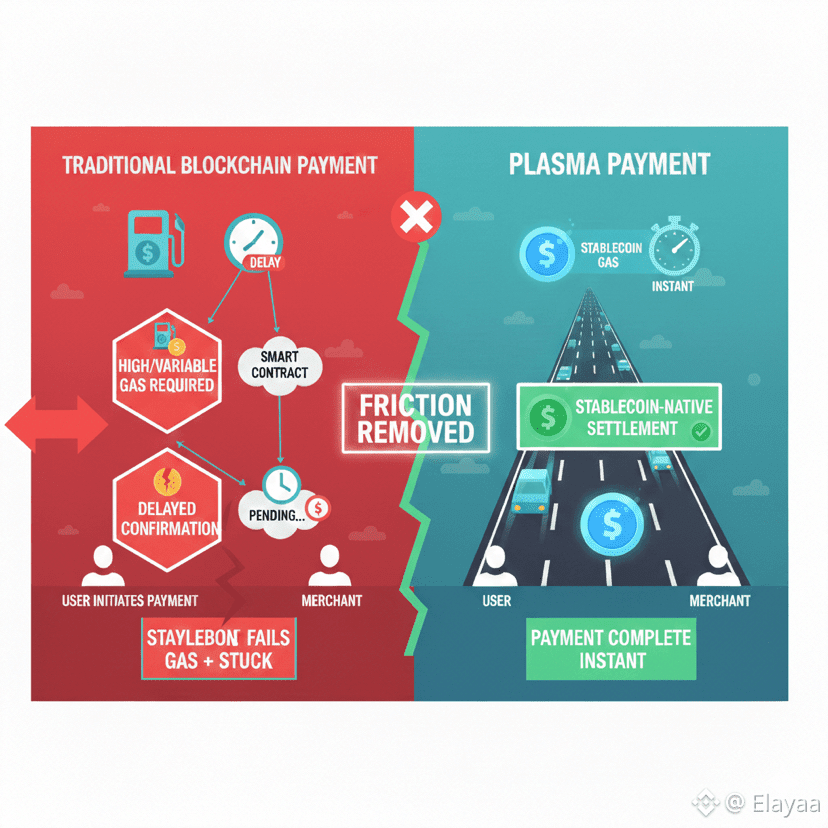
The real problem with payments isn’t speed alone. It’s friction. Small things that seem minor to builders become breaking points for users. Needing the right gas token. Waiting for confirmation. Wondering if the transaction actually went through. These moments create doubt, and doubt is the enemy of payments.
Plasma starts from a different place. It’s a Layer 1 blockchain built specifically for stablecoin settlement. That focus matters because stablecoins are already being used like money. They aren’t experiments anymore. People use them to pay, to move value across borders, and to settle real obligations. Plasma treats this reality seriously.
One of the biggest pressure points in stablecoin payments is gas. On many networks, even if you hold the stablecoin, you still can’t send it unless you also hold the native token. That sounds small until it breaks a payment. Someone has value, but can’t move it. Plasma removes that problem with gasless USDT transfers and stablecoin-first gas. You don’t manage balances just to send money. You send the money.
This design choice changes the feeling of using the network. Payments stop feeling like a technical process and start feeling like what they are supposed to be: simple value transfer. That’s not about convenience alone. It’s about reliability under real conditions.
Speed plays a role here too, but not in the usual marketing way. Plasma uses PlasmaBFT to reach sub-second finality. The important part isn’t the number. It’s the experience. When a payment settles immediately, the user doesn’t wonder if it worked. There’s no waiting, no refreshing, no mental overhead. The transaction is done when the user expects it to be done.
Another quiet problem in payment networks is trust. Not trust in branding, but trust in neutrality. If a payment system can be censored, delayed, or influenced, it stops being reliable money infrastructure. Plasma anchors its security to Bitcoin for this reason. Bitcoin’s role here isn’t about hype. It’s about long-term neutrality and resistance to interference. For payments, that foundation matters.
Plasma is fully compatible with Ethereum through Reth, but it doesn’t try to copy Ethereum’s identity. Compatibility is a tool, not the goal. It allows developers to build familiar applications while operating in an environment designed for stablecoin settlement. The underlying focus stays clear.
What’s interesting is who this design is for. Plasma isn’t choosing between retail users and institutions. It’s building for both by solving the same core problem. Retail users in high-adoption markets need payments that work every time. Institutions need settlement systems that are predictable and final. Both care about reliability more than novelty.
Many blockchains compete by adding features. Plasma competes by removing friction. It removes the steps where payments usually break. It removes the excuses users make when something doesn’t work. It removes the gap between holding value and being able to move it.
This makes Plasma feel less exciting in the short term and more useful in the long term. And that’s an important distinction. Real payment networks are boring by design. They work quietly. They don’t ask users to learn new behaviors. They disappear into the background.
Plasma’s design choices suggest a clear belief: stablecoin payments should work even when conditions aren’t perfect. Even when users are distracted. Even when they don’t want to think about gas, tokens, or confirmations. That belief shows up in every part of the system.
Instead of optimizing for narratives, Plasma optimizes for moments of stress. The moment when someone needs to send value quickly. The moment when a business needs settlement to be final. The moment when complexity usually causes failure.
That’s what makes Plasma worth paying attention to. Not because it claims to be faster or better in abstract terms, but because it is designed around how payments actually fail, and how to prevent that failure.
In a space full of blockchains trying to be everything, Plasma chooses to be specific. It chooses stablecoins. It chooses settlement. It chooses reliability over spectacle. And in payments, that choice matters more than anything else.


