
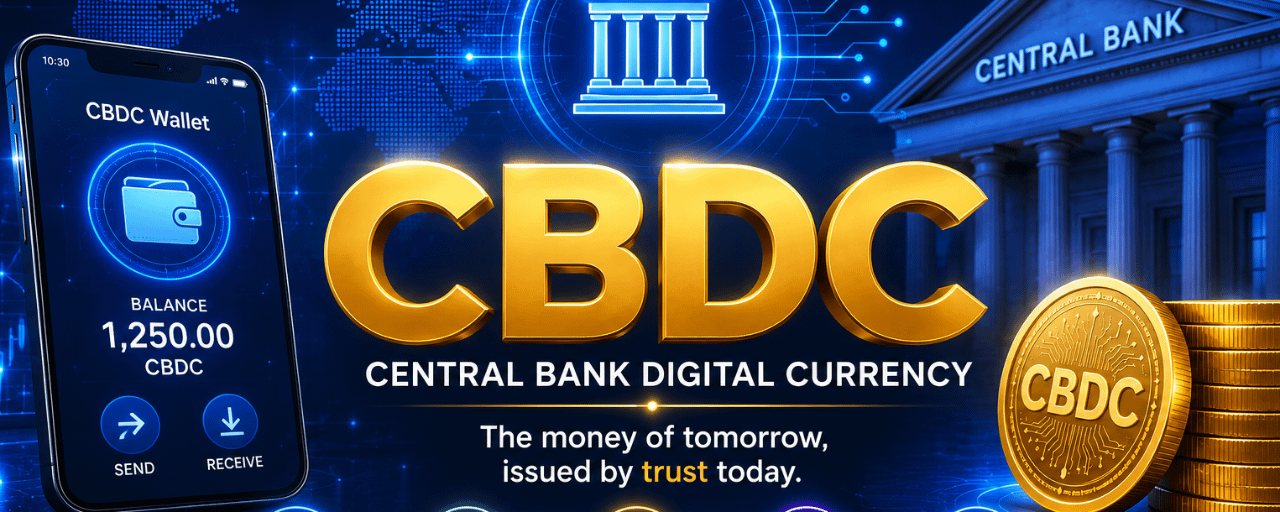
What Are Central Bank Digital Currencies (CBDCs)?
Imagine sending digital money as easily as sending a message—but instead of using Bitcoin or USDT, you're using a digital currency issued directly by your country's central bank.
This is the idea behind Central Bank Digital Currencies (CBDCs).
What exactly is a CBDC?
A CBDC is simply the digital version of a country's official currency.
Think of it as digital cash backed by the government, just like paper money, but existing only in electronic form.
Unlike cryptocurrencies such as Bitcoin or Ethereum, a CBDC is fully controlled and issued by a central bank.
CBDC vs Cryptocurrency
Although they are both digital, they are fundamentally different.
Decentralized
Limited supply
No central authority
Borderless
Resistant to censorship
CBDC
Issued by the central bank
Government controlled
Unlimited issuance according to monetary policy
Legal tender
Transactions may be monitored depending on national regulations
Why Are Governments Building CBDCs?
Several reasons explain this global trend:
✅ Modernize payment systems
✅ Reduce the cost of printing and handling physical cash
✅ Improve financial inclusion
✅ Make cross-border payments faster
✅ Compete with cryptocurrencies and stablecoins
✅ Strengthen monetary sovereignty
Which Countries Are Leading?
Many countries are actively developing CBDCs.
China has already tested its Digital Yuan (e-CNY) with millions of users.
The Bahamas launched the Sand Dollar, becoming one of the first countries to officially deploy a CBDC.
The European Union, Japan, South Korea, Ghana, Nigeria, and many others continue to develop their own projects.
Today, more than 100 countries are exploring CBDCs in one form or another.
Advantages
✔ Faster payments
✔ Lower transaction costs
✔ Better access to financial services
✔ Government-backed security
✔ Easier distribution of public aid during emergencies
Challenges
However, CBDCs also raise important questions.
Privacy advocates worry that governments could gain unprecedented visibility into citizens' financial activities.
Cybersecurity, digital infrastructure, and financial freedom are also major concerns that policymakers must address.
Final Thoughts
CBDCs are not designed to replace Bitcoin.
They represent a new evolution of traditional money, while Bitcoin represents an alternative monetary system built on decentralization.
Understanding both technologies is essential because they will likely coexist in tomorrow's financial ecosystem.
The future of money is becoming increasingly digital—and those who understand these changes today will be better prepared for tomorrow.
Education is your greatest investment.
— SIKANIBAIMA
#CBDC #Bitcoin #Blockchain #Crypto #Web3 #Finance #DigitalCurrency #BinanceSquare #Education