
The August 1 deadline is here.
President Donald Trump's Executive Order on AI gave U.S. federal agencies 60 days to build the framework that could reshape the future of artificial intelligence. Now the clock has run out.
This is no longer just about technology.
This is about power, control, national security, economic dominance, and who gets to write the rules for the intelligence that may eventually surpass humanity.
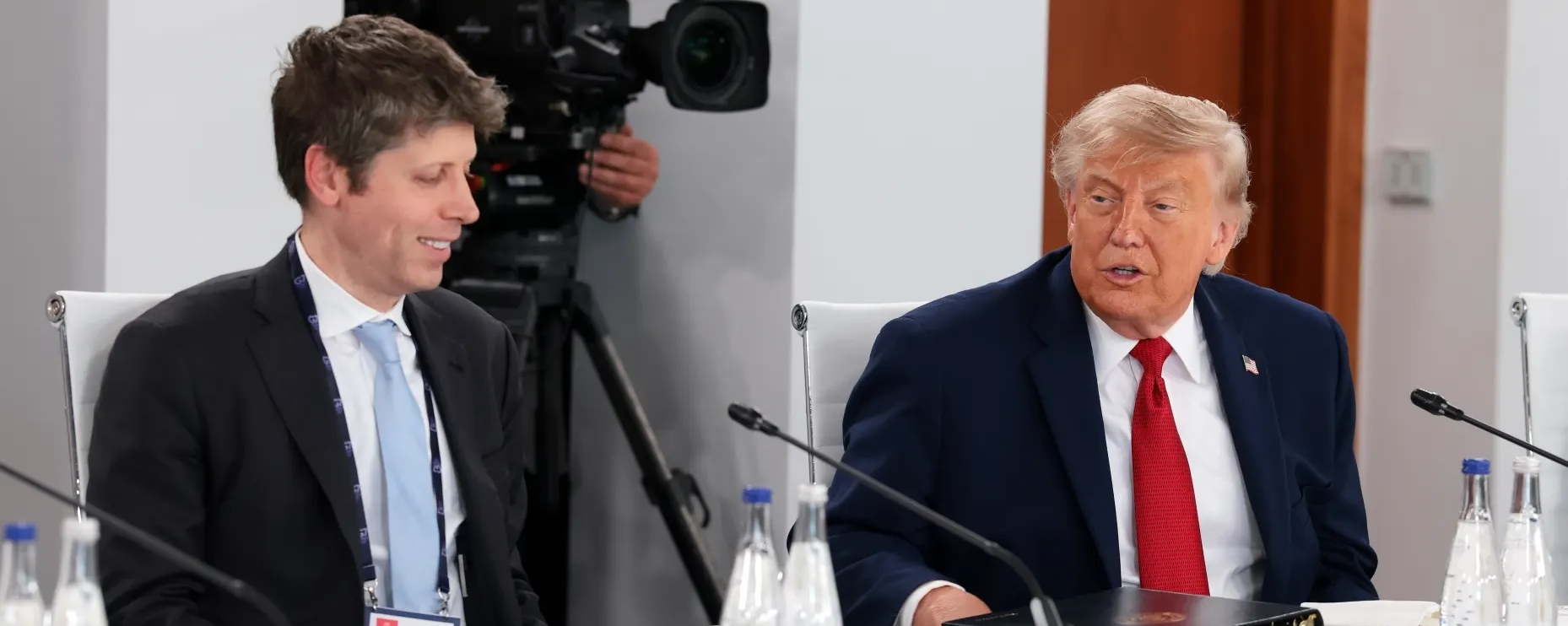
Behind closed doors, the biggest names in AI—including Sam Altman (OpenAI) and Jensen Huang (NVIDIA)—have been meeting with senior Trump administration officials in Washington. Treasury Secretary Scott Bessent, Commerce Secretary Howard Lutnick, Defense Secretary Pete Hegseth, White House Chief of Staff Susie Wiles, and others have been negotiating the final framework that could determine how America's most powerful AI models are developed and released.
The Executive Order proposes that AI developers voluntarily submit frontier models to the U.S. government for evaluation before public release.
That single idea could redefine the balance between innovation and government oversight.
Meanwhile, another battle is exploding inside the AI industry.
Chinese open-weight AI models are advancing at an astonishing pace. Unlike closed commercial systems, these models can be downloaded, modified, and deployed on virtually any infrastructure. They're cheaper, increasingly powerful, and spreading rapidly across the world.
Some policymakers want restrictions.
Others want outright bans.
But Silicon Valley is pushing back.
Jensen Huang publicly warned against "premature restrictions" on open-weight models.
Elon Musk responded with full support.
Microsoft.
Meta.
Palantir.
OpenAI.
Dozens of major technology companies lined up behind the same message:
Don't cripple open AI development before the race is decided.
Anthropic chose a different path, outlining its concerns separately instead of joining the coalition.
The Trump administration has not yet revealed its final position.
But the framework reportedly includes confidential benchmarking, cybersecurity testing, classification of protected frontier models, and the creation of trusted partners that would gain privileged access to the most advanced AI systems.
This is far more than another government policy.
This is the foundation of America's AI strategy for the next decade.
Who gets access?
Who gets restricted?
Who controls frontier intelligence?
Those answers could reshape global technology, military competition, semiconductor demand, cloud infrastructure, investment flows, and the future balance of power between the United States and China.
The AI race is no longer just about building smarter models.
It's about deciding who controls intelligence itself.