


1) Executive Summary
CoW Protocol $COW ist eine zustands-/intentsbasierte Handelsschicht, bei der Nutzer Orders signieren, die das gewünschte Ergebnis beschreiben, und professionelle Solver in Batch-Auktionen gegeneinander antreten, um die bestmögliche Ausführung zu liefern. Anstatt jeden Handel über einen festen Pfad zu routen, macht das Projekt aus jeder Order einen Wettbewerb über nahezu jede wichtige öffentliche und private Liquiditätsquelle – wobei MEV-Schutz direkt im Abwicklungsdesign integriert ist.
Das Problem, das es adressiert, ist strukturell: Onchain-Händler sind MEV-Extraktion ausgesetzt, die Liquidität ist über eine wachsende Zahl von Chains und Handelsplätzen fragmentiert, und die Ausführungskomplexität sollten normale Nutzer nicht selbst verwalten müssen. Wenn sich der Handel über mehr Netzwerke, Wallets und Anwendungen ausdehnt, wird die Lücke zwischen dem Preis, den ein Nutzer erwartet, und dem Preis, den er erhält, zu einer eigenen Produktoberfläche.
Die Antwort von CoW Protocol heißt delegierte Ausführung. Nutzer signieren Intents; Solver berechnen Gas, steuern das Preisrisiko und übermitteln Transaktionen in ihrem Namen – und tragen Ausführungsfehler. Das Geschäftsmodell folgt demselben Ablauf: Nutzer zahlen Gebühren, die aus Handelsüberschuss und Volumen stammen – über Integrationspartner sowie als Netzwerkgebühren, die Gas abdecken. Die CoW DAO behält einen Teil dieser Gebühren als Umsatz, und was nach Solver-Anreizen übrig bleibt, ist der Bruttogewinn.
Die Chance besteht darin, die Ausführungsebene hinter anderen Produkten zu sein – nicht nur ein einzelner Marktplatz. Und Q2 '26 hat diese Positionierung in zwei Richtungen erweitert. Atomic Bundles, im Mai gestartet, gaben jedem Projekt eine wiederverwendbare Vorlage, um Multi-Step, atomare DeFi-Workflows auf der Ausführungsebene von CoW Protocol aufzubauen – mit Euler als erster produktiver Implementierung für Aktionen wie Collateral Swaps und One-Click-Looping. Gleichzeitig wurde die Distribution eingebettet breiter: Lido Fast Swaps routete Staking-Exits über CoW Protocol, Summer.fi nutzte es für automatische Vault-Konvertierungen, CoW Protocol wurde als Execution Provider zu MetaMask Swaps hinzugefügt, auto.fun ergänzte geschützte Swaps, und tokenisierte Stocks und ETFs wurden über xStocks auf BNB Chain sowie cbMEGA auf Base handelbar. Das 2022 gegründete CoW DAO entwickelt das Projekt weiter – über Forschung, Smart-Contract-Engineering und Design.
Das Quartal verband eine marktweite Kontraktion im DEX-Handel mit einem auseinanderlaufenden Nutzungsbild: Finanzkennzahlen fielen zwar gegenüber Q1, blieben aber deutlich über dem Niveau vom Vorjahr, und Juni schloss das Quartal mit der stärksten monatlichen Aktivität – angeführt von Erstnutzern auf BNB Chain. April markierte fünf Jahre seit dem Launch von CoW Swap im Jahr 2021 und brachte außerdem das härteste Ereignis des Quartals: einen Social-Engineering-Angriff, der die Domain cow.fi kaperte. Das Team berichtet, dass die Protokollverträge nicht kompromittiert wurden; es habe die Domain wiederhergestellt, ein öffentliches Post-Mortem veröffentlicht und jede verifizierte Forderung vollständig im Rahmen von CIP-86 bezahlt. Die Governance blieb aktiv bei den Ökonomien: mit Vorschlägen zur Wertverteilung, entwickelt mit Aragon, Solver-Belohnungen, die unter das CIP-85-Framework wechselten, und einer fortgesetzten Reform des Solver-Markts.
🔑 Kernkennzahlen (Q2 2026)
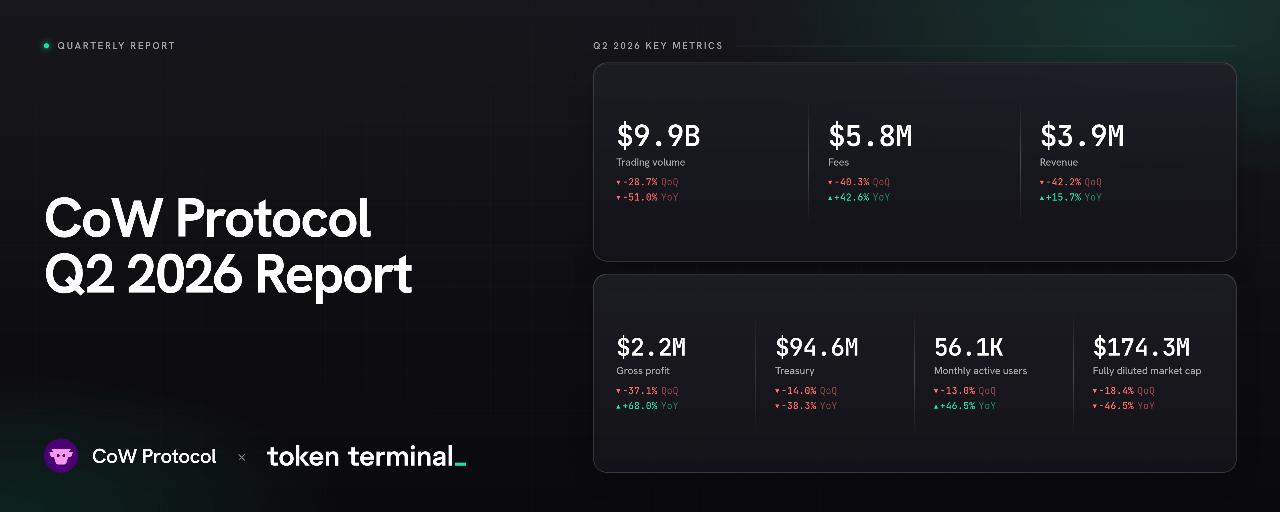
Handelsvolumen: 9,9 Mrd. USD (-28,7% ggü. Vj., -51,0% ggü. Vw.)
Gebühren: 5,8 Mio. USD (-40,3% ggü. Vj., +42,6% ggü. Vw.)
Umsatz: 3,9 Mio. USD (-42,2% ggü. Vj., +15,7% ggü. Vw.)
Bruttogewinn: 2,2 Mio. USD (-37,1% ggü. Vj., +68,0% ggü. Vw.)
Treasury: 94,6 Mio. USD (-14,0% ggü. Vj., -38,3% ggü. Vw.)
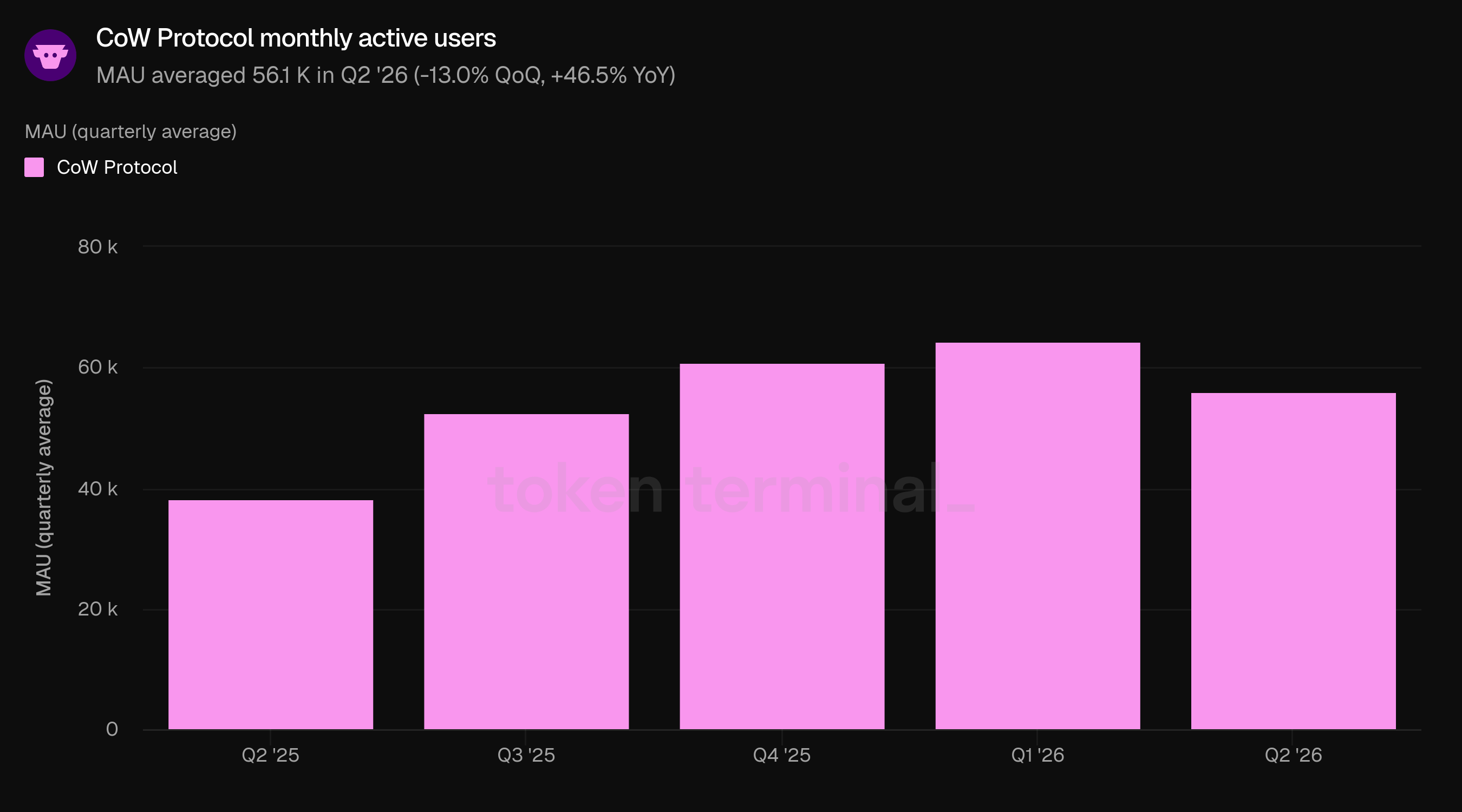
Monatlich aktive Nutzer: 56,1 Tsd. (-13,0% ggü. Vj., +46,5% ggü. Vw.)
Vollständig verwässertes Marktkapital (FDV): 174,3 Mio. USD (-18,4% ggü. Vj., -46,5% ggü. Vw.)
👥 CoW-DAO-Teamkommentar
"Q2 ist das sichtbare Ende eines gezielten Übergangs – kein schwaches Quartal. Volumen und Umsatz fielen erneut, aber diese Schlagzeilen hängen hinter der Entscheidung her, die sie verursacht hat: eine Entscheidung, die wir am Ende von 2025 getroffen haben, um nicht länger um Flow zu konkurrieren, der sich nicht selbst bezahlt. Den führenden Indikatoren kommt mehr Gewicht zu, und drei stachen besonders heraus:"
Der partnerzugeschriebene Umsatz hielt seinen Anteil am Gesamtbild durch den rückläufigen Markt hindurch. Das bedeutet: die Integrationsbasis ist resilient als Anteil am Ganzen, selbst wenn absolute Zahlen im Rhythmus des Zyklus schwanken.
Der interne Pfad des Quartals – ein Mai-Tief, gefolgt von einer starken Juni-Erholung, getrieben von neuen Nutzern – deutet darauf hin, dass die Kontraktion eher am Boden ankommt als sich weiter zu beschleunigen;
Die wichtigsten Arbeiten dieses Quartals liegen bewusst außerhalb der P&L dieses Quartals: in der Qualität des Solver-Wettbewerbs und darin, die Wertverteilung von Forschung zu einem konkreten, quantifizierten Mechanismus zu machen – beides darauf ausgelegt, sich über zukünftige Quartale hinweg zu verstärken, statt nur in diesem einen.
Auch die Strategie selbst entwickelte sich weiter. Q1 drehte sich darum, unrentables Volumen abzugeben; Q2 drehte sich darum, woher unser Flow kommt – hin zu wallet-integrierter Nachfrage, die sich mit gesünderen Margen monetarisieren lässt als price-sensitive Aggregator-Routing. Der Rückgang von Volumen und Umsatz ist der Preis für diesen Übergang, und die beabsichtigte Rückkehr zeigt sich in der Margenqualität, einer breiteren Nutzerbasis und den Token-Mechanismen, die nun in die Governance einfließen.
In Q3 wechseln wir in eine intensive R&D-Phase. Das Team priorisiert Verbesserungen der Plattform, die auf B2B-Wachstum abzielen – darunter schnellere Quotes und kürzere Auktionen – und setzt gleichzeitig die Expansion der CoW DAO nach Solana nachhaltig fort.
2) Handelsvolumen
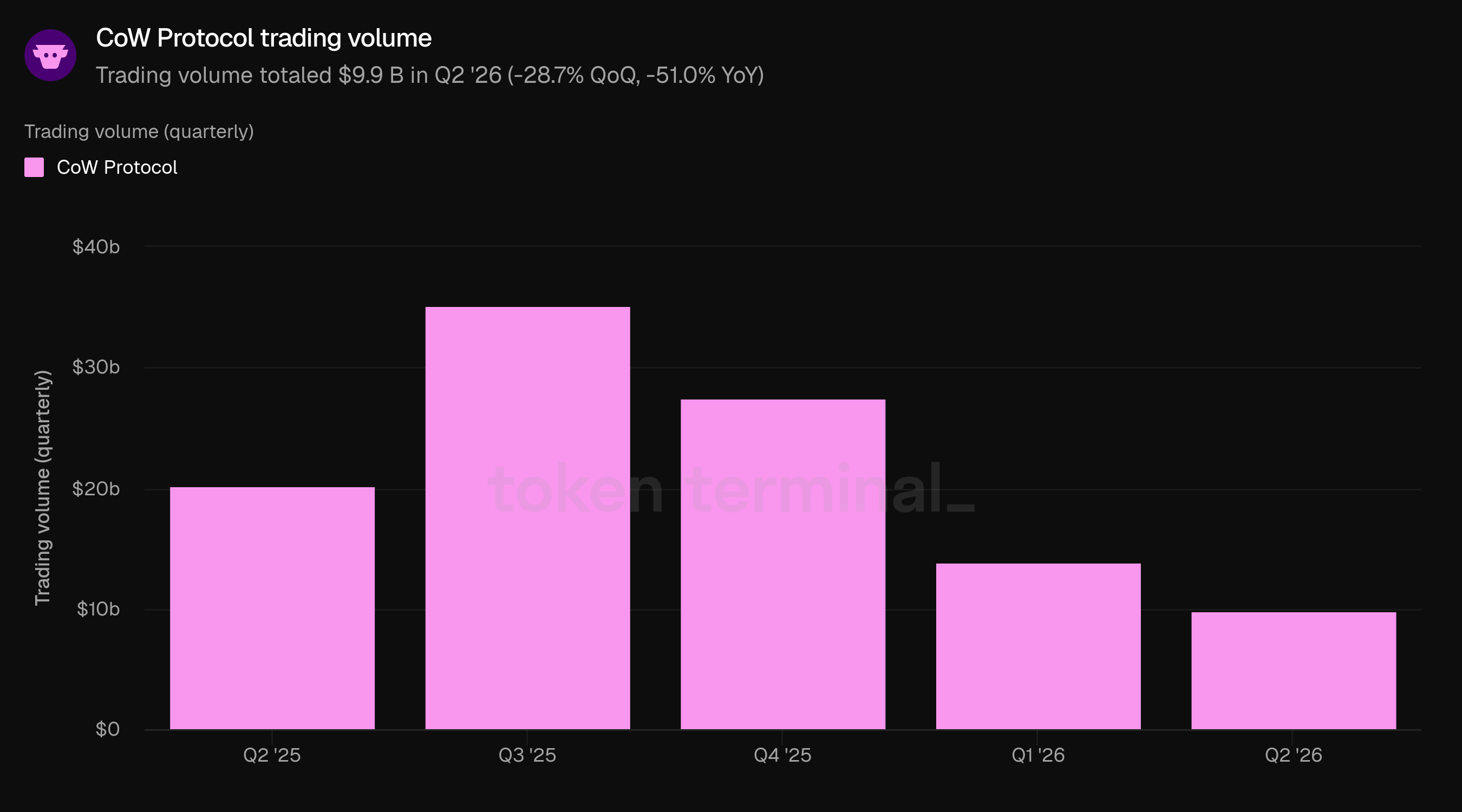
Das Handelsvolumen misst den gesamten Wert der über die Batch-Auktionen des CoW Protocol ausgeführten Trades, wobei signierte Orders von konkurrierenden Solvern abgerechnet werden. Das Volumen betrug im Q2 '26 9,9 Mrd. USD, was einem Rückgang von 28,7% ggü. Vj. und 51,0% ggü. Vw. entspricht; es war das niedrigste Quartal seit Q3 '24.
Der Rückgang war weitgehend eine branchenweite Gegebenheit: Das Volumen der DEX-Aggregatoren fiel sektorweit ungefähr um 18% ggü. Vj., und das gesamte Spot-DEX-Volumen sank im gleichen Zeitraum um ungefähr 35%. Damit ordnet sich die Bewegung des CoW Protocol zwischen den beiden ein. Innerhalb des Quartals belief sich das Volumen auf 4,0 Mrd. USD im April, 2,5 Mrd. USD im Mai und 3,4 Mrd. USD im Juni, sodass das Quartal mit einer Erholung von dem Tief im Mai endete.
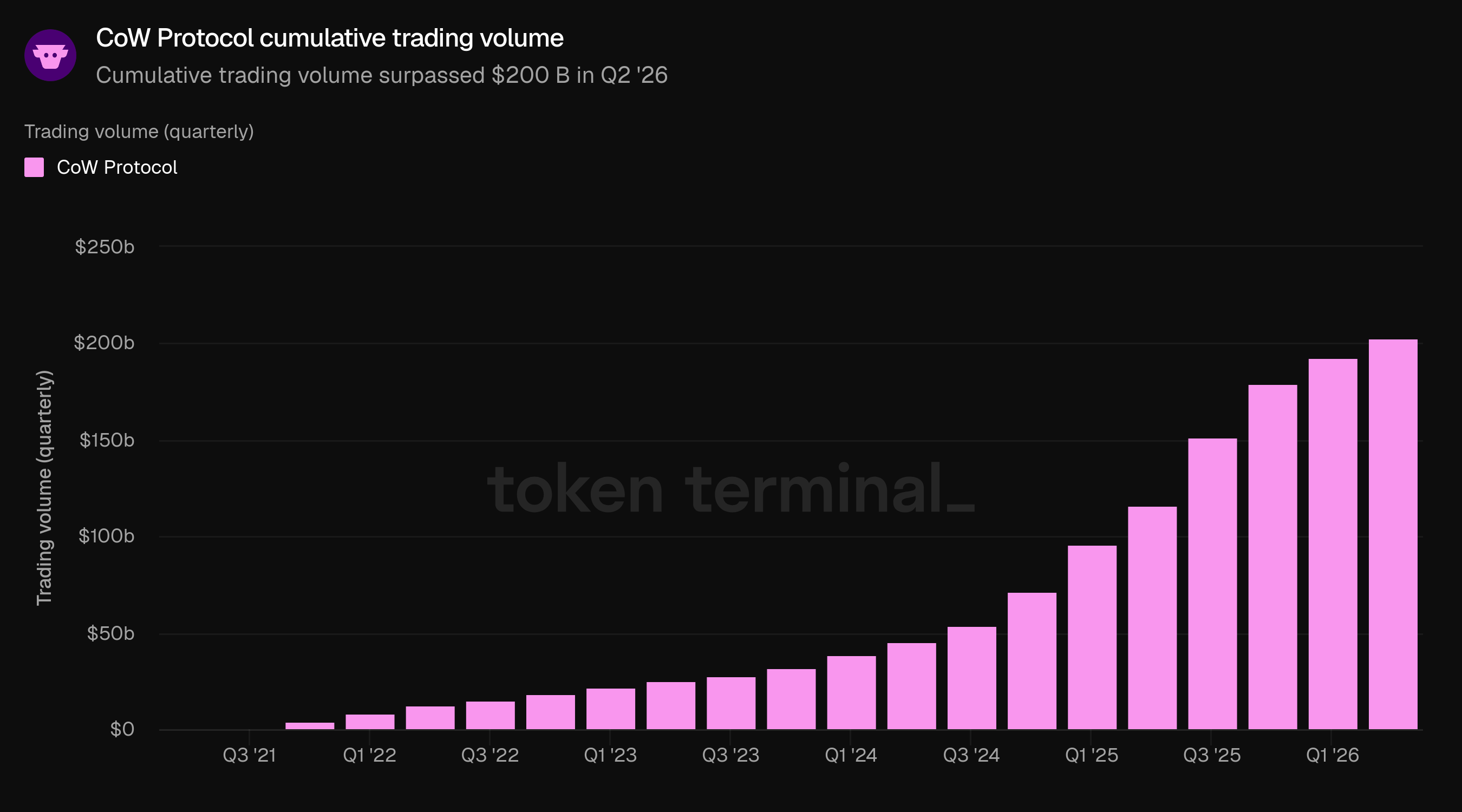
Kumuliertes Handelsvolumen – die laufende Summe des gesamten über das Projekt seit dem Launch abgerechneten Volumens – überschritt im Quartal 200 Mrd. USD und endete Q2 '26 bei 202,8 Mrd. USD. Das Meilenstein-Quartal fiel mit dem fünften Jahrestag von CoW Swap im April zusammen.
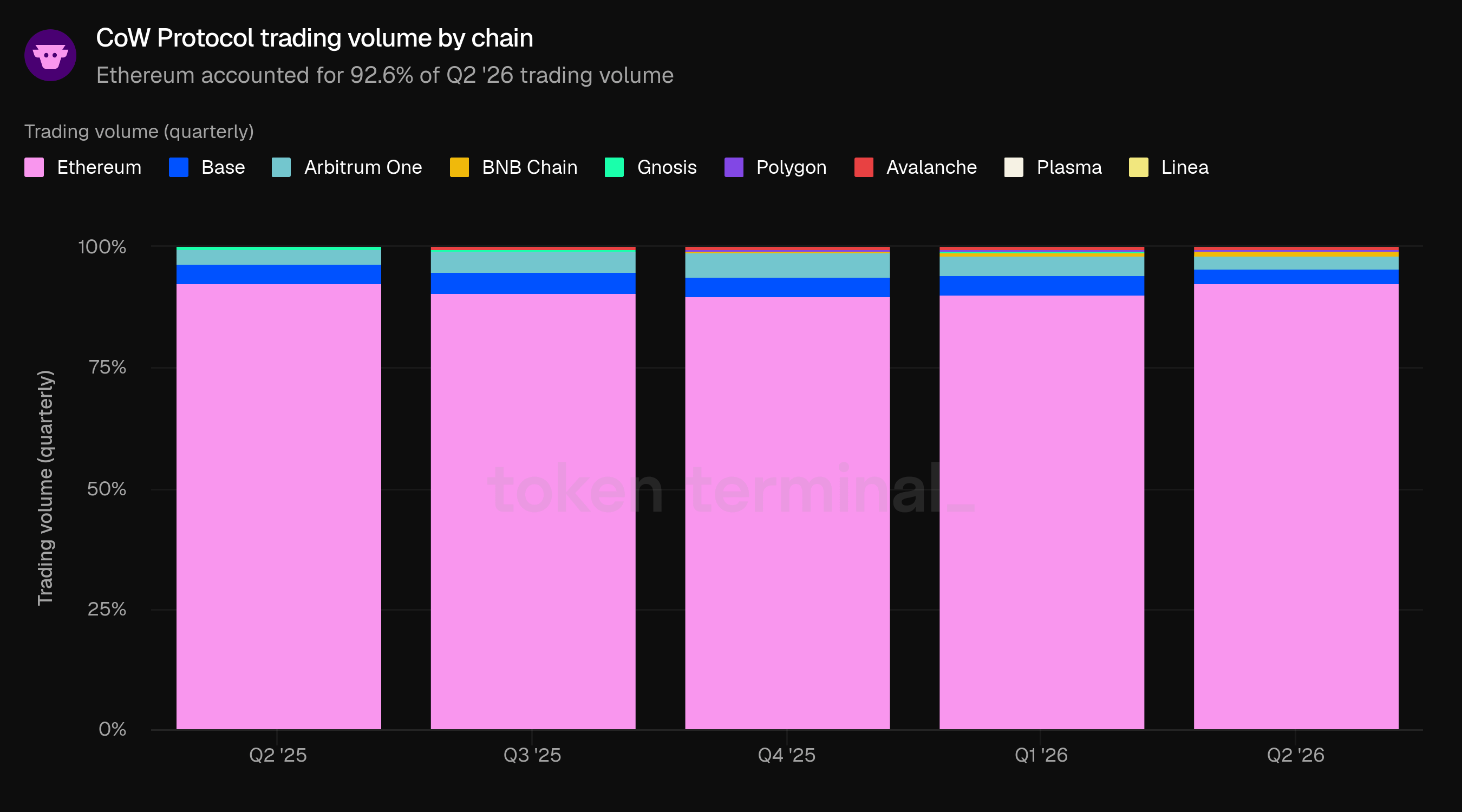
Der Chain-Mix verlagerte sich wieder stärker hin zu Ethereum, während sich der Nutzer-Mix verbreiterte. Ethereum machte 92,6% des Volumens im Q2 '26 aus (+2,4 pp ggü. Vj., +0,2 pp ggü. Vw.). Base lag bei 3,0% und Arbitrum One bei 2,6% – beide unter Q1. BNB Chain erreichte 1,0% des Volumens, von 0,7% steigend, während Polygon, Gnosis und Avalanche jeweils 0,4% oder weniger hielten. Große Trades konzentrieren sich weiterhin dort, wo die Liquidität am tiefsten ist.
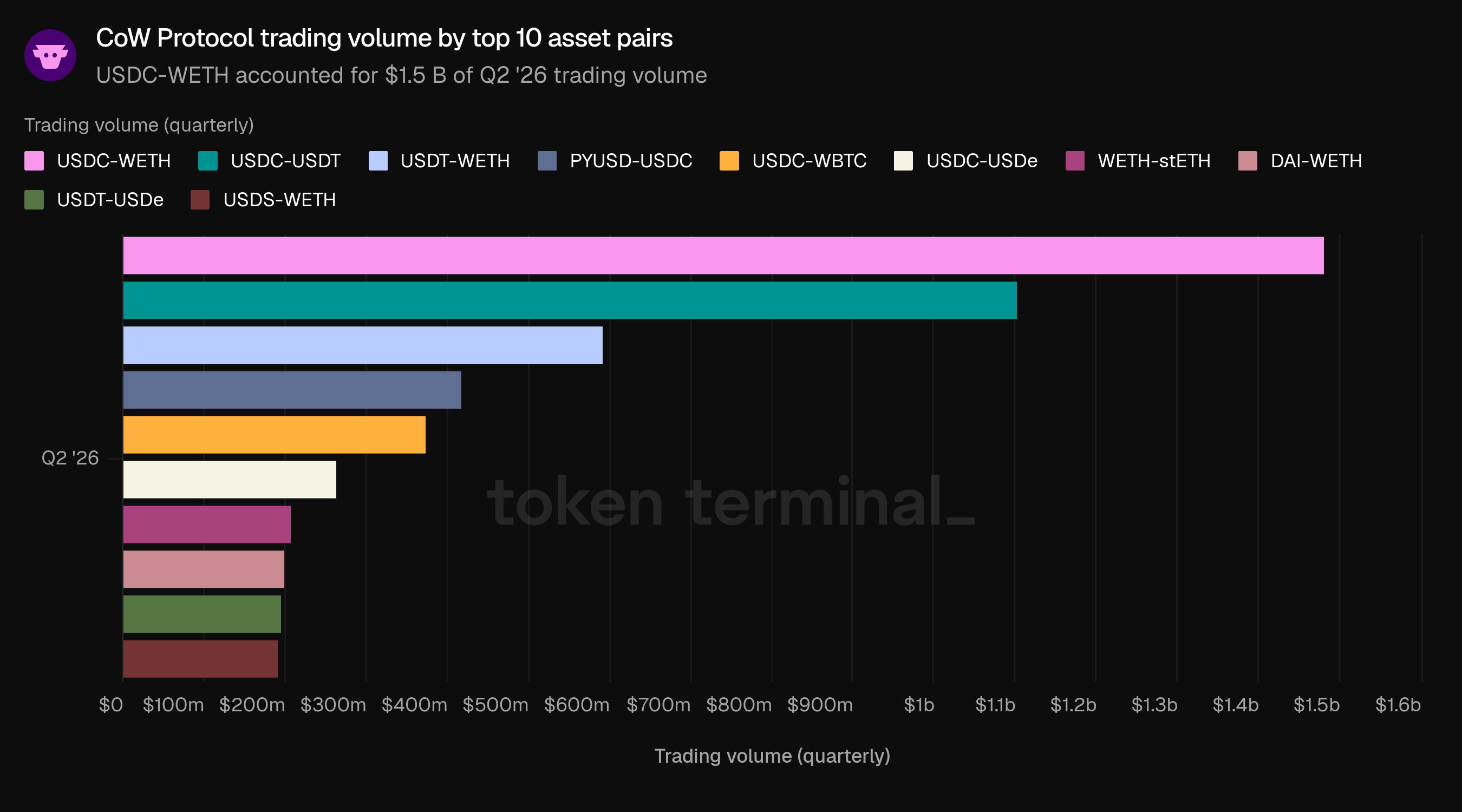
Die Top-10 Asset-Paare machten 5,0 Mrd. USD bzw. 50,9% des Volumens im Q2 '26 aus. USDC-WETH führte mit 1,5 Mrd. USD, gefolgt von USDC-USDT mit 1,1 Mrd. USD und USDT-WETH mit 591,9 Mio. USD. Stablecoin-zu-Stablecoin-Paare bleiben prominent: USDC-USDT, PYUSD-USDC, USDC-USDe und USDT-USDe zusammen beliefen sich auf rund 2,0 Mrd. USD – ein Gewicht, das konsistent ist mit den reduzierten Gebühren für korrelierte und stabile Paare, die im Februar eingeführt wurden. Der Rest der Liste wird von den großen Pairings dominiert, darunter USDC-WBTC mit 374,7 Mio. USD und das Liquid-Staking-Paar WETH-stETH mit 207,3 Mio. USD.
👥 CoW-DAO-Teamkommentar
"Das Muster sagt mehr als das Niveau. Der sequentielle Rückgang verlangsamte sich deutlich gegenüber dem vorherigen Quartal – das spricht für Stabilisierung statt für einen fortgesetzten Abwärtstrend. Der Aufschwung im Juni hatte zwei klar unterscheidbare Treiber: eine große Kohorte neuer, kleinerer Ticket-Nutzer und ein gebündelter Anstieg des Handels über das erste Juni-Wochenende, getrieben durch makroökonomische Bedingungen sowie durch die Preisbewegungen von ETH und BTC."
Diese beiden Treiber verdienen eine unterschiedliche Gewichtung. Die Kohorte der Neukunden ist das strukturelle Signal – sie zeigt, dass die Akquise-Maschine funktioniert und die Basis breiter wird – während die volumengetriebene Aktivität episodisch ist und wir nicht daraus extrapolieren würden. Keine der Aussagen schmeichelt der Optik: Eine breitere Basis kleinerer Trades drückt die durchschnittliche Tradegröße, selbst während sie das Franchise stärkt. Solange dieser Übergang läuft, wird das Volumen eine laute und unterbelichtete Lesart des Geschäfts bleiben."
3) Gebühren
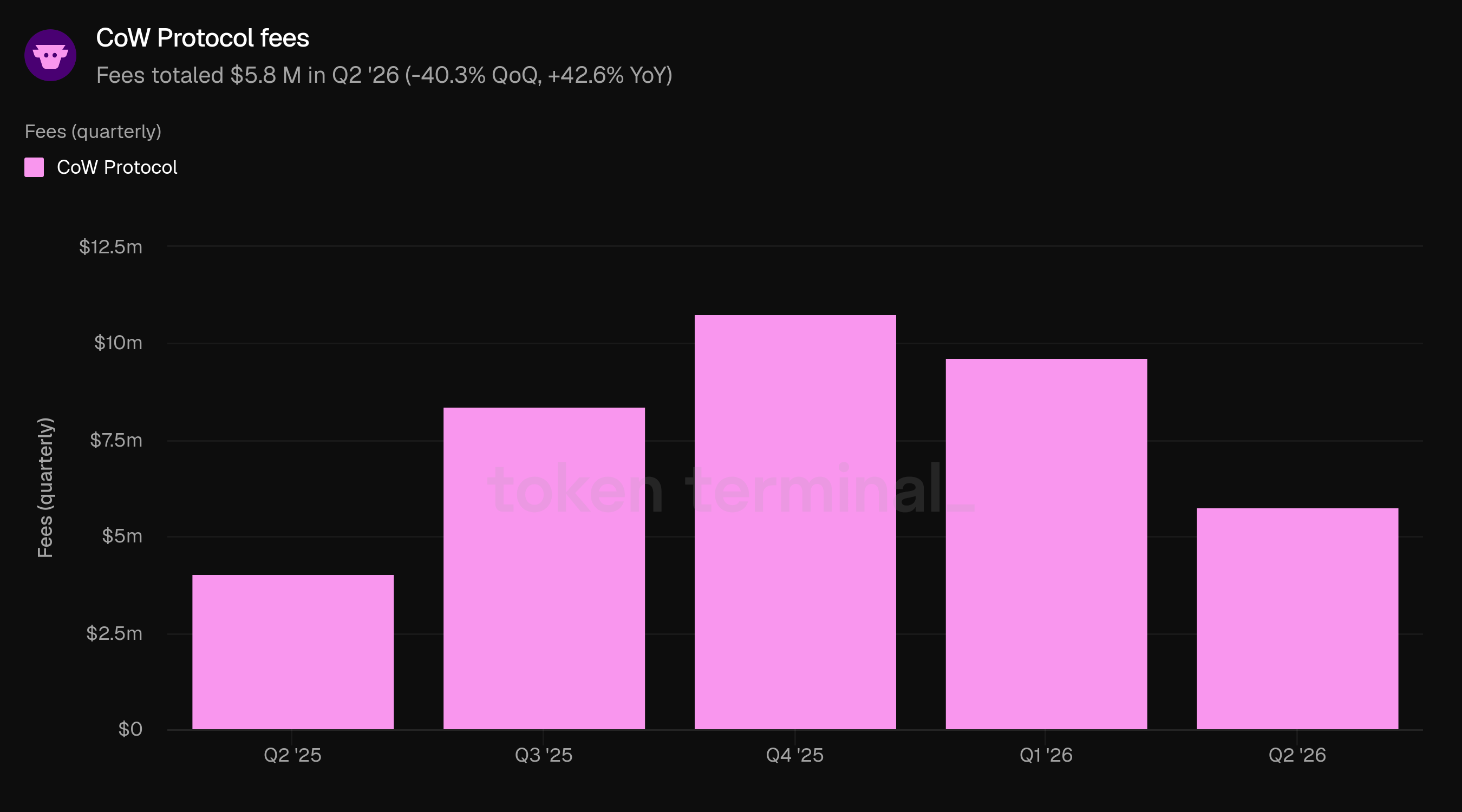
Gebühren messen den gesamten Wert, den Nutzer zahlen, um über das CoW Protocol zu handeln – einschließlich Gebühren auf Handelsüberschuss und Volumen, Gebühren für Integrationspartner, Netzwerkgebühren zur Abdeckung von Gas sowie Gebühren für MEV Blocker. Die Gebühren betrugen im Q2 '26 5,8 Mio. USD, 40,3% weniger ggü. Vj., aber 42,6% mehr ggü. Vw.
Die Gebühren von Q2 '26 entsprechen grob 5,8 bps des Handelsvolumens – runter von 7,0 bps in Q1 '26, aber deutlich über 2,0 bps in Q2 '25. Der YoY-Zuwachs spiegelt weiterhin die im vergangenen Jahr eingeführten Gebührenrichtlinien wider; sequentiell fielen die Gebühren schneller als das Volumen, da sich der Mix im Quartal verschob. Juni war das stärkste Gebührenmonat des Quartals mit 2,5 Mio. USD – zusammen mit dem späten Anstieg der Handelsaktivität zum Quartalsende.
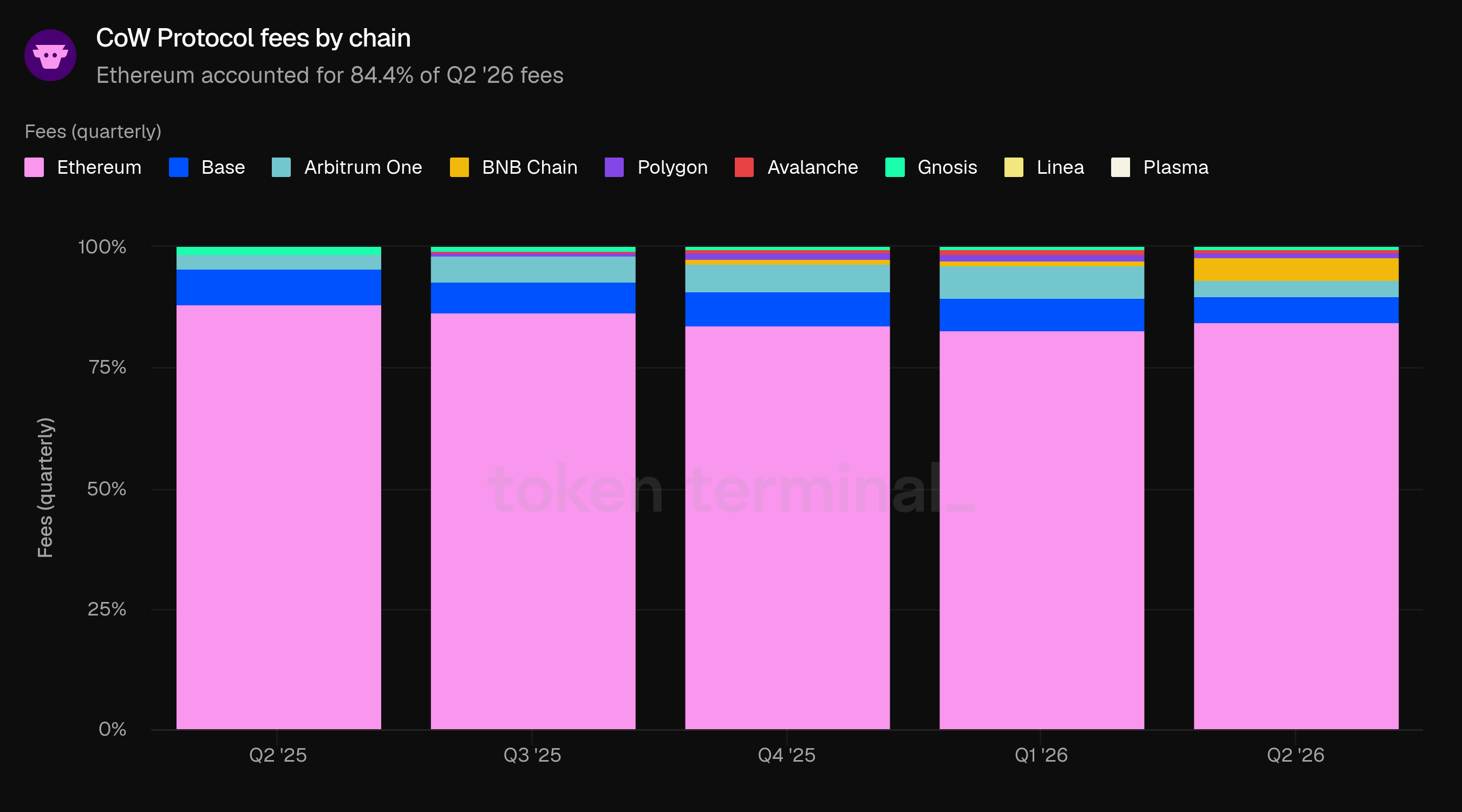
Ethereum stellte 84,4% der Q2-'26-Gebühren (+1,5 pp ggü. Vj., -3,8 pp ggü. Vw.) – der erste quartalsweise Anstieg innerhalb eines Jahres. Base steuerte 5,4% bei, BNB Chain 4,7% (+3,4 pp ggü. Vj.), Arbitrum One 3,4% und Polygon 1,3%. Die 4,7% Gebühren von BNB Chain bei 1,0% des Volumens sind konsistent mit kleineren, retail-lastigen Trades mit höherer Gebührenintensität.
👥 CoW-DAO-Teamkommentar
"Gebühren, nicht Volumen, sind diese Quartal die aussagekräftigere Kennzahl für das Geschäft. Wir haben die beiden bewusst entkoppelt und verdienen pro Einheit Flow, die wir bedienen, mehr."
Der Mix treibt das Ergebnis. Der Shift hin zu wallet-gestützter Nachfrage ist entscheidend, weil dieser Flow strukturell margenfördernder ist als über Aggregatoren geroutetes Volumen – daher monetarisiert er mit höherer und nachhaltigerer Intensität.
Wir erwarten, dass die Gebühren während des Übergangs besser stabil bleiben als das Volumen. Und wir würden jedes Quartal, in dem dieses Verhältnis erhalten bleibt, als Hinweis werten, dass die Strategie funktioniert – nicht als Anomalie. Die entscheidende Frage für die kommenden Zeiträume ist nicht das absolute Gebührenniveau, sondern ob die Gebührenintensität – Gebühren in bps – weiter steigt, während sich der Flow-Mix weiter in Richtung integrierte, von B2B getriebene Nachfrage verschiebt.
4) Umsatz
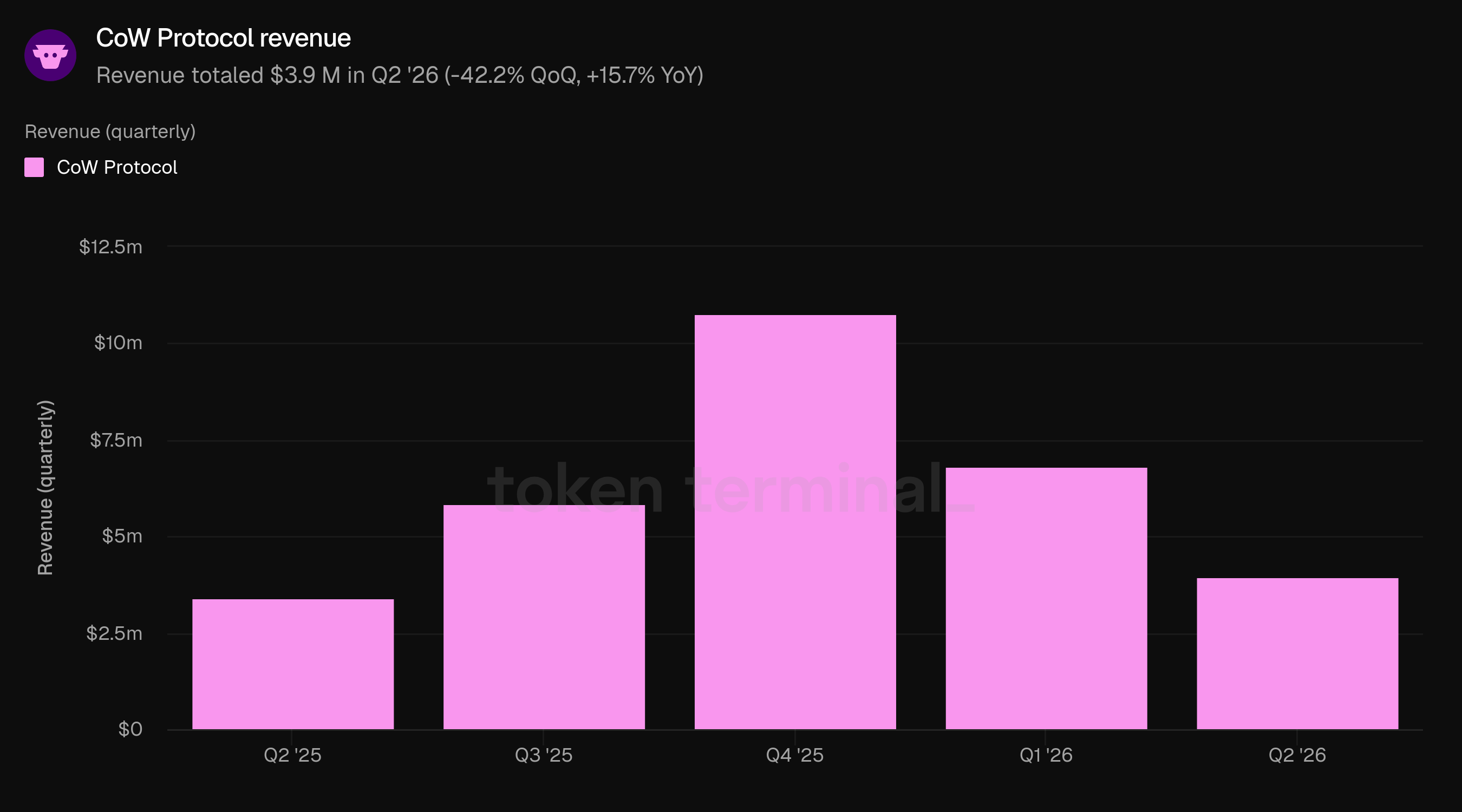
Der Umsatz misst den Anteil der Gebühren, die die CoW DAO behält – abgeleitet aus Handelsgebühren, Erlösbeteiligungen mit Partnern, RPC-Rückvergütungen sowie Aktivitäten im Zusammenhang mit MEV. Der Umsatz betrug im Q2 '26 3,9 Mio. USD, 42,2% weniger ggü. Vj., aber 15,7% mehr ggü. Vw.
Der Umsatz entsprach grob 68% der Gebühren – nahe an den rund 71% aus Q1 '26 – daher spiegelt der sequentielle Rückgang eher die Gebührenbasis wider und nicht eine Veränderung der Beibehaltungsquote.
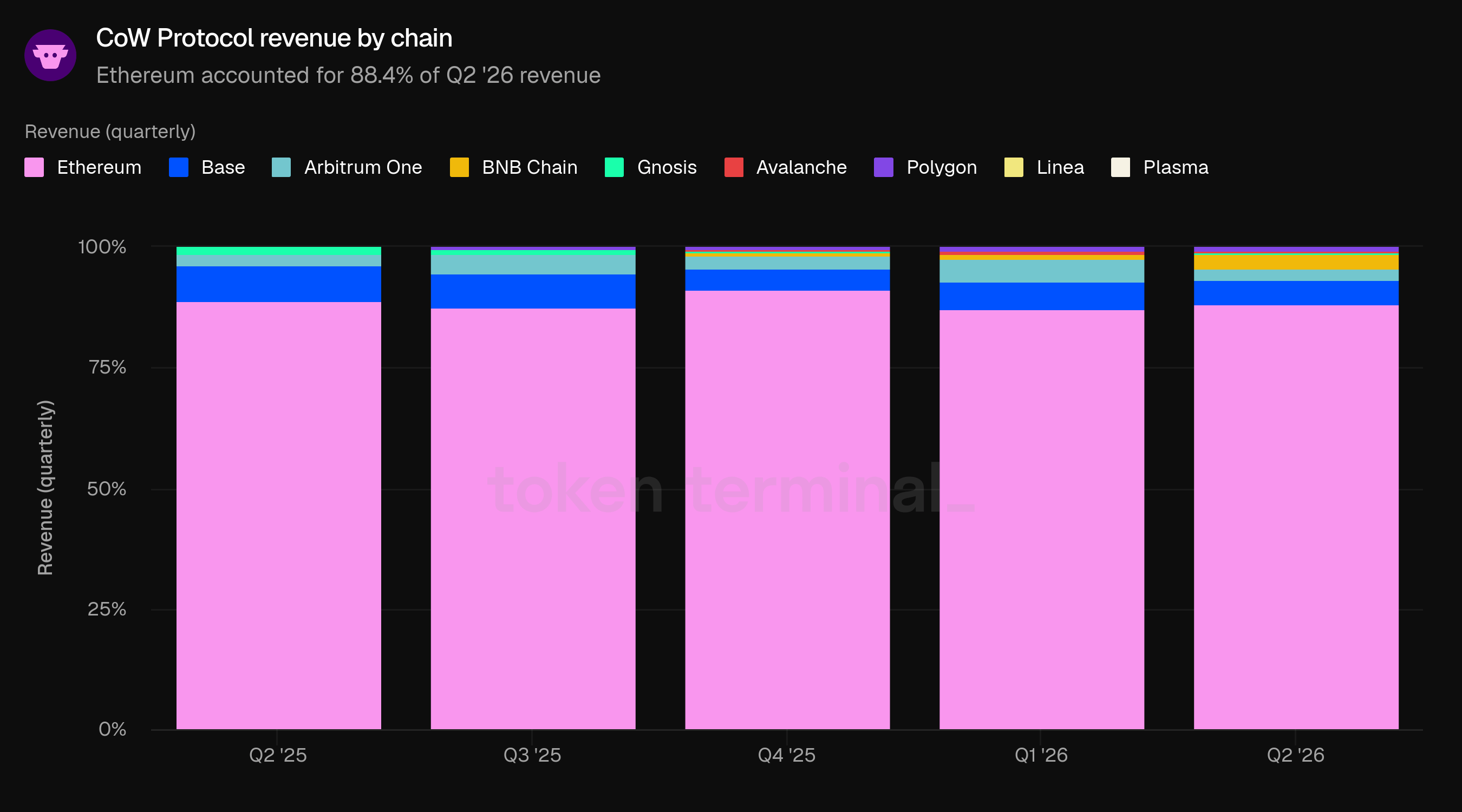
Ethereum machte 88,4% des Q2-'26-Umsatzes aus (+1,2 pp ggü. Vj.), Base 4,9% und BNB Chain 3,3%; das sind +2,3 pp ggü. Vj. und liegt vor Arbitrum One mit 2,3%. Der Umsatzanteil von BNB Chain liegt deutlich über seinem Volumenanteil von 1,0% – dasselbe Muster einer Gebührenintensität ist auch im Fee-Mix sichtbar.
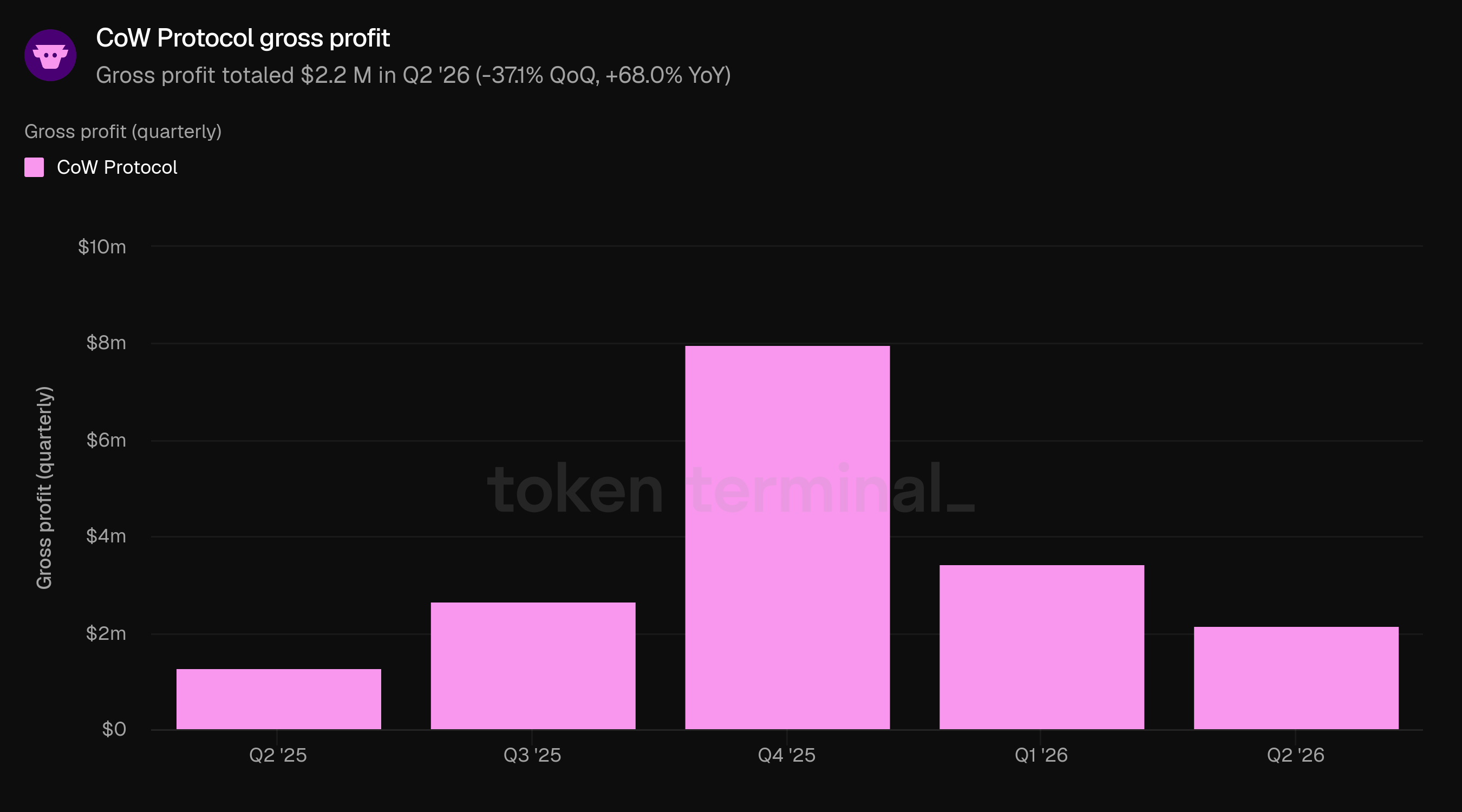
Der Bruttogewinn zeigt, was das CoW Protocol nach Solver-Anreizen behält – die COW-Belohnungen, die Solver für die Ausführung von Orders erhalten. Der Bruttogewinn betrug im Q2 '26 2,2 Mio. USD, 37,1% weniger ggü. Vj., aber 68,0% mehr ggü. Vw.
Der Bruttogewinn ist die Bottom-Line-Sicht des Onchain-Unit-Economics: Von den 5,8 Mio. USD, die Nutzer an Gebühren zahlen, wurden 3,9 Mio. USD als Umsatz einbehalten und 2,2 Mio. USD blieben nach der Entschädigung des Solver-Netzwerks übrig. Alle drei Ebenen fielen ggü. Vj. und stiegen ggü. Vw. – in die gleiche Richtung wie die Gebühren.
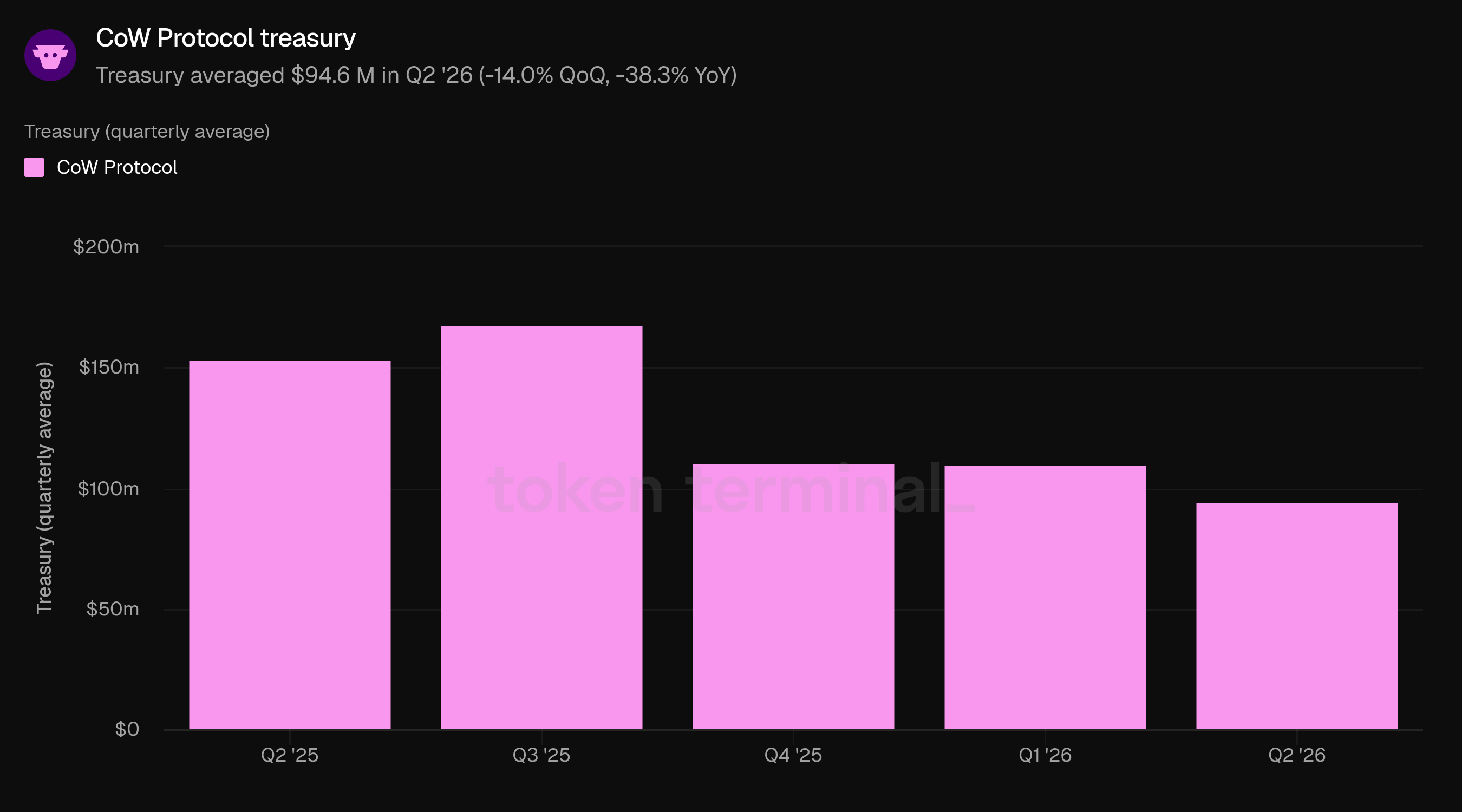
Treasury misst den Wert von Vermögenswerten, die in Onchain-Adressen gehalten werden, die von der CoW DAO kontrolliert werden – einschließlich des Hauptsafes und des Managed Treasury. Das Treasury lag im Q2 '26 im Durchschnitt bei 94,6 Mio. USD, 14,0% weniger ggü. Vj. und 38,3% weniger ggü. Vw.
Der Rückgang passt zur Neubewertung des nativen Tokens: COW macht drei Viertel der Bestände aus und das FDV fiel um 18,4% ggü. Vj. Die Treasury-Mittel finanzieren den Betrieb, Anreize für Beiträge und das Wachstum des Ökosystems – dieselben Ökonomien, die die Vorschläge zur Wertverteilung adressieren.
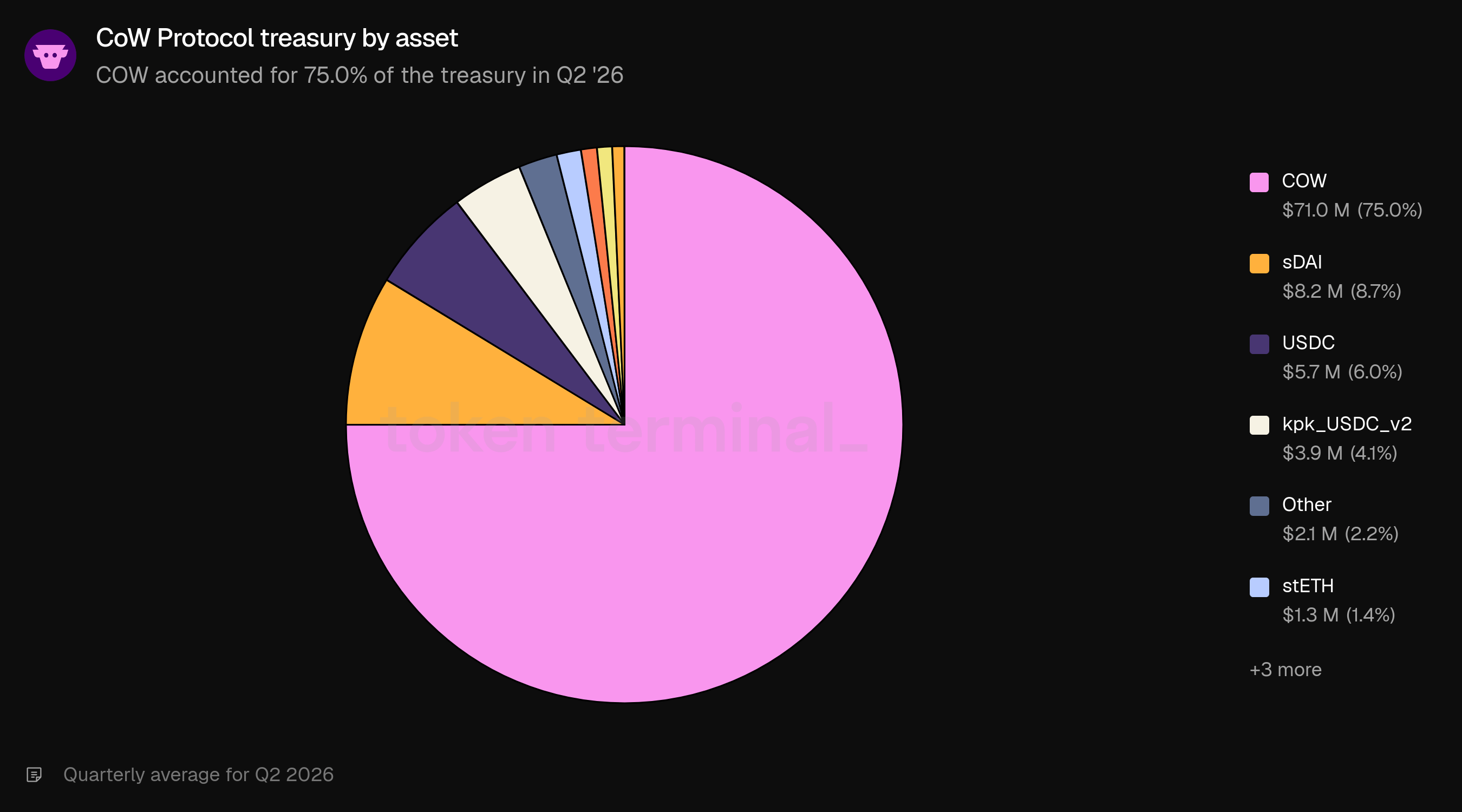
COW machte 71,0 Mio. USD aus – bzw. 75,0% – des durchschnittlichen Treasury-Werts im Q2 '26. Der Nicht-COW-Bestand von rund 23,6 Mio. USD liegt überwiegend in Stablecoin- und renditebringenden Positionen: sDAI mit 8,2 Mio. USD, USDC mit 5,7 Mio. USD, das kpk_USDC_v2-Vault mit 3,9 Mio. USD, stETH mit 1,3 Mio. USD, syrupUSDC mit 880,6 Tsd. USD, kpkEURC mit 818,5 Tsd. USD und sGho mit 675,6 Tsd. USD. Diese diversifizierte Tranche spiegelt die Ausgabekraft des DAO unabhängig vom Marktpreis von COW wider.
👥 CoW-DAO-Teamkommentar
"Der Umsatz fiel absolut im Gleichschritt mit dem Marktzyklus und dem Volumen, auf dem er basiert. Die Relationen blieben jedoch bestehen. Der Partner-zugeordnete Umsatz hielt seinen Anteil am Gesamtwert bei ungefähr 35% – im Wesentlichen unverändert von Quartal zu Quartal – auch in einem rückläufigen Markt: Widerstandsfähigkeit, proportional statt nominal."
Unter dieser Stabilität hat sich die Qualität des Umsatzes verbessert, was die Schlagzeile nicht zeigt. Lending bleibt die größte Kategorie – sowohl nach Volumen als auch nach Umsatz. Der neuere Beitrag kommt von Consumer-Wallets: Sie stiegen dieses Quartal und werden erstmals in messbarem Umfang sichtbar. Wallet-Flow monetarisiert mit gesünderen Margen als über Aggregatoren geroutetes Volumen; dadurch verbessert sich die Umsatzqualität, selbst wenn Lending die Basis weiter verankert.
Wir haben nach dem Domain-Vorfall im April einen Listing-Partner eines Meta-Aggregators verloren, der zuvor ein wesentlicher Beitragender war – mit laufenden Gesprächen, um die Partnerschaft wieder zu aktivieren. Bereinigt darum ist die zugrunde liegende Umsatzbasis stabiler, als der Rückgang auf der Topline vermuten lässt.
Das Volumen treibt den Bruttogewinn kurzfristig mechanisch an, daher sagt diese Quartalszahl wenig über die zukünftige Entwicklung. Entscheidend sind die Mechaniken, weil sie den strukturellen Bestimmungsfaktor der Marge adressieren – nicht den zyklischen.
Wir haben verbessert, wie die Konsistenz der Solver bewertet wird: Wir belohnen glaubwürdige Gebote und eine zuverlässige Abwicklung statt reine Aktivität. Diese Änderung zielt auf die Effizienz des Wettbewerbs, der letztlich die Unit Economics bestimmt. Verwandte Bemühungen, die Teilnahme an diesem Wettbewerb zu verbreitern – ohne das Vertrauensmodell zu lockern – zeigen in dieselbe Richtung.
Wir erwarten, dass diese Änderungen die Marge strukturell unterstützen, während sie reifen, und gleichzeitig bewegt sich die Kennzahl von Quartal zu Quartal weiterhin mit dem Volumen.
5) Monatlich aktive Nutzer
Monatlich aktive Nutzer messen eindeutige Adressen, die über ein 30-Tage-Fenster revenue-generierende Trades über das CoW Protocol ausführen, gemittelt über das Quartal. Die MAUs lagen im Q2 '26 im Durchschnitt bei 56,1 Tsd., 13,0% weniger ggü. Vj., aber 46,5% mehr ggü. Vw.; das war der erste quartalsweise Rückgang innerhalb eines Jahres.
Der Quartalsdurchschnitt bildet nicht ab, wie das Quartal endete. Auf Monatsende-Basis lag die MAU bei 45,2 Tsd. im April, 48,7 Tsd. im Mai und 98,5 Tsd. im Juni – zu dem Zeitpunkt ein Allzeithoch, über dem bisherigen Peak von 80,4 Tsd. aus Februar 2026. Da der Anstieg spät im Quartal kam, hebt er den Q2-Durchschnitt nur teilweise an und setzt stattdessen den Einstiegspunkt für Q3.
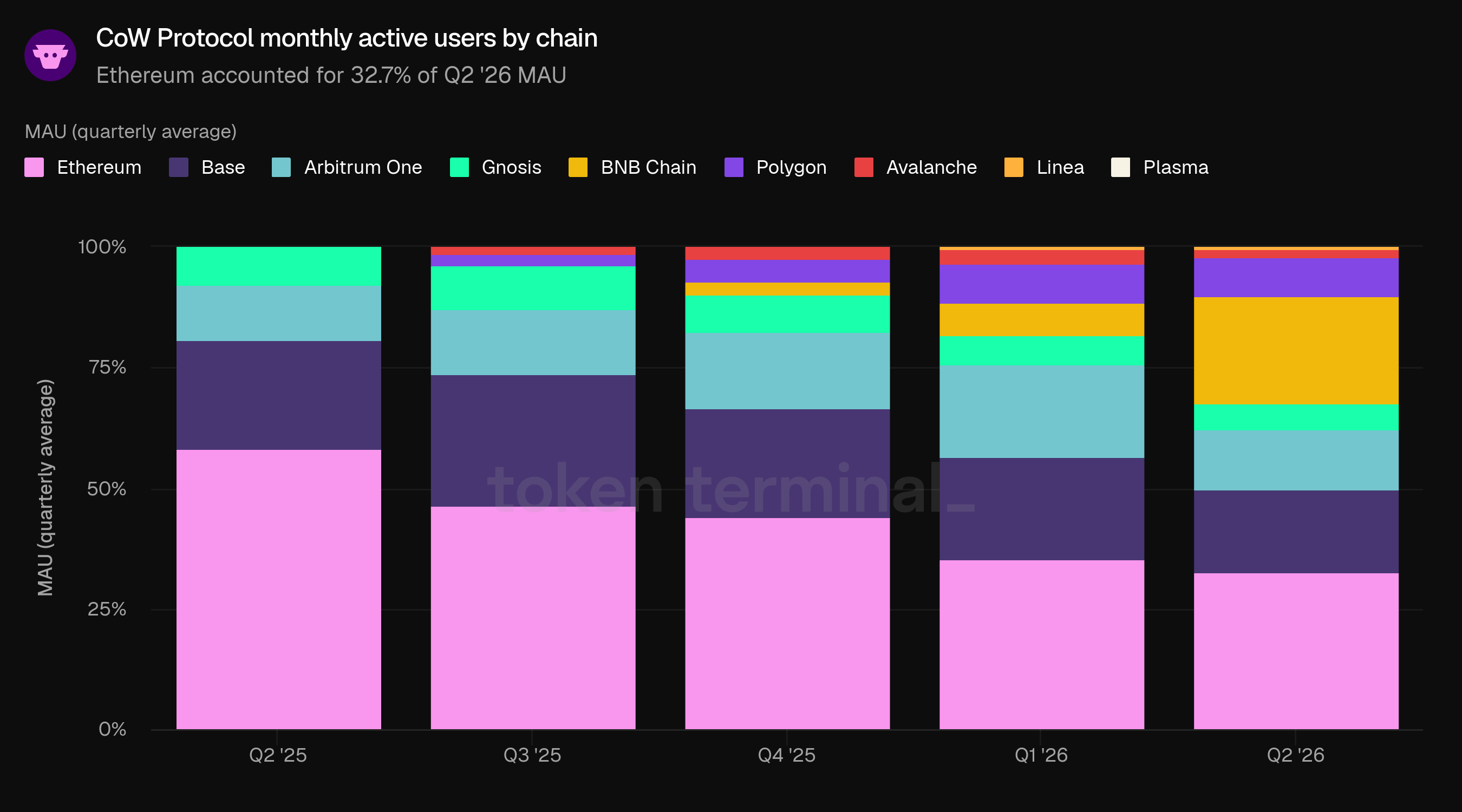
Die Nutzerbasis ist deutlich weniger auf Ethereum konzentriert als die Volumenbasis, und Q2 hat diese Lücke noch erweitert. Der Anteil von Ethereum an den MAUs sank auf 32,7% (-2,6 pp ggü. Vj., -25,5 pp ggü. Vw.), während BNB Chain auf 22,3% sprang (von 6,7% in Q1) und damit zur zweitgrößten Nutzerbasis wurde – vor Base mit 17,2% und Arbitrum One mit 12,4%; Polygon hielt 8,2% und Gnosis 5,3%. Zwei Drittel der Nutzer handeln inzwischen auf Chains außer Ethereum, während Ethereum immer noch neun Zehntel des Volumens abrechnet: Breite bei den Nutzern, Tiefe beim Wert. Das Team führt einen großen Teil des Zuwachses im Juni auf BNB Chain zurück und berichtet, dass 88% der Juni-Wallets dort Erstnutzer waren.
👥 CoW-DAO-Teamkommentar
"Die Entkopplung der Nutzer vom Volumen ist das beabsichtigte Ergebnis der Strategie. Steigende aktive Nutzer bei fallendem Volumen zeigt, dass das Protokoll seine Basis erweitert – weg von einer historisch stark whale-lastigen Konzentration – und dass kleinere durchschnittliche Tradegrößen die Folge dieser Verschiebung sind."
Der Effekt zweiter Ordnung verstärkt sich. Eine größere, diversere Nutzerbasis erhöht die Wahrscheinlichkeit, dass Solver Orders direkt gegeneinander matchen können – Zufälle der Wünsche – was den Nutzern bessere Preise ermöglicht. Bessere Preise wiederum stärken die Argumentation für den nächsten Nutzer. Diese Schleife – nicht die Nutzeranzahl eines einzelnen Quartals – ist das, worauf unsere Ambition abzielt, zur Preisfindungsstätte für On-Chain-Handel zu werden."
6) Vollständig verwässertes Marktkapital
Das vollständig verwässerte Marktkapital (FDV) misst die Bewertung des Projekts unter der Annahme vollständiger Verwässerung, berechnet als der COW-Preis multipliziert mit dem gesamten Umlaufbestand nach den aktuellen Token-Ökonomien. Das FDV lag im Q2 '26 im Durchschnitt bei 174,3 Mio. USD, 18,4% weniger ggü. Vj. und 46,5% weniger ggü. Vw.
Die in Q1 festgestellte Abweichung setzte sich bis Q2 fort: Gebühren, Umsatz, Bruttogewinn und Nutzer blieben über den Werten vom Vorjahr, während das FDV sank. Governance rückte dieser Lücke im Mai näher, als das Kernteam mit Aragon entwickelte Vorschläge zur Wertverteilung veröffentlichte – darunter Solver-Bond-Safes, ein Treasury-Burn-Test und ein flexibles Buyback-Mandat.
👥 CoW-DAO-Teamkommentar
"Steigende Nutzung und eine nachlaufende Bewertung deuten auf einen Markt hin, der unsere Fundamentaldaten noch nicht neu bewertet hat – nicht auf ein sich verschlechterndes Geschäft. "
Das Wertverteilungs-Framework, das nun in die Governance einzieht, ist der Mechanismus, der beabsichtigt, diese Lücke zu schließen – und es stützt sich auf eine Erfolgsbilanz, die bereits in den Daten sichtbar ist, nicht auf Prognosen. Buybacks lagen in dem Quartal etwa 40% über den Solver-Emissionen, wodurch die Solver-Operations des Protokolls strukturell deflationär sind. Das Framework ist darauf ausgelegt, auf dieser Basis aufzubauen und der Performance des Protokolls einen klareren Weg hin zum COW-Token zu geben.
7) Ausblick
CoW Protocol verlässt Q2 2026 mit geringerem Volumen, niedrigeren Gebühren und niedrigerem Umsatz als in Q1, in einem Quartal, in dem der gesamte DEX-Markt schrumpfte – aber deutlich über dem gleichen Zeitraum im Vorjahr. Juni war der stärkste Monat des Quartals für Volumen, Gebühren, Umsatz und Nutzer. Daher ist das Erste zu beobachten, ob dieser späte Aufschwung in Q3 hineinträgt. Frühe Indikatoren dazu: Der Monatsende-Wert der MAUs überschritt in den ersten drei Wochen im Juli 100 Tsd.
Der zweite Strang ist, wie die DAO die Erträge des Projekts mit dem COW-Token verknüpft. Im Mai veröffentlichte das Kernteam in Zusammenarbeit mit Aragon Vorschläge, die vorsahen, COW aus dem Treasury zu verbrennen, um Tokens auszugleichen, die bis Ende 2026 ausgeschüttet würden (geschätzt 60 Mio. bis 85 Mio. COW). Zudem sollte es möglich sein, bis zu 100% des wöchentlichen Umsatzes für den Rückkauf von COW auszugeben, wenn die Marktbedingungen das rechtfertigen. Außerdem sollte ein Fünftel der wöchentlichen Belohnungen der Solver in dedizierte Sicherheits-Deposits geleitet werden. Die Vorschläge blieben bis Mitte Juli Gegenstand von DAO-Diskussionen.
Die Arbeit am Solver-Markt wurde ebenfalls fortgesetzt – dem Wettbewerb zwischen den Agenten, die Trades ausführen. Ein Framework, das Solver für konstante Performance statt für einzelne Einmal-Erfolge belohnt (CIP-85), wurde im April verabschiedet; im Juni folgte eine strengere Methode zur Bewertung der Konsistenz. Vorschläge, die Hürden für die Teilnahme als Solver zu senken, waren zum Quartalsende offen.
Der dritte Strang ist die Distribution. Atomic Bundles – das im Mai gestartete Produkt, mit dem andere Projekte Multi-Step-Transaktionen auf dem CoW Protocol aufbauen können – fand seinen ersten produktiven Nutzer bei Euler. Das Affiliate-Programm, das im April startete, überschritt laut Team bis Mai 100 Mio. USD an verwiesenem Handelsvolumen. Nach dem Quartalsende berichtete das Team anhand seiner eigenen Methodik (8. Juli) über einen 23,5%-Anteil des Handels unter Intent-basierten DEXs. Außerdem schloss es sich der Encrypt the Mempool Coalition an – einer Brancheninitiative, die pending Ethereum-Transaktionen vor Front-Running schützen soll (10. Juli) – und brachte seine Fast Swaps-Funktion zurück in die Staking-Integration von Lido (13. Juli).
Mit Blick auf Q3 sind die offenen Punkte, ob der Schwung aus Juni anhält, wie die DAO über die Wertverteilung entscheidet, und ob die wachsende Zahl von Integrationen zu volumenpflichtiger (fee-paying) Nutzung führt.
8) Definitionen
Kennzahlen:
Handelsvolumen: misst den gesamten Wert der über die Batch-Auktionen des CoW Protocol ausgeführten Trades, quartalsweise gesamt.
Gebühren: misst den gesamten Wert, den Nutzer zahlen, um über das CoW Protocol zu traden – inklusive Gebühren auf Handelsüberschuss und Volumen, Gebühren für Integrationspartner, Netzwerkgebühren zur Abdeckung von Gas sowie Gebühren für MEV Blocker, quartalsweise gesamt.
Umsatz: misst den Anteil der Gebühren, den die CoW DAO behält – aus Handelsgebühren auf Trade-Ebene, Partner-Umsatzbeteiligungen, RPC-Rückvergütungen und Aktivitäten im Zusammenhang mit MEV – quartalsweise gesamt.
Bruttogewinn: misst, was das CoW Protocol nach Solver-Anreizen behält (die COW-Belohnungen, die Solver für die Ausführung erhalten), berechnet als Umsatz minus Solver-Anreize, quartalsweise gesamt.
Treasury: misst den Wert der Vermögenswerte, die in Onchain-Adressen gehalten werden, die von der CoW DAO kontrolliert werden – einschließlich des Hauptsafes und des Managed Treasury – quartalsweiser Durchschnitt.
Monatlich aktive Nutzer: misst die Anzahl eindeutiger Adressen, die über ein 30-Tage-Fenster revenue-generierende Trades über das CoW Protocol ausführen, quartalsweiser Durchschnitt.
Vollständig verwässertes Marktkapital (FDV): misst die Bewertung des Projekts unter Annahme vollständiger Verwässerung, berechnet als der COW-Preis multipliziert mit dem gesamten Supply unter den aktuellen Token-Ökonomien, quartalsweiser Durchschnitt.
9) Über diesen Bericht
Dieser Bericht wird quartalsweise veröffentlicht und mit Hilfe der End-to-End-Onchain-Dateninfrastruktur von Token Terminal erstellt. Alle Kennzahlen werden direkt aus Blockchain-Daten abgeleitet. Diagramme und Datensätze, auf die in diesem Bericht Bezug genommen wird, können im entsprechenden CoW-Protocol-Q2-2026-Report-Dashboard auf Token Terminal eingesehen werden.