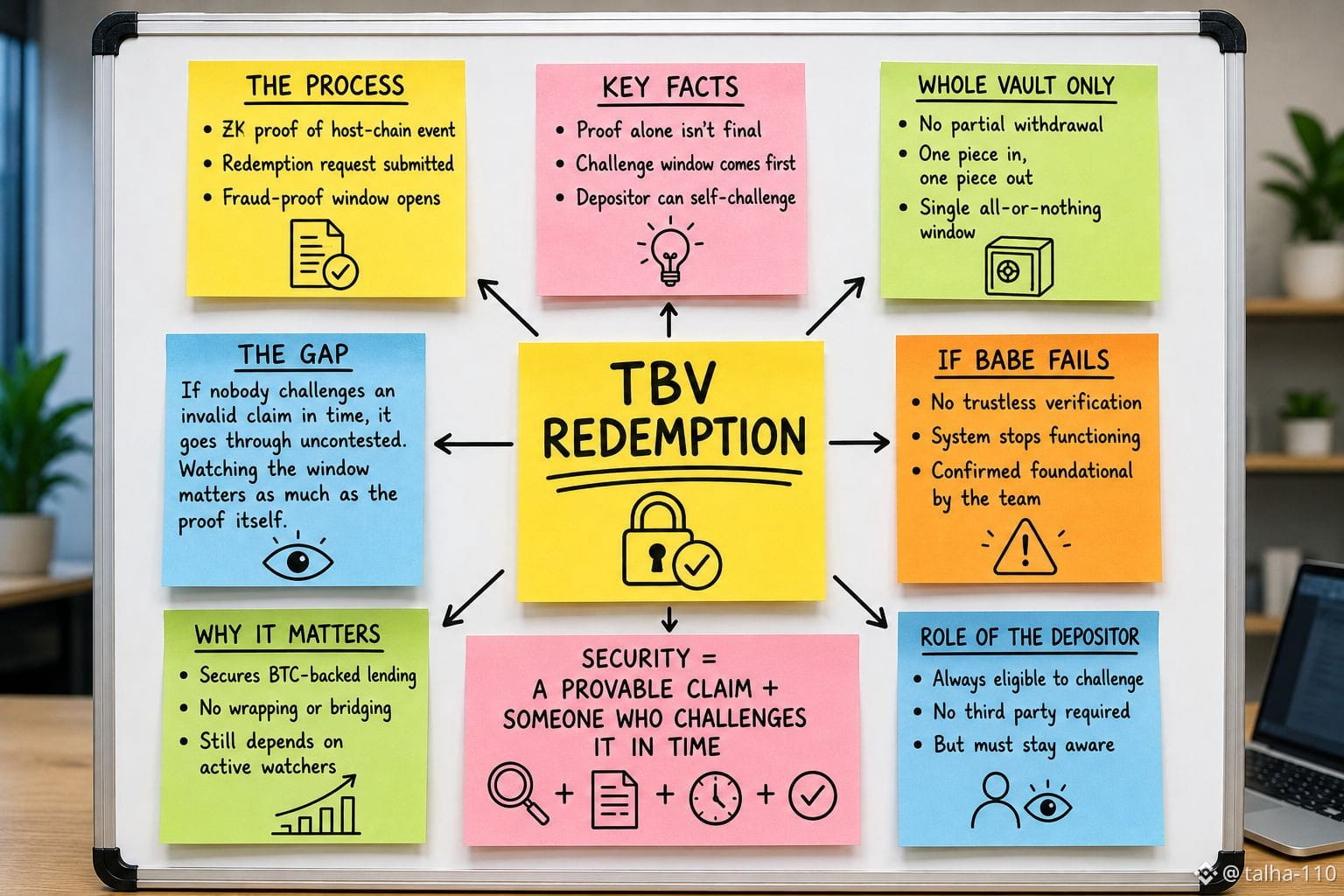
At first I assumed the zero-knowledge proof in Babylon's Trustless Bitcoin Vaults was the whole security story, valid proof means valid redemption, end of discussion. Reading deeper into how TBV actually processes a withdrawal, the proof is only half of it. When someone submits a redemption request, backed by a ZK proof that some event happened on the host chain like Ethereum, that claim doesn't execute instantly. It opens a fraud-proof window first, a period where anyone eligible can challenge the claim if something's wrong. The depositor themselves is always allowed to act as their own challenger, which sounds reassuring until you realize what that actually requires: you personally staying aware enough to catch a bad claim before that window closes. If you're not watching, and nobody else happens to be either, an invalid redemption has a real chance of just going through uncontested. There's also a detail that surprised me more than it should have. Redemption isn't partial. It's whole-vault only, one piece in, one piece out, so there's no gradual unwind, just a single window where the entire position either gets correctly challenged or doesn't. And underneath all of this sits BABE, the proof verification layer making any of this cryptographically checkable in the first place. The team has said plainly that without BABE, there's no trustless verification at all, the whole system just stops functioning. So the honest description isn't "math secures your Bitcoin." It's "math makes a false claim provable, provided someone is actually positioned to prove it in time. @BabylonLabs_io #baby
$BABY
$COTI
$BABY
$COTI