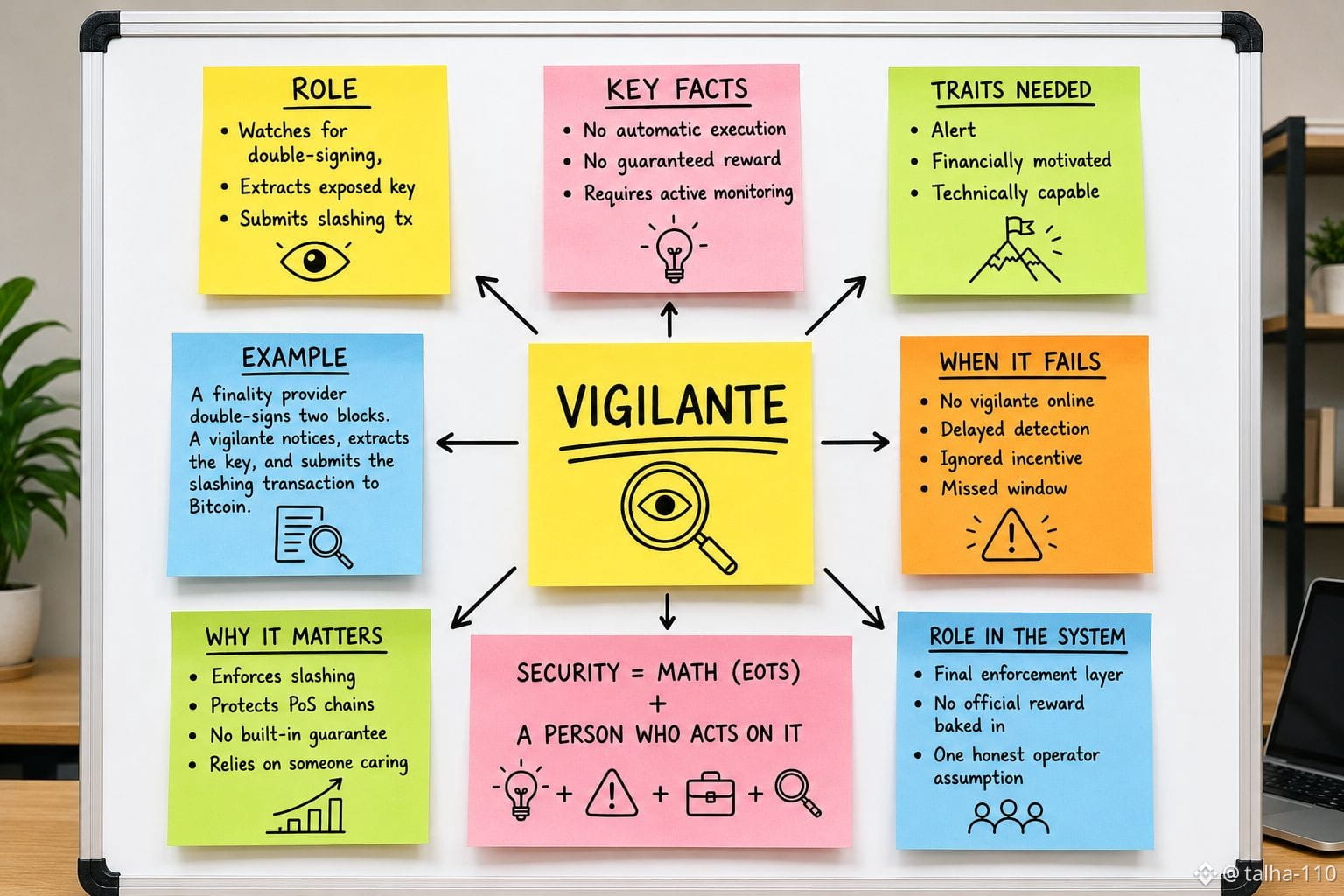
At first I assumed slashing in Babylon happened automatically the moment a finality provider double-signed, like some invisible tripwire just catches it. It doesn't. There's a separate role called a vigilante, and its entire job is to watch, because nothing executes without one. When a finality provider signs two conflicting blocks, the double-signature alone slashes nothing. Someone has to actually notice it, extract the exposed private key from the two signatures, and submit the slashing transaction to Bitcoin themselves. That someone is a vigilante, an operator running monitoring software with zero official reward guarantee baked into the base protocol for doing it. The EOTS mechanism makes the key mathematically extractable the instant double-signing happens, but an extractable key sitting unused doesn't punish anyone. It just sits there as dead potential until a person or bot decides it's worth the effort to act on it. So the entire security of the system quietly depends on at least one vigilante being awake, honest, and motivated enough to bother, at the exact second misbehavior happens. Babylon's own documentation admits at least one honest operator needs to exist for each monitoring role, almost as a footnote. That's not a small detail buried in the fine print. That's the whole enforcement layer resting on whether someone else felt like paying attention that day.
@BabylonLabs_io #baby $BABY
@BabylonLabs_io #baby $BABY