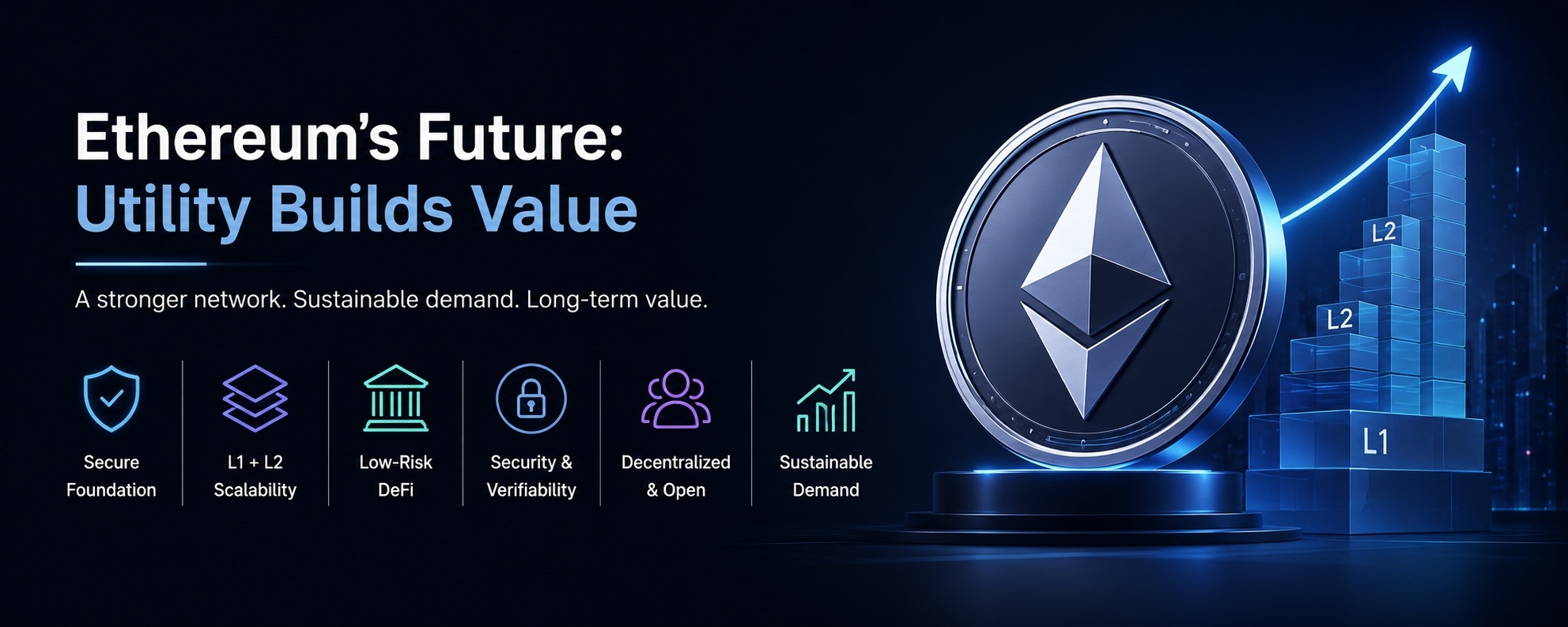
Ethereum has long been viewed as the backbone of decentralized finance, NFTs, and smart contracts. Yet despite its technological leadership, ETH has underperformed Bitcoin over the past three years, raising an important question:
If Ethereum continues to dominate blockchain innovation, why hasn't ETH captured that value?
According to Vitalik Buterin's recent writings throughout 2025-2026, the answer isn't aggressive marketing or price promotion. Instead, Ethereum is undergoing a strategic transformation focused on becoming the world's most trusted settlement layer for decentralized finance, scalable applications, and verifiable computing.
Ethereum's New Direction: Utility Over Speculation
Unlike previous market cycles that emphasized narratives such as "Ultrasound Money" or token scarcity, Vitalik's latest vision focuses on strengthening Ethereum's core infrastructure.
His roadmap centers around:
■ Simplifying Layer-1 architecture
■ Scaling through Layer-2 networks
■ Building low-risk DeFi
■ Improving protocol security
■ Formal verification
■ Open-source transparency
■ Decentralized governance
The objective is straightforward:
Create genuine economic demand for ETH instead of relying on speculative narratives.
Why ETH Has Struggled Despite Ethereum's Growth
One of Ethereum's biggest challenges has been value capture.
While blockchain activity has expanded rapidly, much of that activity has migrated to Layer-2 solutions, reducing transaction fees collected directly on Ethereum's main chain.
Over the last three years:
ETH/BTC declined by roughly 55%
Bitcoin significantly outperformed ETH
Solana delivered even stronger relative performance
This suggests Ethereum remained highly relevant, but markets struggled to identify where ETH itself captures long-term value.
The Low-Risk DeFi Thesis
Vitalik believes Ethereum's future depends less on speculative trading and more on becoming global financial infrastructure.
Instead of chasing high-risk yields, Ethereum should support:
Stablecoin settlement
Savings products
Lending markets
Secure collateral
Payment infrastructure
Institutional finance
In this framework, ETH evolves from being merely a gas token into the primary collateral asset securing decentralized finance.
The Six Metrics Every ETH Investor Should Monitor
Rather than focusing only on token price, investors should monitor six interconnected demand drivers.
1. Fee Burn
Ethereum still benefits from burning transaction fees, although this alone is no longer sufficient to drive valuation.
2. Staking Growth
Higher validator participation strengthens network security while reducing liquid ETH supply.
3. Collateral Demand
Increasing use of ETH in lending protocols and DeFi markets creates sustainable demand.
4. Low-Risk DeFi Expansion
Growth in stable lending and institutional-grade financial products could significantly increase ETH usage.
5. Layer-2 Settlement Activity
As Layer-2 ecosystems expand, investors should assess whether they continue creating value for Ethereum's base layer.
6. Institutional Adoption
ETF inflows, treasury allocations, and institutional custody improve market structure but cannot replace genuine on-chain demand.
Which Ethereum Ecosystem Tokens Could Benefit?
Ethereum's success doesn't automatically translate into gains for every ecosystem token.
Different projects capture different layers of Ethereum's economy:
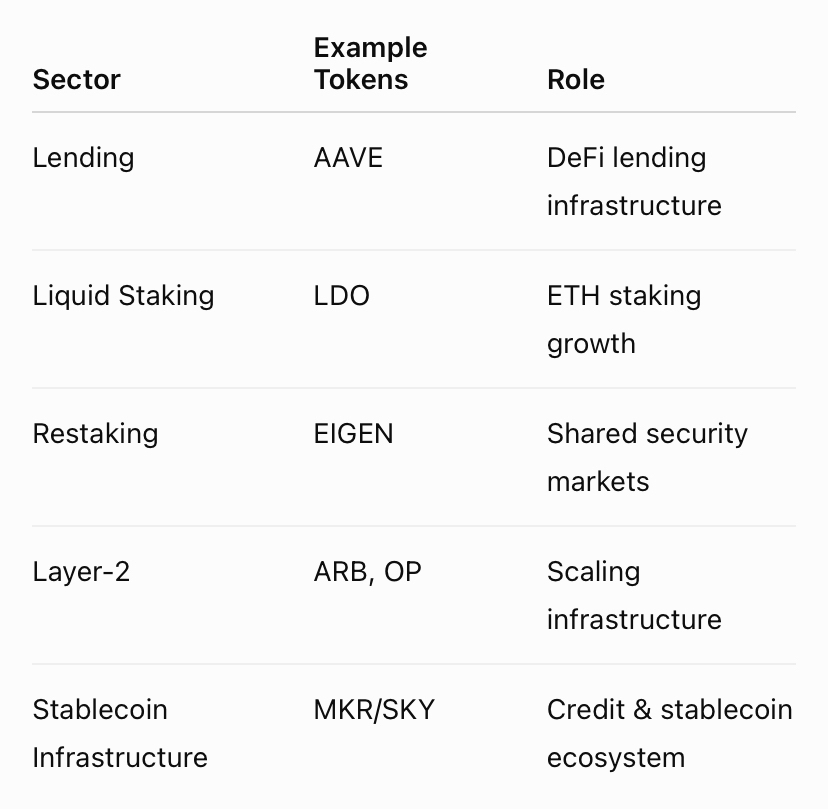 Each project must generate sustainable revenue and utility rather than relying solely on Ethereum's broader narrative.
What Could Strengthen the Bullish Thesis?
Ethereum's long-term investment case improves if several indicators advance simultaneously:
✔ ETH/BTC stabilizes
✔ DeFi collateral increases
✔ Stablecoin settlement expands
✔ Layer-2 networks return measurable value to Ethereum
✔ Institutional demand continues growing
✔ Protocol revenues improve alongside network activity
Risks Investors Should Watch
The thesis weakens if:
ETH continues losing relative strength against Bitcoin.
Layer-2 growth fails to benefit Ethereum's base layer.
DeFi introduces excessive systemic risk.
Institutional ownership grows while on-chain economic activity stagnates.
Revenue generation remains disconnected from network adoption.
Final Takeaway
Vitalik Buterin's vision is not about creating short-term excitement around ETH. Instead, it aims to transform Ethereum into the world's most secure, transparent, and trusted blockchain infrastructure.
For investors, the key question is no longer "Will Ethereum grow?" but rather:
Can Ethereum's expanding ecosystem generate measurable, sustainable demand that directly strengthens ETH's long-term value?
If multiple demand channels—staking, collateral usage, Layer-2 settlement, stablecoins, and institutional adoption—continue to mature together, Ethereum could establish a stronger and more durable investment thesis than one driven purely by market hype.
#Ethereum #ETH #DeFi #CryptoInvesting #ArifAlpha