
@PositiveMindsGlobalResults - @Binance Square Official
A Comprehensive Analysis of BNB's Role in Blockchain Infrastructure, Institutional Finance, Cross-Border Payments, Artificial Intelligence, and Long-Term Valuation Through 2040
Introduction: The Next Evolution of Global Finance
The global financial architecture is undergoing its most profound structural realignment since the advent of modern electronic banking. Over the past decade, distributed ledger technology (DLT) has transitioned from an experimental sandbox into a systemic infrastructure layer. It is fundamentally rewriting the mechanics of capital mobility, asset issuance, and settlement velocity.
Traditional banking rails—forged in an era of localized, batch-processed economies—are increasingly unsuited for a real-time, cross-border digital marketplace. The modern macroeconomy demands instantaneous settlement, programmatic compliance, asset fractionalization, and absolute transparency. This paradigm shift has forced an convergence between legacy finance (TradFi) and decentralized architecture.
Central banks are engineering Central Bank Digital Currencies (CBDCs), sovereign wealth funds are evaluating digital asset custody, and multi-trillion-dollar asset managers are aggressively migrating real-world assets (RWAs) onto public ledgers. In this landscape, blockchain is no longer viewed as a parallel financial system, but rather as the foundational software upgrade for the global financial system itself.
+-----------------------------------------------------------------------+
| THE GLOBAL MACRO SHIFT |
+-----------------------------------------------------------------------+
| Legacy Finance (TradFi) ---> Next-Gen Ledger Architecture |
| - T+2 Batch Settlement - Instantaneous Finality |
| - Siloed Jurisdictions - Interoperable Rails |
| - Manual Compliance Intermediaries - Programmatic Smart Law |
+-----------------------------------------------------------------------+
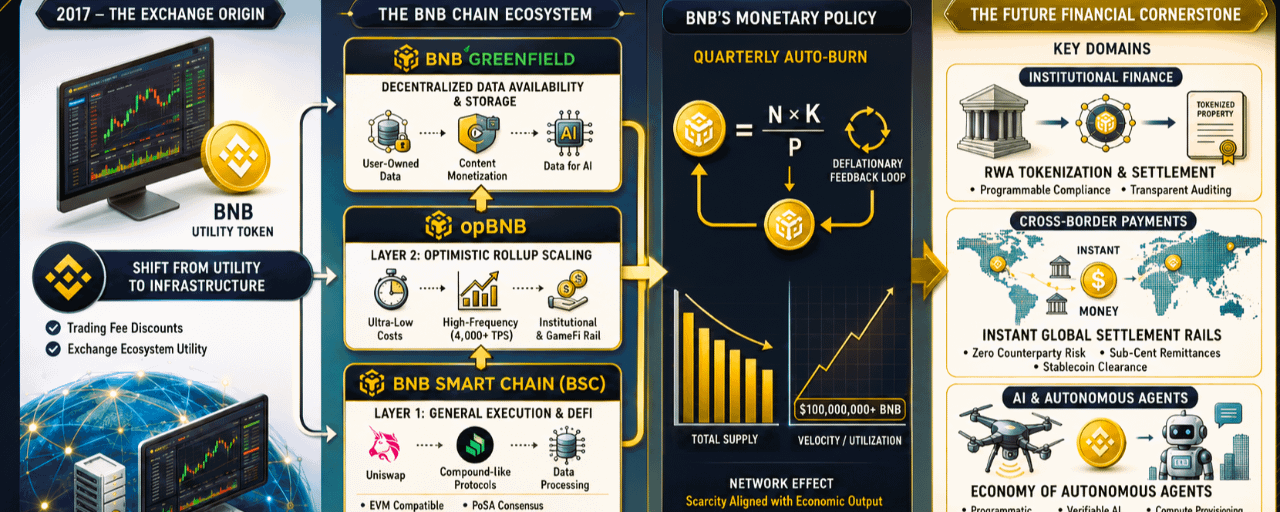
Within this competitive arena, the BNB ecosystem has executed one of the most significant transformations in digital asset history. Launched in 2017 via an Initial Coin Offering (ICO) as a simple utility token designed to reduce trading fees on the Binance exchange, BNB has systematically broken free from its centralized origins.
Today, it operates as the native economic engine of a multi-tiered blockchain infrastructure spanning smart contract execution, Layer-2 scaling solutions, decentralized storage networks, and enterprise-grade Web3 primitives.
This evolution illustrates a critical macroeconomic trend: digital assets are shedding their purely speculative premiums. Long-term network survival and capital allocation are now directly tied to structural utility, network throughput, and real economic throughput.
As sovereign states, institutional clearinghouses, and autonomous software agents select the foundational settlement layers of the next half-century, a critical question emerges: Does BNB possess the technological architecture, economic design, and institutional viability to graduate from an exchange-native asset into a structural cornerstone of the future global financial system?
Chapter 1: From Exchange Token to Global Digital Infrastructure
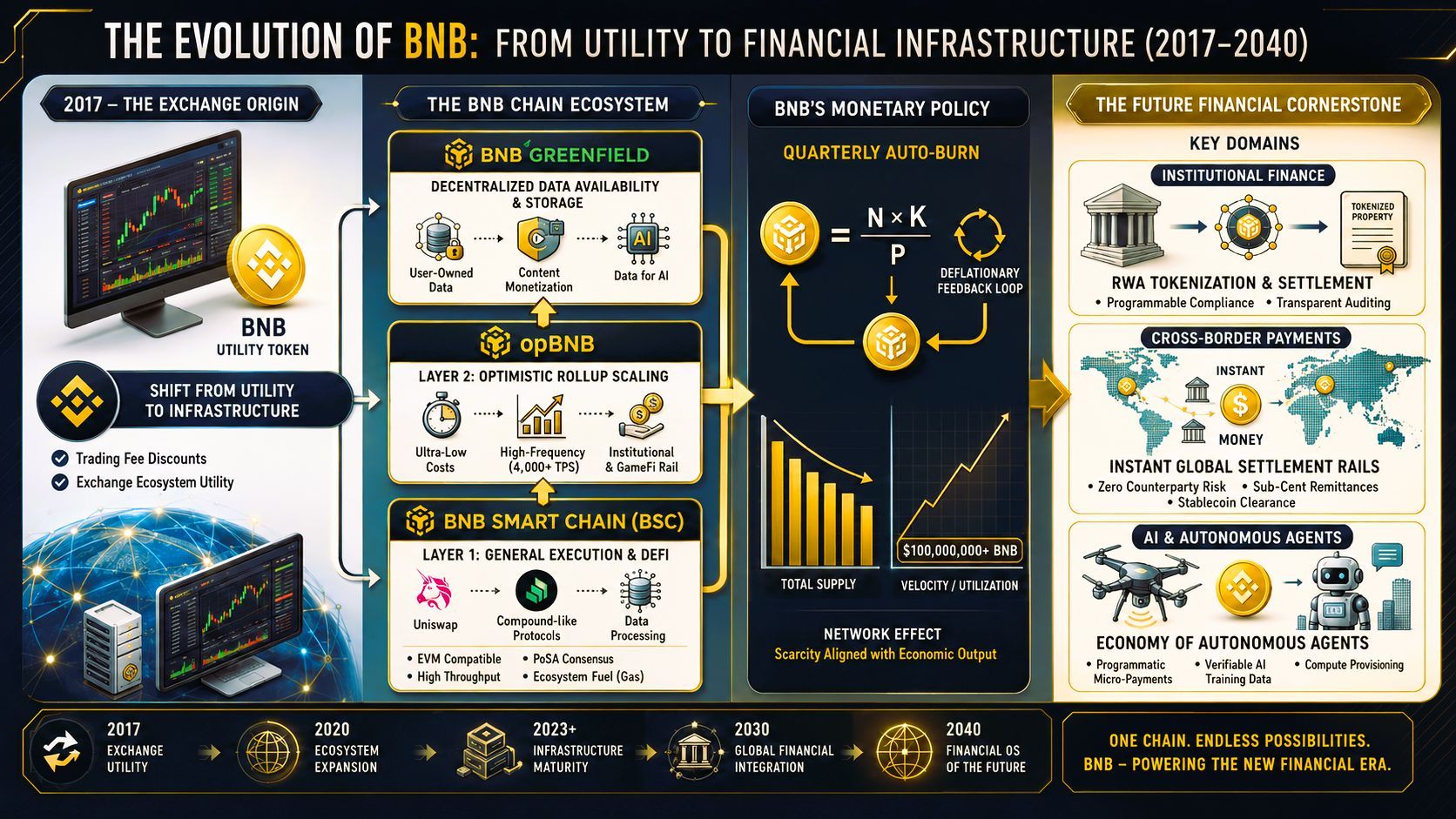
The narrative of BNB as merely an "exchange token" is an anachronism. While its initial value proposition was anchored in the microeconomics of a centralized trading venue, its modern architecture operates as a highly decentralized, multi-layered sovereign ecosystem. The structural viability of BNB as a global financial infrastructure rest upon three core architectural pillars:
BNB Smart Chain (BSC)
ThinkPositiveGlobal — Understanding Global Change, Markets, and the Future
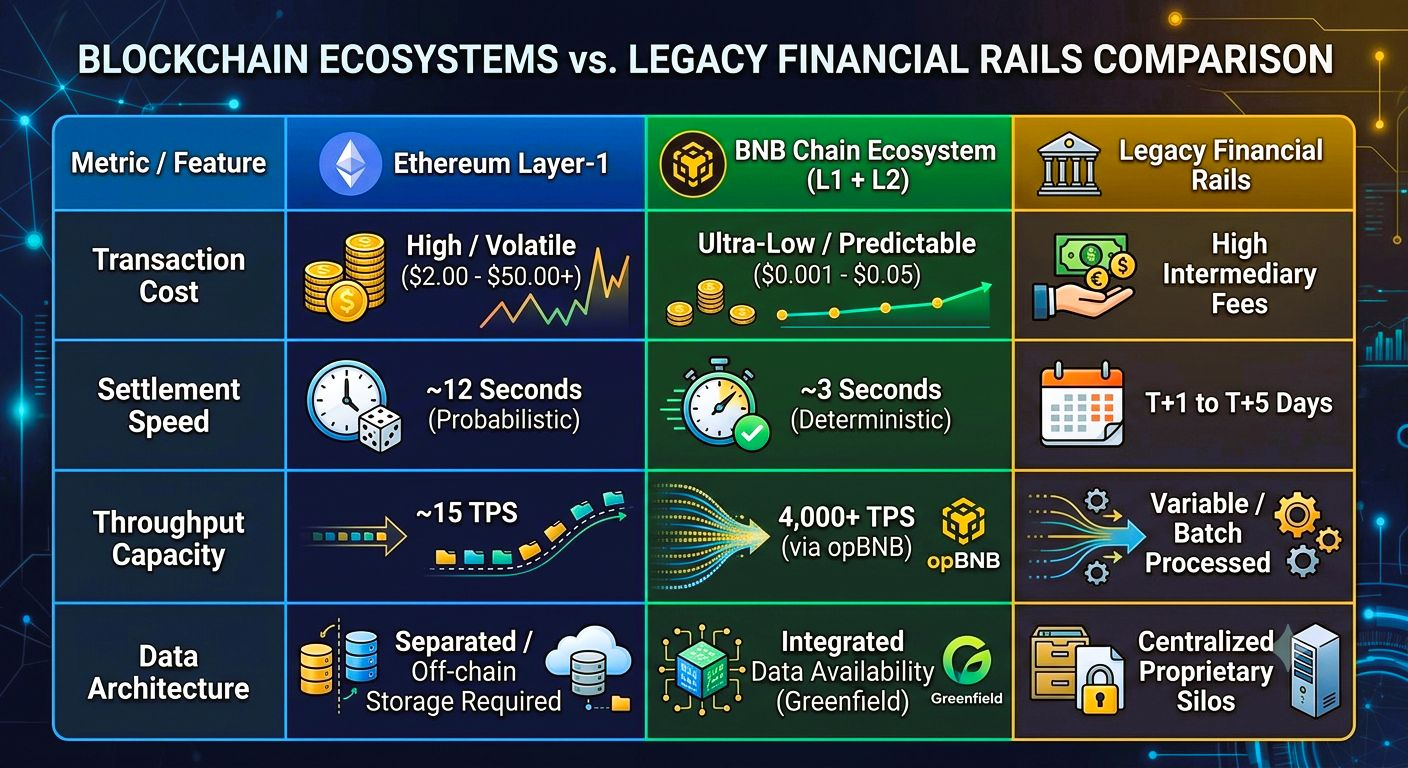
Operating as the primary execution layer, BSC utilizes a Proof-of-Staked-Authority (PoSA) consensus mechanism. This hybrid framework optimizes both transaction throughput and deterministic finality. By retaining EVM (Ethereum Virtual Machine) compatibility, BSC successfully captured a massive share of the developer ecosystem while offering significantly lower gas overhead than Ethereum's Layer-1. It serves as the high-liquidity engine for decentralized finance (DeFi), automated market makers (AMMs), and collateralized lending protocols.
opBNB (The Layer-2 Scaling Primitives)
To accommodate hyper-throughput financial applications and institutional micro-transactions, the ecosystem deployed opBNB. Built on the Optimism OP Stack, this Layer-2 scaling solution leverages optimistic rollups to abstract computational execution away from the main chain.
The result is a throughput capacity exceeding 4,000 transactions per second (TPS) with transaction costs stabilized at sub-cent levels (typically under $$0.001$). This makes it an ideal environment for high-frequency trading (HFT), streaming micropayments, and high-density financial data feeds.
BNB Greenfield
Recognizing that finance cannot operate in a vacuum without data, Greenfield introduces a decentralized cloud storage and data availability layer. Greenfield enables programmable data ownership, allowing users and corporations to host, trade, and monetize data assets via smart contracts.
In an era dominated by large language models (LLMs) and cryptographic verifiable data, Greenfield provides the structural storage foundation that bridges financial capital with information capital.
+---------------------------------------+
| THE BNB INFRASTRUCTURE |
+---------------------------------------+
|
+---------------------------+---------------------------+
| | |
+---------------+ +---------------+ +---------------+
| LAYER 1 | | LAYER 2 | | DATA LAYER |
| BNB Smart | | opBNB | | BNB Green- |
| Chain (BSC) | | (Optimistic Rollups) | field |
| High-Liquidity| | 4,000+ TPS / Sub-Cent | Decentralized |
| DeFi Engine | | Execution Rail | Cloud/Data App|
+---------------+ +---------------+ +-------------
The Digital Fuel of a Programmatic Economy
In legacy finance, transactions require an expensive, multi-layered stack of clearinghouses (e.g., DTCC), correspondent banks, and central bank systems (e.g., Fedwire). Each layer extracts a rent and introduces counterparty and temporal risks.
In the BNB infrastructure, this entire intermediation stack is replaced by automated computational validation. BNB functions as the invariant digital fuel required to execute this computation.
Because every smart contract deployment, asset transfer, data query, and validation state change requires the consumption of BNB as gas, the token’s organic demand curve is directly tethered to global network utilization. As corporate and institutional entities deploy applications across these rails, their operations necessitate the programmatic acquisition and expenditure of BNB, transforming it from a speculative financial instrument into an essential capital asset.
Chapter 2: The Macroeconomic Engine: Deflationary Tokenomics and Monetary Velocity
The viability of any asset aspiring to serve as global financial infrastructure depends heavily on its monetary policy. Uncontrolled supply inflation destroys long-term capital allocation predictability. BNB addresses this via a programmatic, algorithmic monetary policy designed to systematically reduce circulating supply until the total outstanding token count settles at exactly $100,000,000$ BNB—representing a structural $50\%$ reduction from its genesis supply.
This scarcity mechanism operates through two distinct, automated vectors:
The BEP-95 Real-Time Burning Mechanism
Introduced to align network utilization directly with supply contraction, BEP-95 introduces a continuous burn schedule modeled after Ethereum’s EIP-1559. A fixed percentage (typically $10%$) of the gas fees collected by validators in every single block is permanently extracted from circulation and destroyed.
Consequently, as the monetary velocity and transaction volume of the network increase, the rate of token destruction accelerates, introducing an intrinsic deflationary pressure linked directly to real economic usage.
The Algorithmic Auto-Burn
On a quarterly basis, an automated formula calculates a volume of BNB to be destroyed. Unlike discretionary corporate buybacks common in traditional equity markets, this Auto-Burn is entirely objective. It uses verifiable on-chain data to calculate the burn size based on two independent variables: the prevailing market price of BNB and the total number of blocks produced during the quarter.
This programmatic structure insulates the monetary supply from human intervention, political pressure, or centralized corporate mandates.
$$\text{Quarterly Burn Quantity } (B) = \frac{N \times K}{P}$$
Where:
$N$ is the total number of blocks produced during the calendar quarter.
$K$ is a constant price-anchor multiplier (historically set or adjusted via governance, typically averaging around $1000$).
$P$ is the median market price of BNB over the quarter.
This formula contains a counter-cyclical feedback loop: if the market price of BNB drops ($P$ decreases), the total quantity of tokens destroyed per quarter automatically scales upward, accelerating supply contraction during market downturns and establishing a floor of programmatic scarcity.
+--------------------------------------------------------------------------+
| THE DEFLATIONARY FEEDBACK LOOP |
+--------------------------------------------------------------------------+
| Ecosystem Gas Fees (BEP-95) + Algorithmic Auto-Burn |
| | |
| v |
| Continuous Token Destruction |
| | |
| v |
| Shrinking Circulating Supply |
| | |
| v |
| Increased Scarcity per Unit of Economic Throughput |
+--------------------------------------------------------------------------+
Chapter 3: Institutionalization and the Tokenization of Real-World Assets (RWAs)
The next major wave of capital migration involves bringing off-chain assets—such as sovereign debt, commercial real estate, corporate bonds, and private equity—directly onto public ledgers. The Boston Consulting Group estimates that the tokenization of global illiquid assets will scale into a multi-trillion-dollar market by 2030. For institutional allocators, the choice of ledger depends entirely on security, cost efficiency, and ecosystem liquidity.
BNB Chain's optimized execution speeds and low costs make it a highly competitive destination for institutional RWA deployment. When a financial institution issues a tokenized treasury bond or a fractionalized real estate fund, it requires thousands of micro-transactions to distribute yield, manage compliance whitelists, and rebalance portfolios.
On legacy networks, gas fee volatility can easily wipe out the yield on lower-margin assets like short-term sovereign debt. The predictable, sub-cent environment of opBNB allows issuers to run complex automated compliance scripts directly within the runtime environment without eroding asset performance.
Furthermore, by combining BSC’s high liquidity with Greenfield’s programmatic data storage, institutions can link a tokenized financial asset directly to its underlying compliance documentation, audit trails, and legal prospectuses on a single, unified ledger ecosystem.
As regulatory frameworks clarify globally, the institutional demand to hold BNB as a reserve asset to clear, settle, and secure these RWA issuance layers will likely grow in lockstep with corporate onboarding.
Chapter 4: Redefining Cross-Border Payments and Liquidity Liquidation
The current international payment architecture is fragmented, slow, and expensive. The correspondent banking network relies on a complex chain of intermediaries, requiring banks to maintain trillions of dollars in stagnant, pre-funded accounts (Nostro/Vostro) globally to facilitate foreign exchange and settlement. This capital inefficiency traps liquidity and drives up remittance costs.
BNB Chain provides an alternative framework for international settlement, operating across two primary vectors:
+--------------------------------------------------------------------------+
| LEGACY CROSS-BORDER SETTLEMENT |
+--------------------------------------------------------------------------+
| Originator Bank -> Correspondent Bank -> Clearing House -> Beneficiary Bank |
| (Time: 3-5 Business Days | High FX Spreads | Intermediary Fees) |
+--------------------------------------------------------------------------+
+--------------------------------------------------------------------------+
| BNB LEDGER CROSS-BORDER RAIL |
+--------------------------------------------------------------------------+
| Originator Wallet ---------> [ Programmatic Settlement ] ---------> Recipient |
| (Time: ~3 Seconds | Sub-Cent Network Fee | On-Chain Liquidity Routing) |
+--------------------------------------------------------------------------+
High-Speed Stablecoin Settlement Architecture
By hosting major fiat-pegged stablecoins (such as USDT and USDC) on an optimized execution layer, BNB Chain allows multinational corporations and remittance providers to bypass the legacy SWIFT network entirely. Transactions cross borders in roughly three seconds, settling with absolute finality at a fraction of the cost of traditional wire transfers.
Elimination of Counterparty Risk via Decentralized Liquid Cleardown
In traditional cross-border commerce, currency conversion and settlement occur asynchronously, introducing significant counterparty risk during the settlement window. By routing transactions through decentralized liquidity pools native to the BNB ecosystem, foreign exchange conversion can be executed atomically alongside payment transmission.
The transaction either succeeds entirely or fails completely across both currencies simultaneously.
As automated clearing houses and payment service providers (PSPs) integrate these rails to optimize their balance sheets, BNB’s structural role shifts from a localized crypto-asset to a high-velocity global settlement medium.
Chapter 5: Artificial Intelligence, Autonomous Agents, and the BNB Ecosystem
As we look toward the horizon of 2040, the primary users of financial services will no longer be limited to human beings. The rapid proliferation of Artificial Intelligence (AI) is giving rise to an economy run by autonomous agents—independent software programs designed to negotiate, purchase, and exchange assets without human intervention.
An AI agent cannot open a traditional bank account; it lacks a physical identity, cannot sign legacy legal documentation, and is structurally incompatible with banking systems that require manual KYC verification.
Autonomous agents require native digital ledgers that are entirely programmatic, trustless, and accessible via APIs. The BNB ecosystem is uniquely positioned at the intersection of AI compute and financial infrastructure through its multi-layered design:
+-------------------------------------------------+
|
+--------------------------------+--------------------------------+
| | |
+-------------------------------+ +-------------------------------+ +-------------------------------+
| COMPUTATIONAL DATA | | FINANCIAL CLEARING | | COMPUTE PROVISIONING |
| GREENFIELD | | opBNB / BSC | | DECENTRALIZED |
| Immutable training data and | | Instant micro-payments for | | Purchasing raw GPU power |
| tokenized LLM model weights | | API calls and data inference | | via specialized networks |
+-------------------------------+ +-------------------------------+ +-------------------------------+
Micro-Transaction Clearing for Autonomous Agents: If an AI agent needs to purchase a minute amount of data from another agent, it cannot execute a traditional credit card transaction with a $\$0.30$ fixed processing fee. The sub-cent execution costs of opBNB enable true micro-payments, allowing software agents to transact in fractions of a cent.
Tokenized Data Assets on Greenfield: AI models require massive datasets for continuous training. Greenfield enables data scientists to store verified training corpuses, tokenize them, and sell access rights directly via smart contracts. This allows data to be treated as a liquid financial asset class within the BNB framework.
Decentralized Compute and Infrastructure Provisioning: As decentralized AI networks grow, agents will need to dynamically purchase raw GPU compute power, storage space, and data access. By using BNB as the uniform settlement currency across computing networks, storage protocols, and execution layers, the ecosystem creates an integrated framework tailored for the autonomous machine economy.
Chapter 6: Competitive Matrix: BNB vs. Ethereum, Solana, and XRP
To evaluate whether BNB can achieve foundational status in the global financial system, its architecture must be analyzed alongside its primary digital competitors:
+-------------------------------------------------------------------------+
| COMPETITIVE LANDSCAPE INDEX |
+-------------------------------------------------------------------------+
| ETHEREUM: High security, but burdened by high costs and execution silos. |
| SOLANA: Massive raw throughput, but faces network stability trade-offs. |
| XRP: Deep banking relationships, but lacks general programmability. |
| BNB CHAIN: Bridges high speed, low cost, and an integrated data layer. |
+-------------------------------------------------------------------------+
Ethereum (ETH)
Advantage: Ethereum commands the deepest institutional mindshare and the largest volume of decentralized capital lockup. It is widely considered the safest smart contract platform for high-value execution.
BNB Competitive Edge: Ethereum's Layer-1 remains cost-prohibitive and highly volatile during periods of network congestion. While its Layer-2 scaling strategy alleviates some fee pressure, it fractures liquidity and user experience across isolated rollups. BNB Chain offers a more unified, predictable execution environment with a native data storage layer (Greenfield) that Ethereum lacks entirely.
Solana (SOL)
Advantage: Solana offers immense raw speed and a monolithic architecture that keeps all application states inside a single, high-performance ledger.
BNB Competitive Edge: Solana's hyper-throughput requires intense hardware specialization, which can complicate enterprise deployments looking for predictable node requirements. BNB Chain's hybrid structure balances the high speed of an L2 (opBNB) with the reliable, enterprise-tested EVM infrastructure of its core Layer-1, offering smoother integration with legacy IT systems.
XRP Ledger (XRP)
Advantage: Designed specifically for cross-border banking corridors, XRP boasts deep integration with legacy banking institutions and remittance providers.
BNB Competitive Edge: The XRP Ledger is fundamentally restricted in its expressiveness; it lacks the robust, generalized smart contract primitives required to host complex DeFi ecosystems, build modular data layers, or support autonomous AI agents. BNB offers a complete, full-stack digital economy platform rather than just a specialized payment corridor.
Chapter 7: Regulatory Imperatives, Centralization Risks, and Mitigations
For all its technical and economic strengths, BNB’s journey to becoming a global financial cornerstone faces significant structural risks, primarily categorized under regulatory pressure and architectural centralization.
+-----------------------------------------------------------------------+
| STRUCTURAL RISK EVALUATION |
+-----------------------------------------------------------------------+
| REGULATORY OVERHEAD ---> VALIDATOR CONCENTRATION |
| Sovereign compliance mandates Higher throughput requires |
| and international legal friction. fewer, highly reliable nodes. |
+-----------------------------------------------------------------------+
Regulatory Pressure and Corporate DecouPLING
Historically, BNB’s valuation was deeply intertwined with the operational footprint of Binance, the world's largest centralized digital asset exchange. This exposed the asset to intense regulatory scrutiny from global bodies, including the US Department of Justice (DOJ) and the Commodity Futures Trading Commission (CFTC).
To survive long-term institutional due diligence, the BNB ecosystem has pursued an aggressive strategy of structural decoupling. The BNB Chain open-source project now operates as an independent, community-driven initiative managed by decentralized foundations.
For global banks to settle trillions in volume on these rails, the network must continue to prove that its survival and governance are completely independent of any single commercial entity or regulatory jurisdiction.
The Validator Paradox
The high transaction speeds and low fees of the BNB Smart Chain are achieved by utilizing a curated validator set under its Proof-of-Staked-Authority (PoSA) consensus model. While this architectural design avoids the coordination bottlenecks and fee spikes of highly decentralized networks like Ethereum, it does introduce a higher concentration of validator influence.
If a significant portion of validators were coordinated or compromised by a single geopolitical entity or legal jurisdiction, the security of the ledger could face systemic risks.
To mitigate this, the ecosystem is expanding its validator count and rolling out lighter, permissionless validation protocols on its Layer-2 rollups to systematically distribute structural governance.
Chapter 8: Long-Term Valuation Modeling and Structural Scenarios (2027–2040)
To quantify BNB's long-term economic path over the next decade and a half, we examine three potential macroeconomic scenarios based on network adoption, institutional asset migration, and global monetary velocity.
+---------------------------------+
| 2040 VALUATION TRAJECTORIES |
+---------------------------------+
|
+--------------------------------+--------------------------------+
| | |
+-------------------------------+ +-------------------------------+ +-------------------------------+
| BEARISH SCENARIO | | BASE-CASE SCENARIO | | BULLISH SCENARIO |
| $250 - $600 | | $2,500 - $6,500 | | $12,000 - $35,000+ |
| Regulatory containment and | | Captures a steady share of | | Becomes a foundational world |
| platform fragmentation. | | global RWA and payment flows. | | ledger for finance and AI. |
+-------------------------------+ +-------------------------------+ +-------------------------------+
The Bearish Stagnation Scenario ($250 – $600 per BNB)
Triggers: Regulators systematically restrict public ledger access for traditional financial institutions, forcing capital into siloed permissioned networks. The BNB ecosystem fails to further distribute its validator set, leading to ongoing centralization concerns that keep institutional allocators away.
Outcome: BNB is relegated to a niche role, powering retail Web3 gaming, speculative trading, and smaller decentralized applications. Its valuation premium deflates, tracking the lower end of historical support ranges.
The Institutional Base-Case Scenario ($2,500 – $6,500 per BNB)
Triggers: Programmatic compliance frameworks are successfully integrated into the EVM runtime layer, prompting mid-tier global banks, asset managers, and fintech firms to adopt BSC and opBNB for asset tokenization. The BEP-95 burning mechanism contracts the total circulating supply down toward its hard target of $100,000,000$ tokens.
Outcome: BNB establishes itself as a reliable, highly liquid Tier-2 global financial asset. It is widely held by fintech balance sheets and institutional funds to pay for transaction clearing, data execution, and cross-border settlement infrastructure.
The Global Sovereign & Machine-Economy Cornerstone Scenario ($12,000 – $35,000+ per BNB)
Triggers: Hyper-tokenization takes hold globally, moving a double-digit percentage of international financial assets onto public chains. Autonomous AI agents become the dominant drivers of global transaction volume, relying on the unified payment and storage capabilities of opBNB and Greenfield. Emerging economies adopt the network as a foundational cross-border settlement rail, bypassing legacy correspondent banking systems entirely.
Outcome: BNB transitions into a true global capital asset. The combination of intense utility-driven demand and a shrinking programmatic supply creates a highly premium valuation framework, anchoring the network as a core software infrastructure layer for the global digital macroeconomy.
Conclusion: Can BNB Become a Foundational Financial Asset?
BNB's evolution from a simple exchange discount token to an expansive, multi-tiered blockchain infrastructure is a remarkable case study in digital asset development. It has built a highly efficient technical stack that combines high throughput, near-instant settlement finality, low transaction costs, and integrated decentralized data storage.
+-----------------------------------------------------------------------+
| THE CONVERGENCE POINT |
+-----------------------------------------------------------------------+
| Technical Throughput + Systemic Scarcity + Enterprise RWA |
| |
| v |
| Foundational Financial Architecture |
+-----------------------------------------------------------------------+
Whether it can fully transform into a foundational asset of the global financial system depends on its ability to navigate upcoming regulatory landscapes, continue decentralizing its core infrastructure, and successfully capture the next structural waves of real-world asset tokenization and autonomous machine commerce.
If the ecosystem can maintain its independence, security, and low cost structure while systematically burning its supply, BNB is well-positioned to step out from the shadow of the exchange floor—and establish itself as a vital structural layer of the modern digital economy.
Disclaimer: This article is for informational and educational purposes only and does not constitute financial or investment advice. Always conduct your own research (DYOR) and assess your risk tolerance before making financial commitments in volatile global climates.
ThinkPositiveGlobal — Understanding Global Change, Markets, and the Future