
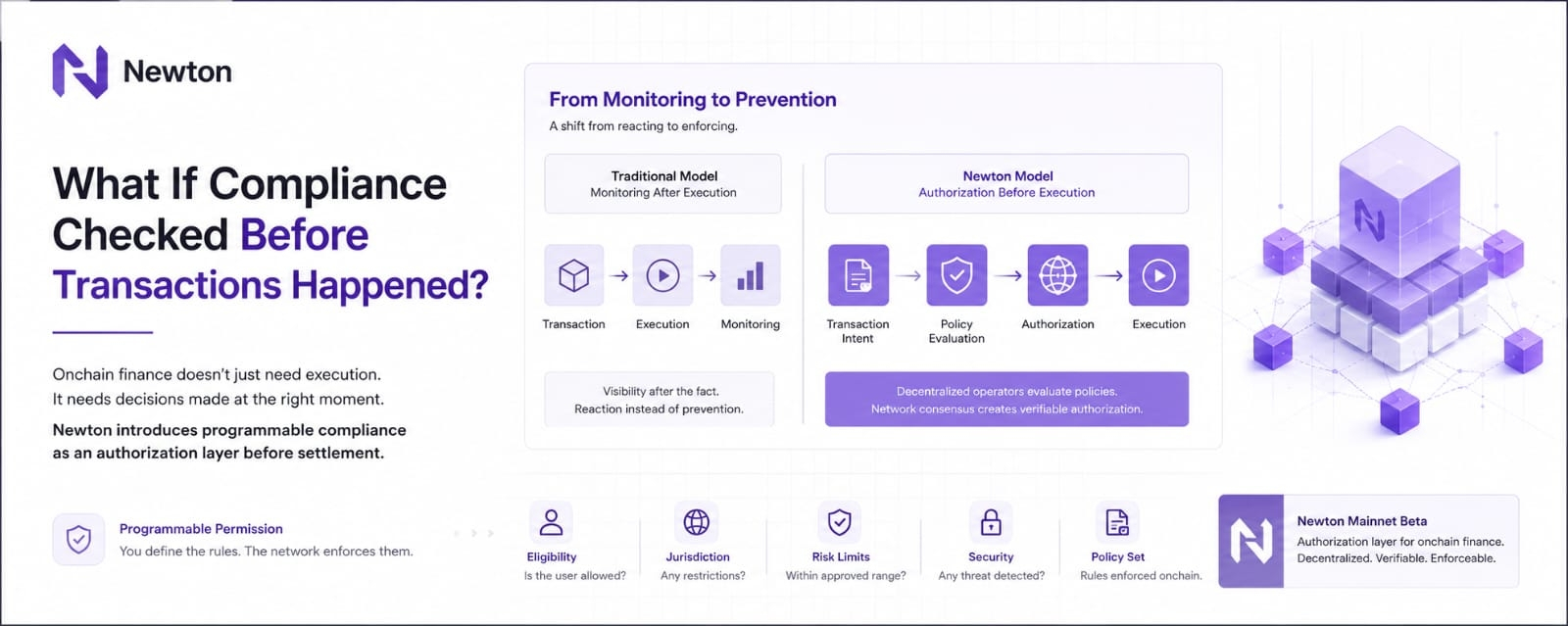

One thing I kept noticing while studying blockchain infrastructure is that many systems are very good at explaining what happened, but much weaker at deciding what should happen before execution.
In traditional finance, compliance is usually a separate process. Teams review documents, check databases, monitor activity, and investigate suspicious behavior. These systems work, but they were designed around a world where institutions controlled the rails.
Onchain finance works differently.
A smart contract does not know whether a user should be allowed to interact with it. It only knows whether the transaction follows the code conditions written inside the contract.
That creates an important gap.
A wallet can pass verification today, but future conditions can change. A jurisdiction can become restricted. A risk parameter can be exceeded. A transaction can interact with a suspicious address. A strategy can move beyond its intended limits.
The question is no longer only:
“Did this transaction follow the smart contract?”
The bigger question becomes:
“Should this transaction have been allowed in the first place?”
This is where programmable compliance becomes interesting.
Instead of treating compliance as a report generated after activity happens, Newton Protocol introduces the idea of making compliance an active authorization layer before settlement.
The process changes from:
Transaction → Execution → Monitoring
to:
Transaction Intent → Policy Evaluation → Authorization → Execution
A transaction request can be evaluated against specific policies before it reaches final execution.
Those policies can include multiple conditions:
Is the user eligible?
Does the transaction meet identity requirements?
Does it violate jurisdiction restrictions?
Does it exceed risk limits?
Are security conditions satisfied?
The important shift is that these rules are no longer just written in documents or stored in dashboards. They become executable logic connected directly with blockchain transactions.
For me, the most interesting part is not simply compliance automation. It is the change in where trust exists.
Today, many blockchain applications depend on external assumptions:
“Someone checked this.”
“A system is monitoring this.”
“A team will react if something goes wrong.”
But reaction is different from prevention.
A decentralized financial system handling larger amounts of value needs more than visibility. It needs a way to enforce decisions before assets move.
Newton’s approach focuses on creating that missing authorization step.
When a transaction requests approval, decentralized operators evaluate the active policy conditions. Instead of one server making the final decision, multiple participants contribute to the authorization process and produce a verifiable result.
This matters because compliance itself becomes a trust problem.
If one centralized service decides whether every transaction is acceptable, the system simply moves the dependency from a bank server to another server.
A decentralized authorization network changes that model by distributing the evaluation process.
Another important technical challenge is external information.
Compliance and risk decisions often depend on data outside the blockchain. Identity status, risk signals, and security information can change over time.
The difficult part is not only receiving this information. The difficult part is making decentralized participants agree on the same decision.
Newton’s architecture focuses on this coordination problem by allowing operators to evaluate policies using shared rules and reach consensus on the authorization outcome.
This creates a bridge between external information and onchain execution.
The implications go beyond compliance.
The same model can apply to DeFi vaults, tokenized assets, stablecoins, and autonomous AI systems.
A vault could enforce its investment rules automatically.
A financial application could require certain eligibility conditions before allowing access.
An AI agent controlling funds could have predefined boundaries around what actions it is permitted to take.
The bigger idea is that future blockchain applications may not only need smart contracts that execute instructions.
They may need authorization systems that understand whether those instructions should be executed.
Blockchain gave us programmable ownership.
Smart contracts gave us programmable agreements.
The next step may be programmable permission.
Newton Mainnet Beta represents this direction by building an authorization layer where policies become part of transaction execution instead of being separate from it.
The question I keep coming back to is:
If blockchain is becoming the foundation for global financial systems, should compliance remain a manual process around the technology — or should it become part of the technology itself?