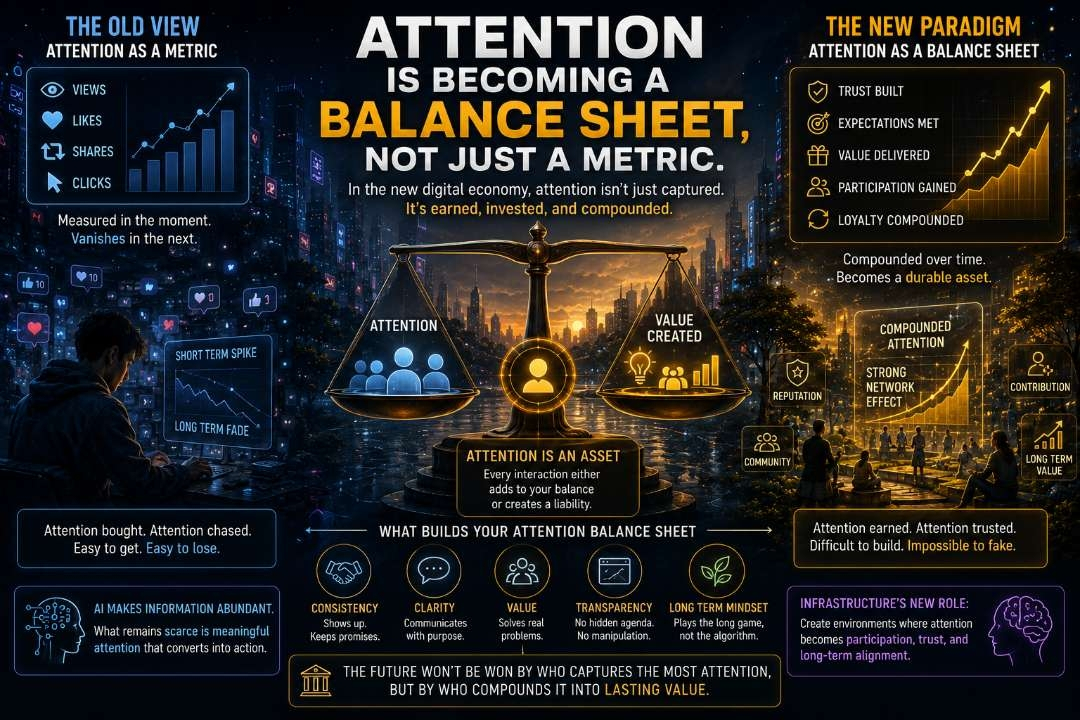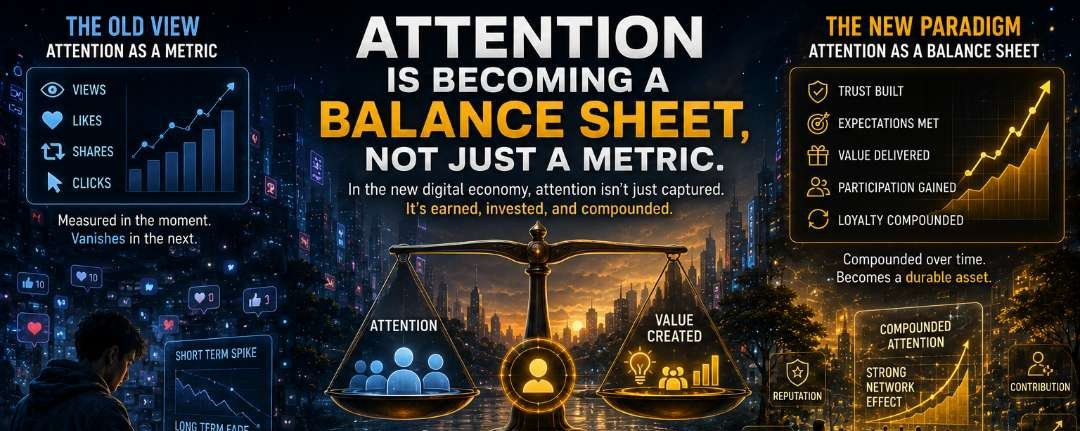
The more I think about it, the stranger the internet starts to look. We still talk about attention as if it's nothing more than clicks, impressions, or engagement. Dashboards reduce it to numbers, advertisers buy it in bulk, creators chase it every day. Yet the longer I watch digital economies evolve, the harder it becomes to believe that attention is merely a metric.
It behaves much more like an asset.
Not an asset in the traditional financial sense, but something that quietly compounds, deteriorates, appreciates, and influences everything built on top of it. That realization kept bothering me because we rarely describe attention using economic language, even though it already behaves like capital.
At first I assumed information was the scarce resource online. That made sense when search engines were the gateway to knowledge. Today AI can summarize almost any topic, generate endless content, and answer questions in seconds. Information has become abundant enough that producing more of it doesn't necessarily create more value.
What remains scarce is sustained attention.
But even that feels incomplete.
Two projects can receive the same amount of attention and experience completely different outcomes. One converts curiosity into lasting participation. The other disappears as quickly as it arrived. The difference isn't the quantity of attention. It's the quality of what that attention becomes after it arrives.
That's where my perspective shifted.
Maybe attention isn't valuable because people look at something.
Maybe it's valuable because it changes future behavior.
Viewed that way, attention starts resembling a balance sheet rather than a marketing statistic. Every interaction either strengthens or weakens an ecosystem's long-term position. Every expectation fulfilled quietly adds an invisible asset. Every disappointment creates an equally invisible liability. None of those entries appear on-chain, yet they influence future participation just as much as liquidity or capital allocation.
That feels like an unusual way to think about markets, but it explains something I've struggled to understand for a while.
Some ecosystems seem to recover from setbacks remarkably quickly. Others never regain momentum despite improving technically. Perhaps they're not rebuilding infrastructure. They're rebuilding accumulated attention that was converted into doubt instead of confidence.
Once I started thinking that way, projects like Newton Protocol looked different to me. I stopped seeing another protocol competing for market share and started seeing evidence of a broader transition. As AI agents, institutions, creators, and individuals increasingly operate inside the same digital economy, infrastructure isn't simply supporting transactions anymore. It's supporting environments where attention can evolve into durable participation rather than short-lived visibility. That's a subtle shift, but it changes the role infrastructure plays inside the economy. It becomes less about moving value efficiently and more about preserving the conditions that allow value to keep circulating.
The interesting part is that balance sheets aren't built overnight.
Neither is meaningful attention.
Both accumulate slowly through repeated interactions that reinforce expectations instead of constantly resetting them. Markets often celebrate explosive growth, but sustainable economies rarely emerge from isolated moments of excitement. They emerge from thousands of small interactions that gradually convince participants to return again without being persuaded from scratch every time.
AI makes this even more interesting.
As machines generate more content than humans could ever consume, raw visibility becomes cheaper. When everyone can produce attention-grabbing material, attention itself loses some of its signaling power. What begins to matter instead is whether that attention consistently transforms into understanding, participation, contribution, and long-term alignment.
That's a different economy entirely.
Perhaps the next competitive advantage won't belong to whoever captures the most attention.
It may belong to whoever compounds it most responsibly.
The more I follow that thought, the less I believe future digital economies will be evaluated only by transaction volume, user counts, or token activity. Those numbers describe movement, but they don't always describe resilience.
Maybe resilience is hidden somewhere else.
Maybe it's quietly recorded inside the invisible balance sheet every ecosystem builds through the quality of the attention it earns.
If that's true, then attention was never just another metric waiting to be optimized. It has been an economic asset all along, one whose real value only becomes visible after enough time has passed for today's interactions to shape tomorrow's decisions. And perhaps that's the balance sheet future infrastructure will ultimately be measured against.