
i have a habit when i see technical terminology i don't fully understand — i don't move on until i find the analogy that makes it click. jargon is usually just a familiar concept wearing unfamiliar clothes
zkPermissions showed up in everything i read about Newton Protocol. zero-knowledge circuits, programmable constraints, scoped delegation. okay. but what is it actually
i went looking for the plain language version and found it in Newton's own documentation. one sentence that reframed everything
"through zkPermissions, users define what agents can and cannot do — similar to how OAuth controls access in traditional web applications"
OAuth. that's the one 👀
if you've ever clicked "sign in with Google" you already understand the problem zkPermissions is solving
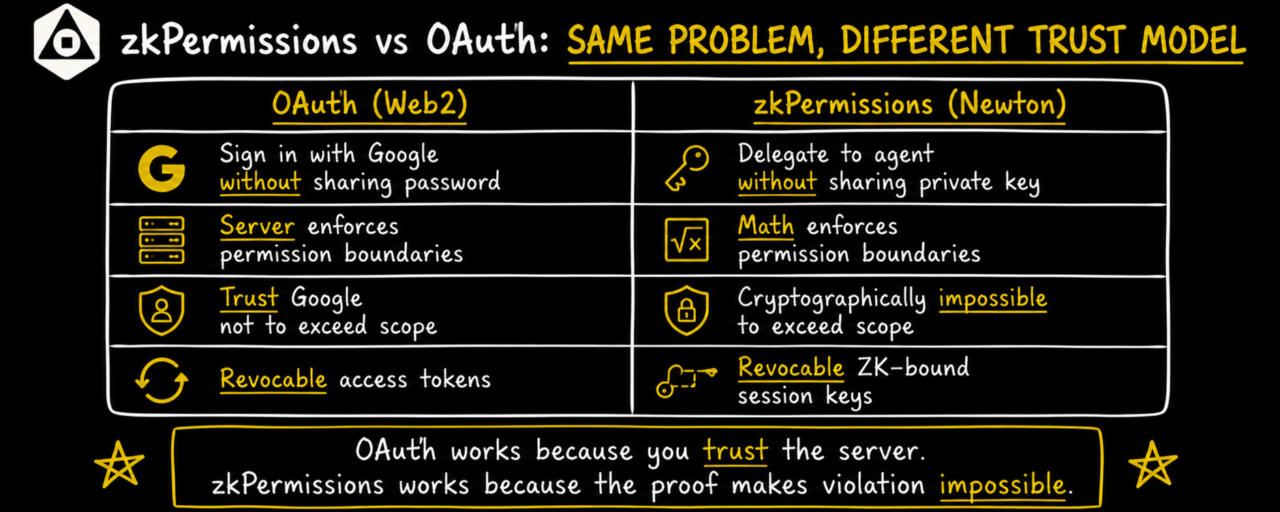
OAuth is the web standard that lets you give an app access to your Google account without giving it your password. instead of handing over your credentials, you grant a scoped permission — this app can read your email but not send it, can see your calendar but not delete it. the permission is specific, limited, and revocable
before OAuth existed, the alternative was giving every app your actual password and trusting them not to misuse it. which is insane in retrospect. but that's exactly where crypto is right now with automated agents
if you want an AI agent to manage your DeFi positions, the current alternative in most systems is giving it your private key. which is the equivalent of giving an app your Google password and hoping for the best
zkPermissions is Newton's answer to that problem. instead of giving an agent your private key, you issue a permission — this agent can execute trades but only when volatility is below X, can rebalance but only up to Y% of the portfolio, can interact with these protocols but not those ones. the permission is cryptographically enforced, not just trusted
where zkPermissions goes beyond what OAuth ever could
here's the part that actually surprised me when i dug deeper
OAuth works because you trust Google to enforce the permission boundaries. the app doesn't get access beyond what Google's server allows. that trust in the central authority is what makes OAuth work — and it's also its fundamental weakness. if Google's OAuth server has a bug, or gets compromised, or changes its policy, the permissions stop meaning what you thought they meant
zkPermissions doesn't work through a trusted server. it works through zero-knowledge circuits — cryptographic constraints that are mathematically enforced rather than policy enforced
the difference: with OAuth, the boundary is "the server won't let the app exceed this scope." with zkPermissions, the boundary is "it is cryptographically impossible for the agent to exceed this scope"
not "we trust Newton not to let the agent do something outside its permission." not possible at all given the math
that's a fundamentally different trust model. the constraint doesn't live in a server policy. it lives in the proof itself 🧐
the specific conditions zkPermissions can encode
from Newton's documentation, zkPermissions support:
data-driven execution conditions — "only act when this price feed shows X"
risk sensitivity checks — "stop if volatility exceeds Y"
transaction volume limits — "never move more than Z in a single transaction"
timing restrictions — "only execute between these hours"
protocol restrictions — "interact with these contracts, not those"
and critically, every session key — the thing that actually lets an agent act on your behalf — is bound to a zkPermission. not referenced by a permission. bound. the session key literally cannot be used outside the constraints the zkPermission encodes
the gap worth knowing about
here's the honest version of where things stand
the full zkPermissions rollup — the multichain version that makes these permissions work cost-efficiently across different networks — is listed as upcoming, not live
what exists today is a working implementation using session keys and ERC-4337 smart account standards. the zkPermissions work. but the dedicated rollup that makes them cheap enough to use for high-frequency automation across multiple chains is still on the roadmap
Newton's docs say this explicitly: "launching a zkPermissions rollup that enables cost-efficient, multichain-compatible zero-knowledge permissions" is a forthcoming milestone
so the technical capability is real. the production-grade version that makes it economically viable at scale is what the rollup enables
why the OAuth analogy matters beyond the technical explanation
the reason this analogy stuck with me isn't just that it's a good explanation. it's what it implies about who Newton is actually building for
OAuth didn't become ubiquitous because developers chose it as the most elegant solution. it became ubiquitous because users demanded it — because "sign in with Google" was obviously safer than handing every app a password
if zkPermissions becomes the standard way of delegating to onchain agents, it won't be because the ZK cryptography is impressive. it'll be because users eventually realize that giving an agent a scoped permission is obviously safer than giving it a private key
the adoption path for zkPermissions probably looks a lot like the adoption path for OAuth. slow, then sudden, driven by a security incident that makes the alternative feel obviously wrong
Newton is building the infrastructure for that moment. whether the moment comes before or after the runway runs out is the question nobody can answer from a whitepaper 🙏