

What struck me about Newton Protocol wasn't the idea of autonomous AI agents. It was the quieter realization that the protocol may ultimately create a market where policies compete more intensely than the agents themselves. My thesis is that Newton's architecture shifts competition away from intelligence and toward authorization quality, bEcause every action must sUrvive deterministic policy evaluation before it can influence capital.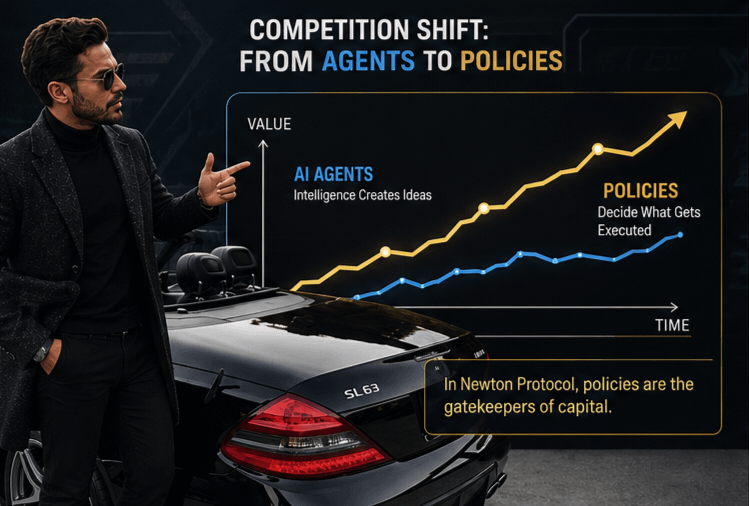
Most discussions naturally focus on building smarter agents. That sounds intuitive. If AI becomes more capable, better decisions should follow. Yet Newton inserts a programmable pOlicy layer between intention and execution. The interesting part isn't that an agent can generate an opportunity. It is that the opportunity has no economic value unless it satisfies an independently evaluated policy. Intelligence becomes necessary, but no longer sufficient.
That changes incentives in a way I hadn't expected.
Normally, AI developers compete by improving prediction quality, execution speed, or strategy design. Newton introduces another competitive arena. Policies themselves become assets that determine which behaviors are allowed to reach the blockChain. A conservative policy may reject profitable opportunities but reduce catastrophic mistakes. A permissive policy may increase returns while exposing users to greater downside. The protocol doesn't declare either approaCh superior. It simply evaluates whichever rules the user chooses with deterministic consistency.
That distinction matters because deterministic evaluation guarantees something narrower than many people assume.
The protocol is designed so identical policies and identical inputs produce identical authorizAtion results across operators. That strengthens auditability and predictability. It does not prove the policy represents the user's best interests, nor does it guarantee that external information remains accurate while the decision is being evaluated. The strongest cryptographic guarantee applies to consistent rule execution. Judgment still lives in policy deSign and trusted data sources.
Once I looked at it this way, I started thinking less about AI capability and more about policy economics.
If developers discover that certain policy templates consistently balance safety and opportunity better than others, those policies could become valuable intellectual property. Users might compare authorization logic before comparing AI models. Reputation could gradually shift from "Which agent performs best?" to "Whose policy framework survives real market stress?" That creates an entirely different competitive landscape from today's AI narrative.
There is an interesting tradeoff hidden inside that possibility.
Giving users highly customizable policies increases individual control, but it also transfers responsibility. Poorly designed rules may reject good opportunities, permit avoidable losses, or create operational friction. Better infrastructure cannot eliminate the consequences of weak governance decisions. It simply makes those decisions execute more consistently.
This feels especially relevant as autonomous financial systems mature.
The industry often assumes smarter AI naturally produces safer automation. Newton suggests another possibility. As AI improves, the bottleneck may gradually shift from generating decisions to defining acceptable decisions. Intelligence scales rapidly, but authorization quality may become the scarcer resource.
I'm not completely sure where that balance settles.
Developers may continue competing primarily through model quality, or policy design may become the lasting source of differentiation. It depends on whether users ultimately trust autonomous judgment or programmable constraintS more.
If that shift happens, Newton Protocol may be remembered less for enabling AI agents and more for turning policy design into a competitive economic layer.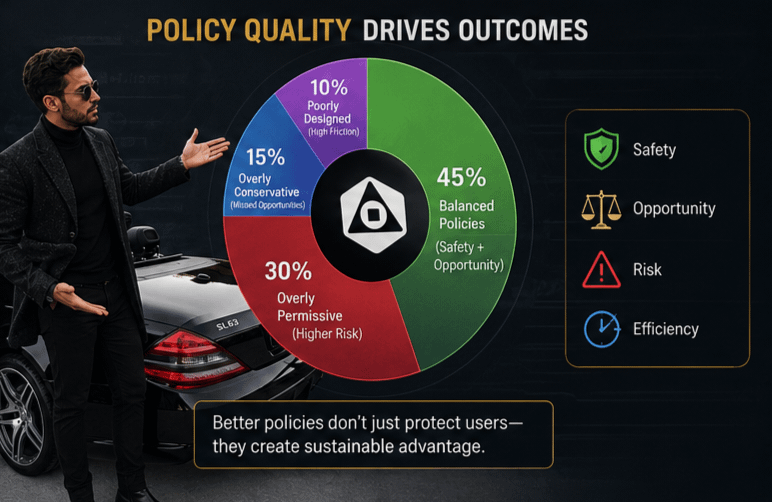 The next market may not reward the system that thinks the fastest, it may reward the system that defines acceptable thinking most precisely.
@NewtonProtocol $NEWT #Newt