

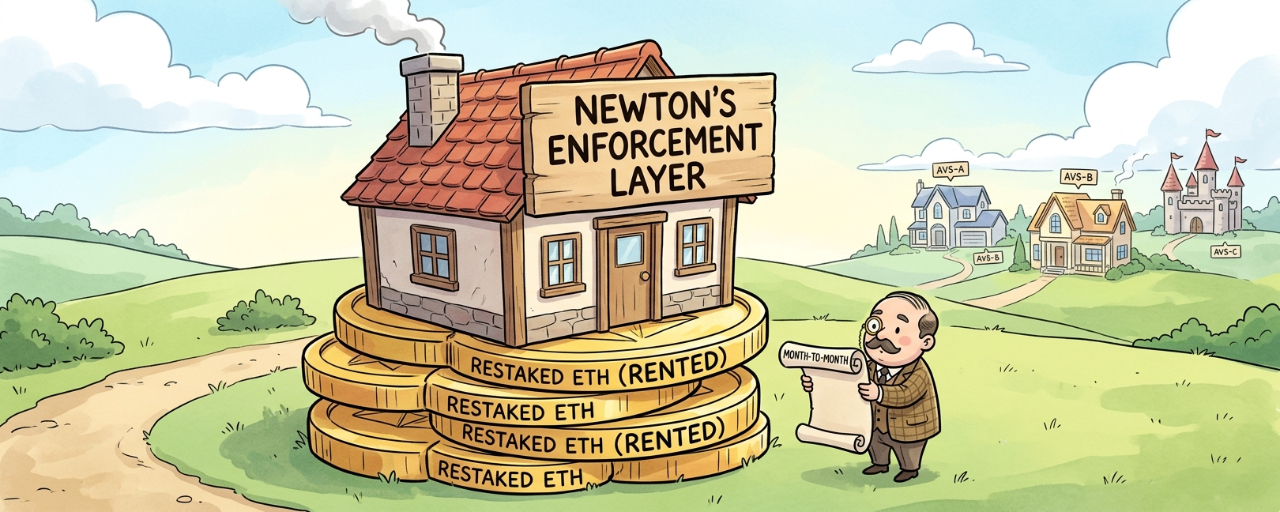

Spent the morning half-watching a stream about ETH restaking yields — one of those "3 to 6% extra yield, minimal effort" pitches — and honestly wasn't planning to connect it to anything. Then later I opened up Newton Protocol's docs again, out of curiosity more than anything, because the "autonomous internet" framing kept showing up in my feed and I wanted to see what was actually under it.
And that restaking video kind of followed me into it, which is annoying because now I can't unsee the overlap.
Newton's whole pitch is that it's building the trust layer for an internet where agents and vaults transact on their own, policies enforced automatically, no humans babysitting every transaction. Sounds autonomous. Sounds self-contained. So I went looking for what actually secures that enforcement layer, expecting some native mechanism specific to Newton.
It's not native. The operator network that evaluates policies and signs off on transactions is secured through EigenLayer restaking. Meaning the actual economic weight behind "this transaction was checked correctly" isn't coming from NEWT holders or Newton-specific stakers — it's coming from restaked ETH, delegated by people who are, at the end of the day, chasing yield across dozens of AVSs at once.
I thought that was just a technical footnote at first. Like, fine, it's built on EigenLayer, lots of things are, restaking is the whole "reuse Ethereum's security" model, that's kind of the point.
But here's the part that actually bothers me once I sat with it. Restaked ETH doesn't belong to Newton. It's rented. Restakers choose which operators to delegate to and which AVSs to support, and that decision is driven by where the yield and the risk-adjusted returns look best — not by loyalty to any one authorization layer. EigenLayer alone is sitting on something like 94% of restaking market share right now, so there's also just... concentration risk sitting underneath everything built on top of it. If restaker interest rotates toward whatever AVS is paying better that quarter, or if a slashing event anywhere in the restaking stack spooks capital, the security backing Newton's enforcement isn't something Newton controls. It's downstream of decisions being made by people who've never heard of Newton and don't need to care about it.
So the "autonomous internet" bit stops feeling quite right to me. An autonomous system, in my head, is one that doesn't depend on an external, mood-dependent capital allocation decision to keep functioning. What Newton's actually built is a policy enforcement layer whose trust is borrowed, week to week, from a restaking market that's still mostly running on incentives and points rather than durable AVS revenue — at least based on what I'm reading about the sector broadly. That's not nothing, but it's also not "autonomous," it's more like autonomous-if-the-landlord-keeps-renewing-the-lease.
I keep going back and forth on whether this is actually a real risk or just me being paranoid about a security model that, in fairness, has held up fine so far — EigenLayer's base contracts reportedly stayed intact even during stress events elsewhere in the restaking stack. Maybe borrowed security that's survived real stress is just... good infrastructure design, and I'm overthinking the "autonomous" word because marketing language is always a little aspirational.
Where I think this actually matters is for anyone treating a Newton-secured vault or agent as fully self-sufficient risk-wise. The policy logic might be airtight, the curator might be reasonable, but the enforcement guarantee underneath all of it is only as stable as restaker incentives happen to be that month, and that's a layer most people aren't even checking.
Anyway. Going back to actually looking at the charts now, which are somehow more boring than this was.