
What struck me wasn’t Newton Protocol’s ability to place programmable rules around autonomous financial activity. It was the hidden authority required to replace those rules when reality changes faster than governance. My thesis is that Newton’s real constitutional problem begins not when an AI breaks policy, but when an obsolete policy continues to be enforced perfectly.
Newton operates as a decentralized policy engine for transaction authorization. 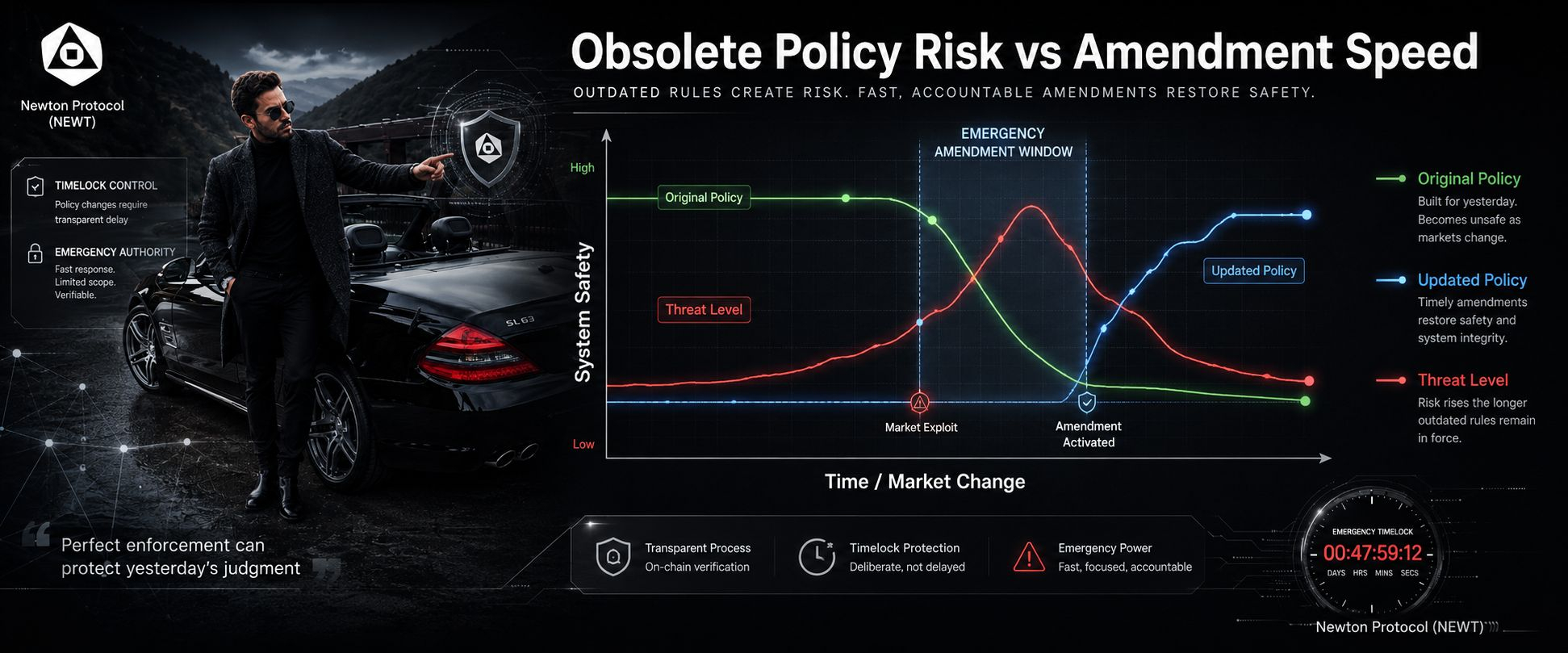
Applications can express conditions in Rego, operators evaluate them, and connected contracts verify the resulting authorization before execution. In Newton Shield, an attestation is bound to the policy ID currently attached to a vault, remains valid only for a configured block window, and fails closed when required checks do not pass. Those details turn policy from advice into an executable boundary.
The obvious interpretation is that this preserves user control. Yet control is not only the ability to write the first rule. It is the ability to decide when that rule no longer represents the owner’s intent.
Imagine a vault policy allowing an AI strategy to allocate funds only to approved markets, below a concentration ceiling, and while external risk signals remain acceptable. Then one approved market is exploited. The strategy may obey every written limit, operators may evaluate the policy correctly, and the contract may verify a valid attestation. The authorization chain could work exactly as designed while protecting yesterday’s judgment against today’s evidence.
This is where policy replacement becomes an incentive problem. Whoever can change the bound policy can redirect future machine behaviour without directly moving the assets. That actor possesses a quieter form of control than custody: the ability to redefine which actions count as legitimate.
Fast amendment power reduces exposure to new threats. It also allows an administrator, compromised owner key, or pressured governance group to change rules immediately before a valuable transaction. A delay makes amendments easier to observe, but may force the system to follow a dangerous policy during the waiting period. Newton Shield illustrates the tension: normal failures close execution, while its emergency bypass is owner-queued and must wait for a configured timelock.
At first, that bypass looks like an operational detail. I think it is closer to a constitutional emergency clause. It defines who may step outside ordinary authorization, under what delay, and with what visible evidence. The party controlling this route does not merely maintain the system; it decides when normal law can be suspended.
The incentives are uneven. Asset owners benefit from rapid escape when a strategy becomes unsafe. Depositors benefit from visible delays preventing silent rule changes. Operators benefit from evaluating one clearly bound policy rather than interpreting competing versions. Developers carry the harder burden: designing upgrades that remain responsive without becoming privileged backdoors.
This distinction matters for adoption. A policy engine can prove that execution matched a rule, but institutions will also need to know who selected that rule, when it became active, what replaced it, and whether pending authorizations survived the change. Capability answers whether Newton can enforce policy. Adoption depends on whether users can reconstruct the authority behind each decision.
I found broad campaign discussion describing Newton as a “constitution” for AI, but that metaphor often stops at rule enforcement. The harder market question is amendment legitimacy. As autonomous strategies gain wider discretion, policy-version history may become as important as transaction history because a valid action can only be interpreted against the constitution active at that moment.
I’m not completely sure where the correct balance sits. Immediate amendments can concentrate power; delayed amendments can preserve known danger. Wider approval may improve legitimacy while making emergency coordination slower.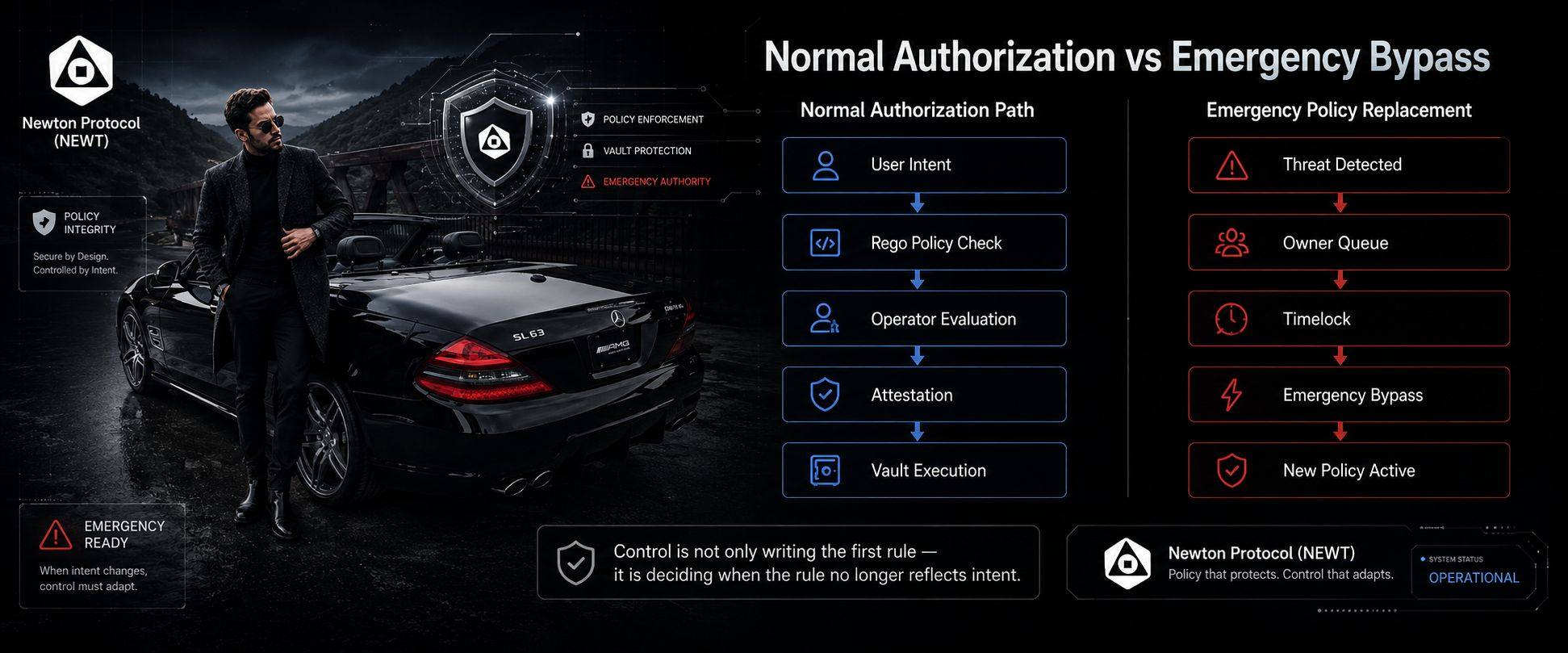
If this holds, AI finance will not be secured merely by teaching machines to obey. It will require systems that make changes in human intent visible, attributable, and difficult to exploit.
The deepest control over an autonomous system belongs not to whoever executes its rules, but to whoever can rewrite them.
@NewtonProtocol $NEWT #Newt