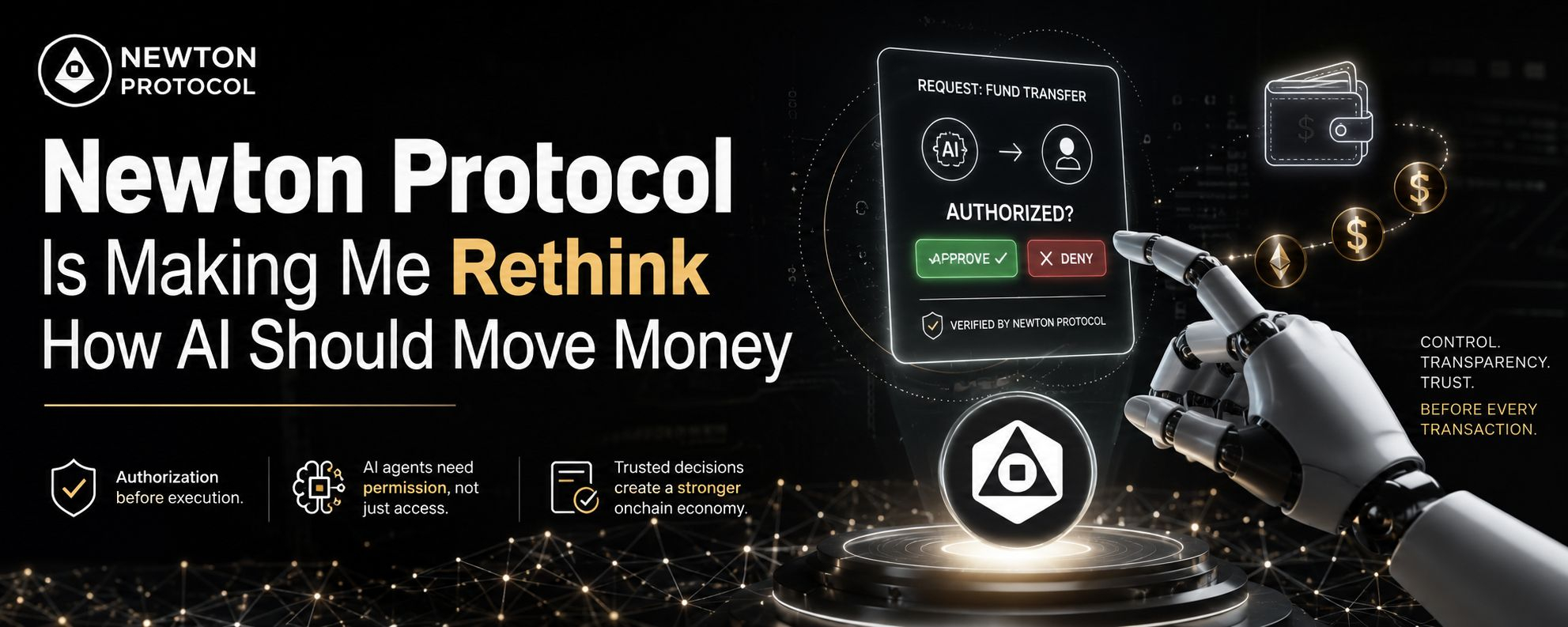
The more time I spend inside Newton Protocol, the less I think about transactions and the more I think about permission. That shift did not happen because I read another technical document. It happened because I kept noticing the same operational question appearing in different forms. If autonomous agents are expected to make financial decisions, where does hesitation actually live? Newton keeps pushing that hesitation into its authorization layer, and once I started looking there instead of at execution, my attention stayed there.
Most blockchain systems are comfortable proving that something happened. Newton seems more interested in proving that something deserved to happen before it ever reaches execution. At first that sounded like another security improvement. Now I suspect it changes something much larger about how automated systems behave when they are allowed to act repeatedly instead of occasionally.
The economy of autonomous decisions is probably an economy of rejected decisions first.
That sounds pessimistic until you imagine a practical workflow. Suppose an AI agent wants to rebalance treasury assets every few minutes according to predefined policies. The difficult part is not moving the funds. Blockchains already know how to do that. The difficult part is deciding whether today's request still satisfies yesterday's authorization. If wallet permissions changed, if spending limits were reduced, or if a compliance rule was updated only moments ago, blindly executing yesterday's assumptions becomes a hidden failure mode.
Newton's authorization model absorbs that uncertainty before execution begins. Mechanically, that means an agent can receive an authorization response that forces it to stop before creating an irreversible transaction. The operational consequence is subtle. Instead of debugging failed settlements afterward, developers spend more time designing better decision policies beforehand. The friction moves upstream. It does not disappear.
That sounds attractive, although I keep wondering what happens when authorization itself becomes the busiest part of the system.
Imagine hundreds of agents requesting approval for nearly identical actions within the same period. Even if authorization remains technically correct, the queue itself becomes part of the user experience. A delayed approval is different from a rejected approval, yet both interrupt automation. One creates uncertainty. The other creates certainty that nothing will happen. Those are completely different operational outcomes even though neither produces an onchain transaction.
This is where my confidence becomes less certain.
Adding an authorization layer reduces careless execution, but it also introduces another surface where delay accumulates. Every extra validation step lowers one category of risk while increasing another. The obvious gain is fewer unauthorized actions reaching execution. The quieter cost is that developers now need workflows for expired permissions, repeated requests, and agents that must gracefully handle "not yet" instead of simply "yes" or "no." Retry logic becomes part of product design rather than an implementation detail.
I would actually like to watch this under sustained production pressure rather than ideal conditions. Does a cautious authorization policy create healthier automation, or does it slowly teach developers to ask for broader permissions simply to avoid repeated interruptions? I honestly do not know. Both outcomes seem plausible.
Another mechanical example keeps coming back to me.
Suppose an organization authorizes an agent to spend within a daily budget of 5,000 USDC rather than granting unrestricted wallet control. The limit itself is simple. What changes operationally is what happens after the limit is reached. The agent cannot quietly exceed policy because execution is no longer the first checkpoint. Someone has to approve another authorization, reduce spending, or redesign the workflow. A single parameter quietly changes organizational behavior. Teams begin discussing authorization windows instead of recovery plans after mistakes.
That feels healthier.
It also feels slower.
Perhaps that is the tradeoff we have been avoiding for years by pretending automation and unlimited autonomy were the same thing.
I also keep testing another thought whenever I read Newton's documentation. If authorization decisions become reusable instead of recreated every time, do experienced participants gradually move faster while newcomers experience more friction? That would not necessarily be unfair, but it would mean efficiency starts accumulating around verified history instead of technical skill alone. I cannot tell yet whether that becomes a feature or an invisible barrier.
Only after thinking through those workflows does the role of NEWT start making sense to me. The token feels less like a speculative object and more like infrastructure supporting the authorization economy that Newton is trying to build. If decision policies, validation mechanisms, and network participation become persistent parts of daily operations, there has to be a way to coordinate incentives around that layer. Mentioning the token before reaching this point would have felt premature because the operational model is the argument.
Maybe the interesting question is no longer whether autonomous agents will control capital. That assumption increasingly feels accepted.
The harder question is whether future systems will measure intelligence by how many actions an agent completes, or by how many unnecessary actions it quietly refuses to perform.
I keep thinking the second metric might matter more, although I am not yet convinced we know how to build around it. That uncertainty is probably the most interesting part.