
I used to believe the future of AI in crypto was all about giving agents more autonomy.
Faster trading.
Smarter strategies.
Less human involvement.
The more I explored @NewtonProtocol and its Mainnet Beta, the more I realized I had been looking at the problem from the wrong angle.
The real challenge isn't making AI agents more powerful.
It's deciding what they should be allowed to do before they ever touch an on-chain transaction.
That simple idea completely changed how I think about trust.
Today, we often judge an AI agent by its performance. If it makes good decisions, we trust it more. If it makes bad ones, we reduce its authority.
But Newton introduces a different perspective.
Instead of asking whether an agent is trustworthy, the protocol asks whether the authorization behind that action is trustworthy.
That difference might sound small, but I think it's huge.
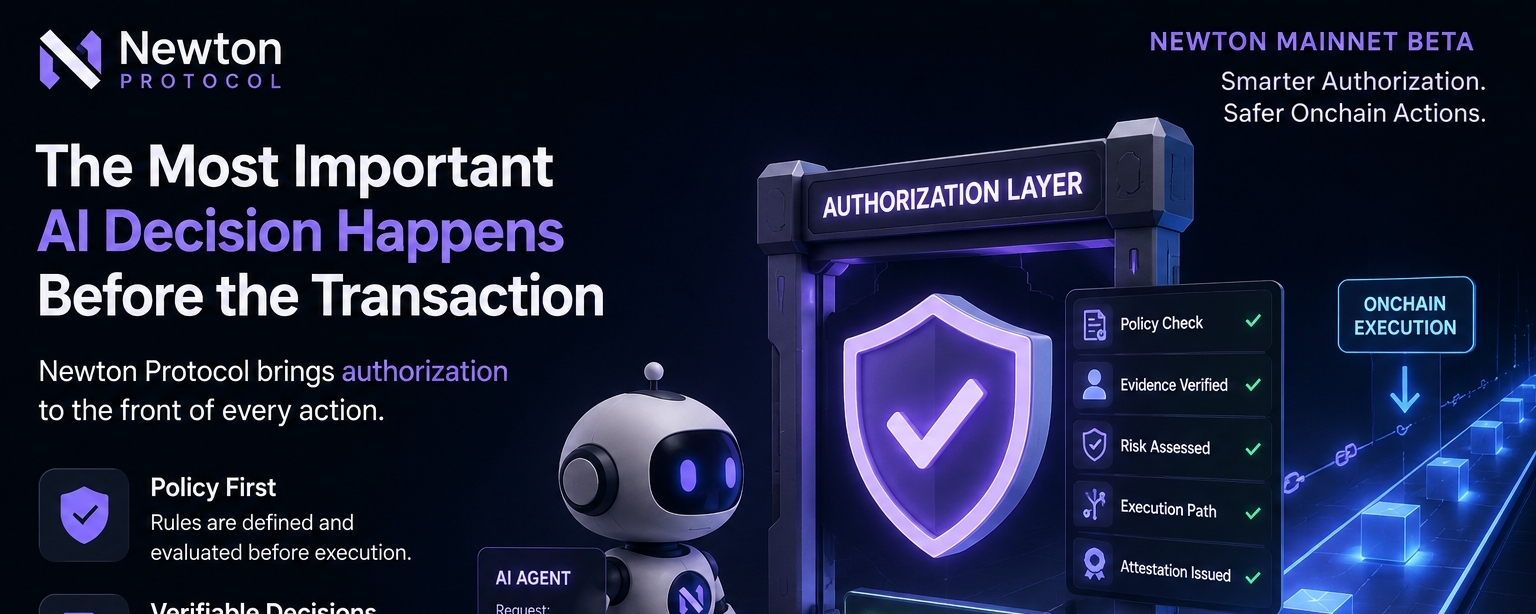
Newton Mainnet Beta brings authorization to the front of the decision-making process. Before an action is executed, policies can evaluate whether it follows predefined rules, whether the required evidence exists, and whether the transaction should be approved.
To me, that's a much stronger foundation than simply hoping an intelligent agent always behaves correctly.
Something else caught my attention while thinking about this model.
I used to assume that if one AI agent could control more capital than another, it simply meant people trusted it more.
Now I think the opposite could be true.
Greater authority may actually reflect stronger safeguards.
Maybe the policies protecting that agent are more detailed.
Maybe the credentials have been verified more carefully.
Maybe the allowed actions are much narrower than they appear.
Or maybe the entire authorization process has already been tested many times before.
In other words, permission itself starts carrying information.
That's fascinating because it shifts trust away from personality and toward process.
Instead of saying, "I trust this AI," we begin saying, "I trust the system that evaluated this decision."
I believe that distinction will become increasingly important as AI starts managing larger amounts of value across decentralized finance.
Of course, I don't think policies alone solve everything.
Even the best framework can fail if the rules behind it are poorly designed.
A perfectly enforced bad policy is still a bad policy.
That's why I don't see authorization as a replacement for trust.
I see it as something that makes trust measurable.
When every important decision can be explained, verified, and reviewed later, confidence no longer depends only on reputation.
It depends on evidence.
That feels like a healthier direction for Web3.
Another reason I find Newton interesting is that it encourages developers to think beyond execution.
For years, blockchain innovation has focused on making transactions cheaper, faster, and more scalable.
Those improvements matter.
But if autonomous AI becomes a normal part of on-chain infrastructure, authorization may become just as important as execution itself.
After all, speed is valuable only when the right actions are being executed.
As more AI agents begin interacting with tokenized assets, automated vaults, and complex DeFi strategies, the ability to define clear boundaries could become one of the most valuable pieces of infrastructure.
That's why Newton Mainnet Beta stands out to me.
It isn't simply asking how AI can do more.
It's asking how AI can do more responsibly.
And I think that's the conversation the industry needs right now.
The future won't belong to the AI agents with the biggest permissions.
It will belong to the systems that can clearly explain why those permissions were granted in the first place.
For me, that's what makes @NewtonProtocol worth watching. #newt #Newt $NEWT
