
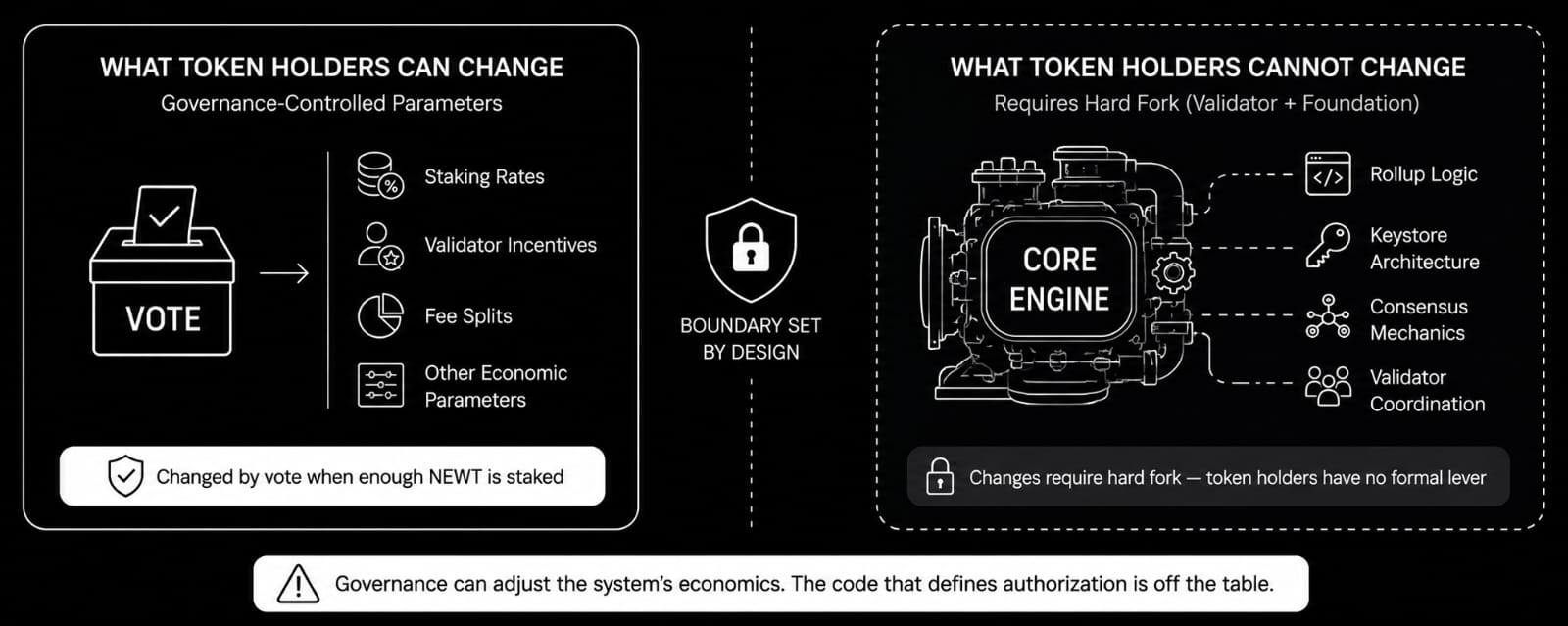
I kept re-reading the same paragraph in Newton's disclosure, waiting for it to say something different the second time. It didn't. The Protocol has two upgrade tracks, and only one of them belongs to the people holding the token.
Governance-controlled parameters staking rates, validator incentives, fee splits can be changed through a vote once enough NEWT is staked. Everything else-rollup logic, Keystore architecture, consensus mechanics, validator coordination sits outside governance entirely. Those changes require a hard fork, the same blunt instrument Ethereum reaches for when its base layer needs to move.
On paper this reads as prudence. You don't want a token vote quietly rewriting how permissions get verified. But sit with it a moment longer and the split starts to look less like protection and more like a boundary drawn before anyone was in the room to argue about where it should sit. The Foundation decided, in advance, which parts of the system the community gets to touch and which parts it doesn't. That's not unusual in crypto most projects do some version of this-but Newton's core function is authorization. The parts locked behind a hard fork are the parts that actually decide what "authorized" means at the code level.
There's a practical argument for the design. Keystore architecture and consensus logic are the kind of thing where a rushed governance vote could break finality for everyone mid-transaction. Requiring validator coordination for those changes is slower, but slower is often what you want near the parts of a system that can't be rolled back cleanly. I don't think this is careless engineering. I think it's a bet that most users will never test the boundary, because most users never propose changing consensus mechanics.
The honest risk sits in what happens when someone does. If validators and the Foundation disagree about a hard fork over a security patch, a fee model, or a jurisdictional demand token holders have no formal lever to break the tie. Governance can express frustration. It cannot force the outcome. That's a real gap between the appearance of decentralization and the mechanics of who actually holds the pen.
I don't have a clean resolution for this, and I'm slightly bothered that I don't. The design might be exactly right for a system this young. It might also be the thing that quietly decides who Newton answers to, years from now, after the vote has already happened somewhere else.
@NewtonProtocol #Newt $NEWT $LAB $T
