

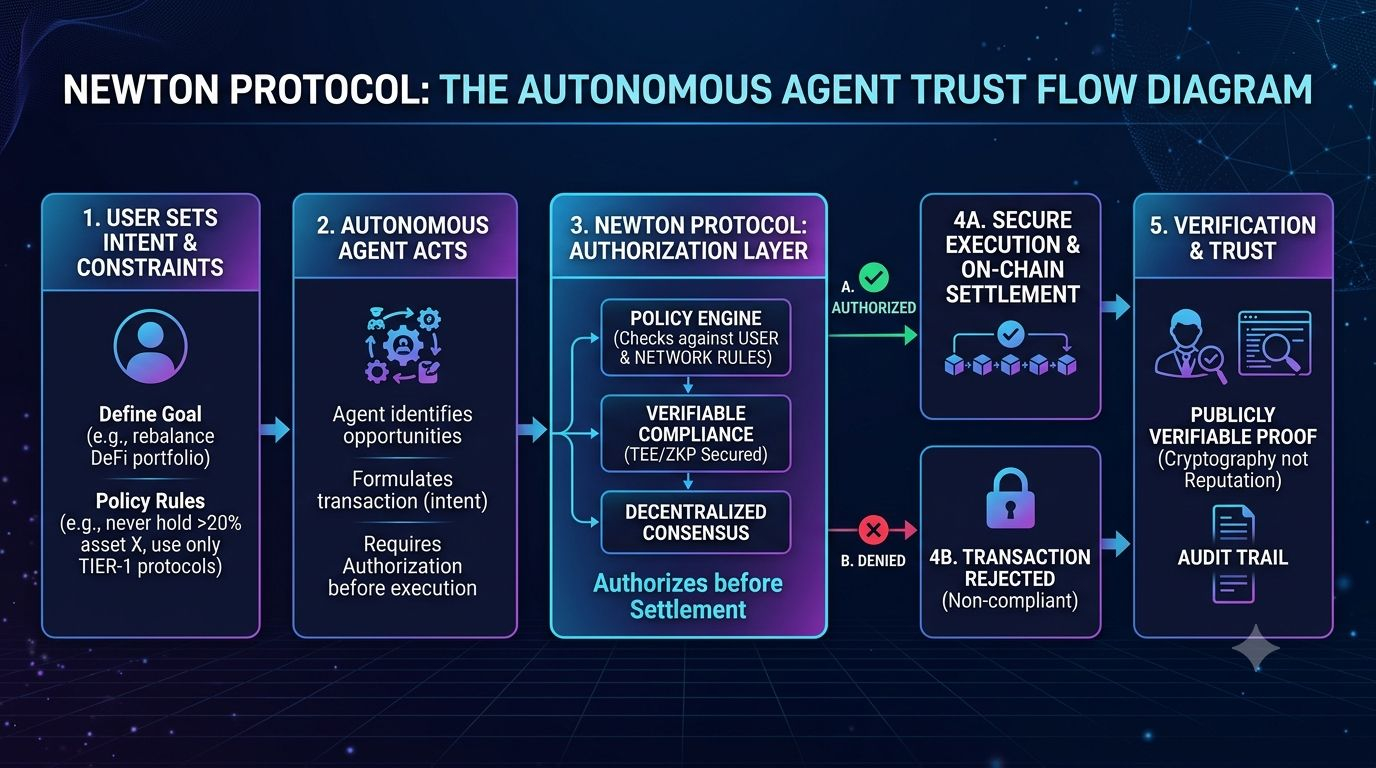
Crypto spent a decade solving trustless money. That part's basically done. Now it's stuck on something harder: trustless action. Sending a token from one wallet to another? Easy. Took years to build, sure, but the concept is simple. Letting something else act for you — a script, a model, an agent, whatever you want to call it — is a different animal. You're handing off control while you sleep. And you need that to be actually safe, not just probably safe. That's the gap Newton Protocol is trying to close. Before I get excited or skeptical about it, I want to sit with why that gap is so hard to close in the first place.
Newton comes out of Magic Labs — the same team behind Magic's wallet tech — with a nonprofit foundation set up to handle the long game of decentralizing it. The pitch: a rollup built specifically for AI-driven automation. Not a general chain with some AI apps bolted on after the fact, which is basically what half of this cycle's "AI plus crypto" narrative amounts to. This is infrastructure shaped around one hard question — how do you let an agent spend your money, under your rules, without just handing it your private key and crossing your fingers. There's something almost old-fashioned about that. And I mean that as a compliment. It's not chasing a vibe. It's trying to fix a real gap that everyone building agentic finance keeps quietly stepping around.
So let's actually get into the architecture, because the mechanics matter more than the marketing copy around them. The system leans on a few pieces stacked on top of each other. First, there's the Keystore rollup, where user permissions actually live. Not a single yes-or-no approval — granular rules. Only trade if volatility crosses some line. Rebalance when an indicator drops below a threshold. Cap spending inside a rolling window. Kill access the second some condition trips. They call this zkPermissions. The idea is these permission states update cheap and verify cheap, and eventually they travel across chains instead of being stuck on one rollup.
Second: the Model Registry. An onchain marketplace, basically. Developers publish agent models — packaged trigger-action logic, essentially contracts encoding a strategy — and other users or protocols can grab them, activate them, mix and match, instead of building from zero every time. This is the "marketplace for AI developers" line you see plastered across every exchange write-up about the token. It's a reasonable bet. Most platforms that actually took off in crypto needed a permissionless publishing layer to get real variety, instead of everything coming from one core team. Does it pull in a critical mass of serious builders, or does it end up as a graveyard of copy-paste clones fighting over the same yield? Nobody knows yet. Roadmap slides don't answer that question.
Third — and this is the part that actually grabs me, and also the part I'm least willing to just take on faith — is the combo of trusted execution environments and zero-knowledge proofs. The TEE handles the offchain compute: the expensive, messy work of running a model against live market data. The ZK layer is supposed to let anyone check, after the fact, that the computation ran straight, no cheating, without trusting the operator's word and without redoing the whole thing yourself. On paper, that's elegant. You get the flexibility of offchain compute — something onchain execution alone could never touch at scale — plus a cryptographic receipt proving nobody fudged it.
But look. TEEs have a rough track record. Side-channel attacks. Hardware vulnerabilities. The occasional break that makes the word "trusted" feel more like a wish than a fact. So when the project markets itself as the "locks" for crypto's "glass house" — crypto built the glass house, Newton builds the locks, that's the actual tagline — I get it. Good metaphor. But a metaphor isn't a security audit. I want a much longer track record before I'll call this trust problem solved instead of just repackaged in fancier language. Real money, real attackers, real time. That's the only test that counts.
There's a compliance angle here too, and honestly it caught me off guard — it seems to be where a lot of the current momentum actually sits, more than the AI trading pitch that got the project noticed in the first place. Compliance-as-code. Builders write policies — using something like Rego, which already has a foothold in cloud infrastructure — and a decentralized network of operators checks every relevant transaction against those policies inside the TEEs, spitting out proofs that the check actually happened and happened correctly. Anyone can verify those proofs through the project's own explorer. Who's this for? Institutions. Stablecoin issuers. Real-world-asset platforms. Anyone who needs to prove they're following the rules in real time without a single centralized gatekeeper sitting in the middle of every transfer.
Smart pivot, honestly, even if it wasn't the original headline. Compliance infrastructure is a massive, underserved market. If Newton can position itself as neutral rails — where regulators, institutions, and autonomous agents all show up on equal footing — that's a much stickier pitch than yet another automated trading layer fighting for scraps. Whether regulators actually start accepting cryptographic proofs instead of the usual paperwork and manual review, though? That's a slow-moving question. Answered agency by agency, jurisdiction by jurisdiction, over years. I wouldn't bet the whole thesis on that happening fast.
Now the token. NEWT does what you'd expect a network token to do. Gas for the rollup — covers execution, agent-triggered automation, permission updates, with a fee market styled after Ethereum's EIP-1559 approach to keep things fair when the network's busy. Staking asset, securing the network through delegated proof of stake — delegate to validators, they verify agent execution and finalize state changes, there's an unstaking period, and slashing if someone acts maliciously. It's also operator collateral: the people actually running agents and checking policies have to stake NEWT, and if their agents misbehave, that stake gets torched. Straightforward incentive alignment. And eventually, governance — staked holders vote on upgrades, fees, funding.
Fixed supply, one billion tokens. No inflation built in. Most of it is nominally earmarked for the community — staking rewards, grants, airdrops — with the rest split between core contributors and early backers, locked up behind multi-year vesting and cliffs before any linear unlock even starts. Only about a fifth of the total supply was circulating at launch. That means the bulk of this token is still working its way onto the market over the next few years. Here's the ugly truth nobody likes saying out loud: a lot of tokens in this category launch with way more speculative energy than actual usage behind them. The real question for Newton — the make-or-break question, honestly — is whether actual automation volume, real agents doing real useful work and generating real fees, grows fast enough to soak up that incoming supply. If it doesn't, the price just grinds lower as each cliff hits. That's not me being harsh. That's just the math every young protocol token eventually has to face, and Newton doesn't get a pass just because the tech underneath is interesting.
What keeps pulling me back to this thing, more than the tokenomics, is a bigger question buried in the phrase "verifiable automation." Sounds like it settles the trust issue for good, doesn't it? Verifiable. Proof. Auditable. But here's the catch — verification only tells you the agent did what it was told to do. It doesn't tell you the instructions were smart. A perfectly verified agent can still make a genuinely bad trade. It can chase a stale price feed straight off a cliff. It can get front-run by someone who's read its published logic more carefully than the person who deployed it. Cryptography can prove the rules got followed to the letter. It can't tell you the rules were good rules. That gap matters more than it sounds like it should. And most of the marketing in this space — not just Newton's — glides right past it. "We made execution provably faithful to the instructions" is a real, hard-won achievement. It is not the same claim as "we made this safe for your savings."
And yet. I keep going back and forth on this one. There's something genuinely necessary about building this layer, even if the first version doesn't nail every detail. The real alternative — the actual status quo across most of this industry — is centralized bots running on someone's private server, offchain scripts nobody outside the team can check, custodial setups where your only recourse is hoping the operator isn't quietly rugging you or one bad exploit away from losing everything. That's not hypothetical. That's the default condition of most "AI trading" products in crypto right now, and it's already cost real people real money with zero way to check what actually happened. Against that backdrop, an architecture that at least tries to make agent behavior legible, permissioned down to the detail, and independently checkable by anyone who bothers to look — that's progress. Caveats and all.
I keep questioning whether I'm being too generous here. Is TEE-plus-ZK doing real work, or is it just a fancier vocabulary for the same leap of faith users have always had to take, dressed up to sound more rigorous than it is? I don't have a clean answer, and I'd be suspicious of anyone who claims they do. Where I land — tentatively — is that it's real progress. Incremental, not revolutionary. The kind of infrastructure upgrade that matters a ton if the adoption and the security both hold up over time, and quietly disappears into another dead GitHub repo if they don't.
Adoption is the whole game here, when you strip away everything else. Infrastructure lives or dies on whether developers actually build on it and whether users trust it enough to hand over permissions — even limited, revocable ones — instead of just doing everything manually from cold storage. The roadmap points the right direction: a public agent marketplace, multichain expansion of the permissions layer so it's not stuck on one ecosystem, aggregated proof verification to push costs down enough for high-frequency use cases to actually make economic sense. Lower fees mean smaller developers can afford to experiment. A real, permissionless marketplace gives agent builders an actual reason to publish instead of keeping every strategy locked up. None of that guarantees anything. But it does suggest a team that gets it — the real bottleneck was never the cryptography. It's the unglamorous, patient work of making the whole thing cheap and simple enough that people actually bother showing up.
Where does this land? I don't know. And I'd be skeptical of anyone who tells you they do with total confidence. There's a real future where Newton becomes invisible plumbing — nobody outside a small circle of infra nerds ever thinks about it, because it just quietly works underneath every serious agentic finance app, the same way nobody thinks about the settlement layer under their stablecoin transfers. There's an equally real future where the TEE assumption breaks in some genuinely embarrassing, costly way. Or the compliance story never gets real regulatory traction and dies as a good idea institutions were never quite willing to bet on first. Or the unlock schedule just outpaces real usage long enough that the whole thing buckles under its own speculation before the utility case has time to grow up. Both futures feel equally plausible to me right now. That's probably the most honest thing I can say about where this stands.
But here's what I keep landing on. The specific problem Newton is circling — how do you let something act on your behalf without just trusting it blindly, the old way — isn't going anywhere. If anything, it gets more urgent every year AI agents get more capable and more woven into how people handle their money. Somebody's going to solve that problem, or at least chip away at it in a real way. Whether it's this specific team, this specific rollup, this specific token — I honestly couldn't tell you. Maybe it's Newton. Maybe it's whatever smarter thing gets built on top of Newton's mistakes five years from now. But the question they're asking is the right one, even while the answer stays unproven. That distinction — a good question versus a proven answer — is worth holding onto instead of collapsing into either blind hype or knee-jerk dismissal.
One more thing, and I want to say it straight, not bury it in a footnote: none of this is investment advice. I can't tell you what to do with your money, and a project's technical ambition and its token's price are two different things that don't always move together — and rarely on any timeline you can predict. If you're looking at NEWT as something to trade rather than infrastructure to understand, weigh the vesting schedule and the volatility history at least as hard as you weigh the roadmap. Historically, in the short term, those factors have mattered just as much as the quality of the idea. Sometimes more.
@NewtonProtocol #newt #Newt $NEWT
