
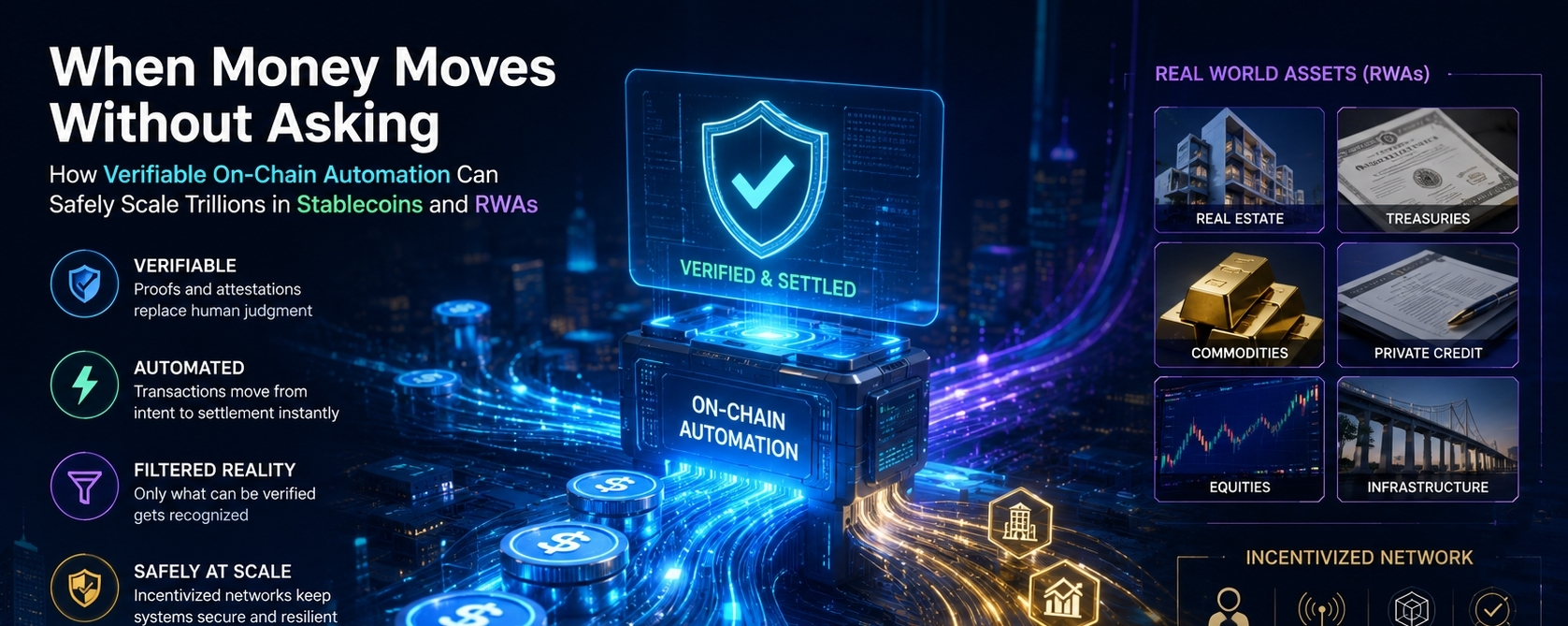
It didn’t stand out at first. Nothing dramatic, nothing that demanded attention. Just a small detail on a dashboard, a stablecoin reserve attestation refreshing itself, a timestamp quietly updating without anyone touching a thing. No approval, no second glance, no visible decision being made. And yet, something real had just happened. The system wasn’t waiting anymore. It had already been told what mattered, what counted as “enough,” and it simply carried that forward on its own. That’s when it started to feel like more than just efficiency. It felt like a shift in how decisions themselves were happening. Because what we’re really asking automation to do at this level isn’t just to move money faster, it’s to take over the small, invisible pauses that used to exist inside every meaningful transfer, the moments of hesitation that never showed up in logs but quietly shaped outcomes.
We often talk about friction as something to eliminate, but friction was never just a technical inconvenience. It was where human judgment lived. When a person cleared a transaction or approved a transfer, there was always a subtle pause, a space between starting something and finishing it, where things could still be questioned. That space didn’t leave a record, but it mattered. With verifiable on-chain systems, that pause is almost gone. Transactions move so quickly from intent to settlement that the idea of a “maybe” barely exists anymore. It’s not that the system ignores caution, it just redefines it. Instead of a moment of reflection, caution becomes a checklist of conditions that were already verified before anything even started. And that’s where things begin to feel both reassuring and a little unsettling at the same time.
The trust behind all of this is supposed to come from verification. Proofs, attestations, and cryptographic guarantees step in where human judgment used to sit. On paper, that sounds stronger, more objective, less prone to error. But verification has its own boundaries. A system that depends on what it can confirm will naturally start to overlook what it cannot. It doesn’t loudly reject those things, it just stops considering them altogether. A real estate record tangled in slow, paper-based processes, or reserves spread across regions with uneven reporting, don’t get flagged as problems. They simply fall outside the system’s field of vision. Over time, what scales isn’t necessarily everything of value, but everything that can be clearly seen and verified within that framework. In a quiet way, the system begins shaping reality, not by force, but by recognition.
At the same time, there’s a layer of pressure building underneath all this that doesn’t look like risk in the usual sense. The systems that keep this automation running, the keepers, relayers, and oracle networks, are all driven by incentives. They’re rewarded for speed, for responsiveness, for acting on signals as quickly as possible. Individually, each action seems small and harmless. But at scale, these actions multiply into something much larger, a constant flow of micro-decisions driven by economic motivation. The pressure doesn’t feel obvious because it’s spread so thinly across the system. It becomes part of the background, something you don’t notice until it reveals itself in a moment of stress. In that kind of environment, safety starts to mean something slightly different. It’s less about making sure nothing ever goes wrong and more about ensuring that when things do go wrong, they’re rare enough or subtle enough that they don’t disrupt the overall sense of stability right away.
So when people talk about scaling trillions in stablecoins and real-world assets through on-chain automation, it feels like the conversation is missing something deeper. This isn’t just about building a faster financial system. It’s about creating a layer where trust itself is continuously processed, verified, and settled without pause. It runs quietly, filters constantly, and moves so quickly that the chance to question it starts to disappear. In measurable ways, it may very well be safer, more transparent, more consistent. But there’s a harder question that lingers underneath all that confidence. If a system can only recognize what it was designed to verify, and if it moves too fast for reconsideration to exist, then at some point, trust stops being something we actively evaluate. It becomes something we accept by default, not because we’ve examined it closely, but because the system never really gave us the space to ask whether we should.