
I used to think the hard part was collecting the right information. Lately, I'm not so sure. The more systems I look at, the more it seems that information is usually there somewhere. What keeps slowing everything down is deciding whether another system is willing to rely on it. That feels like a different problem entirely.
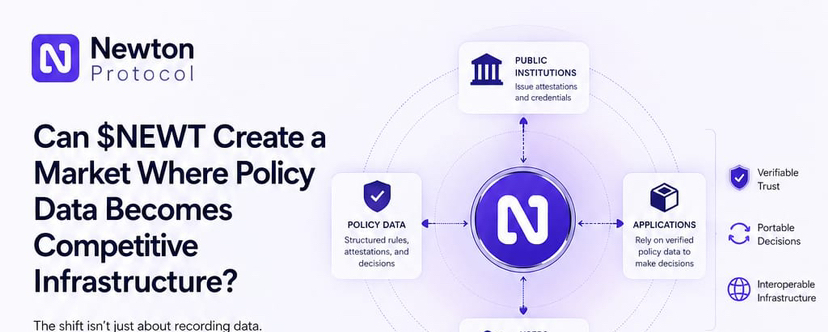
That thought came back while I was thinking about Newton Protocol and whether policy data could become competitive infrastructure. At first, that sounded like another way of organizing records. Then I started wondering if the records were ever the valuable part. Maybe the real value sits inside the decisions attached to them.
A credential, after all, is not just data sitting in a database. It is someone making a claim. A university claims a degree exists. A regulator claims a business meets certain standards. A protocol claims an address qualifies for a distribution. The file itself is almost secondary. What matters is whether another participant accepts the claim without starting the entire investigation again.
That is where systems begin to behave differently from how they look on paper.
Verification sounds technical, but it is really just checking whether a claim can be trusted before acting on it. An attestation is simply evidence from someone recognized as an authority saying, "I stand behind this statement." Those ideas seem straightforward until another platform inherits them. Suddenly the question is no longer whether the claim exists. It becomes whether the responsibility for relying on that claim also transfers.
I keep noticing how often this transfer fails.
Someone verifies their identity once, then verifies it again elsewhere. They prove eligibility to one application, then repeat almost the same process for another. Token distributions work the same way more often than people admit. Distribution looks automatic because tokens appear in wallets, but underneath, someone decided who qualified, who did not, which conditions counted, and which evidence was accepted. Movement follows judgment. It rarely replaces it.
That changes how I think about policy data. Maybe it isn't simply storing rules. Maybe it is storing previous decisions in a form that another system can understand without recreating all the uncertainty that came before.
Even then, uncertainty never disappears completely.
Imagine two organizations using the same verification result. Everything feels efficient until regulations change, eligibility shifts, or an exception appears that the original policy never considered. Suddenly both organizations have to decide whether the earlier decision still deserves trust. The shared data remains identical. The meaning attached to it quietly changes.
That seems to happen everywhere. Information ages differently than decisions do.
I think people sometimes confuse consistency with trust. They are related, but they are not identical. A system can apply the same rule every single time and still produce outcomes that feel difficult to defend because the surrounding circumstances evolved while the rule remained fixed. Consistency reduces randomness. It does not automatically preserve legitimacy.
Scaling makes this more visible. Small systems often survive because humans compensate for missing structure. Someone reviews an edge case. Someone sends an email. Someone notices an unusual pattern and overrides the default process. Those invisible adjustments rarely appear in architecture diagrams, yet they hold everything together.
As participation grows, those quiet interventions become expensive. Not only financially. They become difficult to coordinate. Different reviewers reach different conclusions. Different jurisdictions interpret the same evidence differently. The same credential begins producing different consequences depending on where it arrives.
That is where policy data starts looking less like documentation and more like infrastructure. Not because it records what happened, but because it influences what can happen next.
I find that distinction surprisingly important.
Proof alone rarely finishes anything. It simply narrows disagreement. The consequence still has to be accepted somewhere else. A verified credential may demonstrate eligibility, but distribution remains a separate administrative decision. Verification and distribution are connected pieces of one longer process, not isolated events. One determines confidence. The other applies responsibility.
Perhaps that is why trust seems so fragile when it crosses institutional boundaries. Every participant inherits not only information but also exposure. If a previous decision turns out to be incomplete, the cost spreads beyond the original verifier. Shared trust also means shared accountability, even when nobody explicitly planned for it.
That makes me wonder whether competitive advantage eventually shifts away from collecting more data and toward maintaining policy quality over time. Not policies that are merely correct once, but policies that remain understandable, reviewable, and defensible as circumstances change. That feels much harder than adding another database or another verification layer.
People experience this difference in quiet ways. One platform approves them instantly while another asks for documents they already submitted somewhere else. Eligibility changes without explanation. Appeals take longer than verification itself. None of those frustrations usually come from missing information. They come from systems refusing to inherit someone else's confidence.
Maybe Newton is pointing toward a future where policy itself becomes reusable infrastructure rather than isolated administrative work. Or maybe it simply exposes how difficult portable decisions really are once responsibility begins moving alongside proof.
I'm still not convinced the hardest problem is verifying claims. The more I think about it, the harder question might be whether a decision can travel without losing the context that made it reasonable in the first place. I'm not sure any infrastructure solves that completely, and perhaps that uncertainty is exactly what keeps these systems evolving.