

I was looking through Newton Protocol again, and the part that kept pulling me back was not the usual surface narrative around a new network going live, but the narrower idea behind Newton Mainnet Beta: the attempt to place an authorization layer directly between intent and settlement. That sounds simple when written in one line, yet the more I sat with it, the more unusual it felt. Most onchain systems still seem obsessed with proving that value can move quickly, while Newton appears more interested in asking whether value should move at all under a given set of conditions. I sometimes wonder if that is actually the more mature question for crypto now. Settlement has been solved well enough to attract serious capital, but the missing layer has often been the part that lives in policy documents, internal dashboards, legal interpretations, or operational trust between teams. Looking from the outside, Newton Mainnet Beta seems to be testing whether those pre-transaction judgments seer can become programmable without collapsing into pure centralization. What seems interesting is that it is already live on Base and Ethereum and is framed not as after-the-fact monitoring, but as a pass-or-fail checkpoint before money moves. That changes the emotional feel of the stack. Instead of treating compliance, risk, or mandate limits as commentary around a transaction, Newton tries to make them part of the transaction pathway itself. I'm not completely sure the market has fully absorbed how different that is, because it asks builders and allocators to care less about raw composability and more about conditional composability. And maybe that is where the real tension begins: if crypto became attractive partly because it removed friction, what happens when a protocol is built to reintroduce a kind of structured friction on purpose?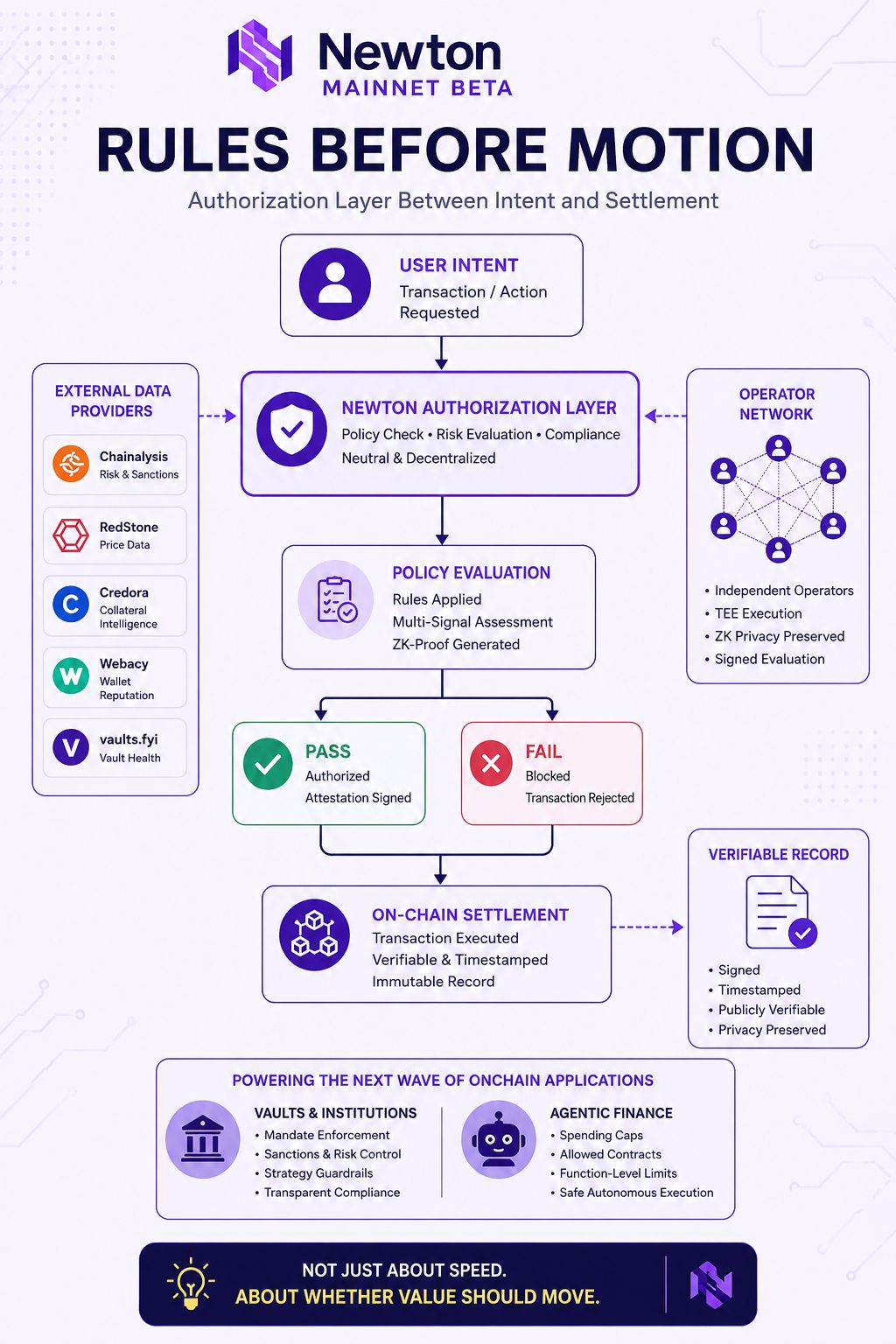
The mechanism itself makes me think even more than the launch headline. Newton describes a model where a transaction is checked against policy, evaluated across a operator network, and then produces a signed, timestamped record that others can verify. while still trying to preserve sensitive data through zero-knowledge techniques. On paper, that architecture feels like an answer to a problem many teams talk around but rarely solve cleanly: how do you enforce real-world constraints without putting the whole system back behind a single gatekeeper? I sometimes wonder whether the most important word in Newton's design is not "policy" or even "authorization," but "neutral." The protocol keeps emphasizing that builders can compose data from multiple external providers and that no single vendor has to own the decision path. Chainalysis for sanctions and risk signals, RedStone for price data, Credora for collateral intelligence, Webacy for wallet reputation, vaults.fyi for vault health - taken together, that begins to look less like one product and more like an attempt to formalize a market for machine-readable judgment. The question that comes to mind is whether this is the beginning of a new onchain primitive: not just smart contracts that execute logic, but authorization networks that decide when execution is permissible. If that framing holds, Newton Mainnet Beta may matter less for what it processes today and more for what it teaches other systems to demand tomorrow. And yet I keep hesitating, because every policy engine inherits the biases and blind spots of its inputs. If the upstream data is partial, stale, or contested, how much confidence should anyone place in a cleanly verified output? A signed attestation can prove that a rule was applied, but t cannot magically prove that the rule itself was wise.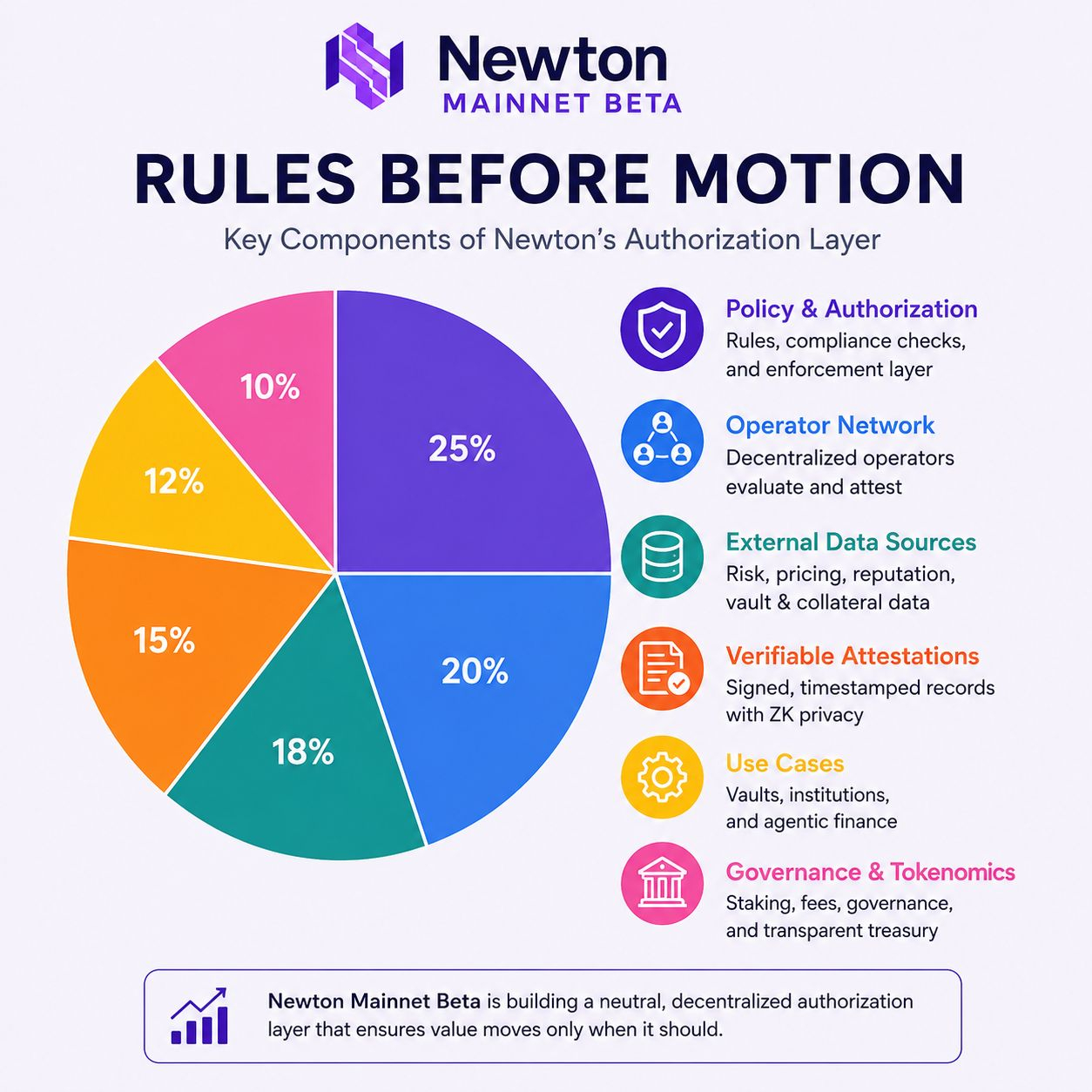
That uncertainty becomes even more visible when I think about the first use cases Newton keeps pointing toward, especially vaults and agentic finance. On the vault side, the valueproposition is fairly intuitive: depositors, curators, and institutions can rely less on soft promises and more on enforceable guardrails around sanctions exposure, oracle divergence, depeg conditions, concentration limits, or strategy mandate drift. I can see why that matters. A curator saying "trust me, I follow the rules" now feels like an increasingly weak operating model in a market that wants auditable behavior. But what seems equally important is the possibility that the same architecture could be used for autonomous agents, where spending caps, allowed contracts, function-level limits, and rate controls become the difference between useful automation and very expensive chaos. That is where Newton becomes intellectually difficult for me. I sometimes wonder whether the protocol is quietly trying to solve two separate futures at once: institutional adoption, where compliance and verification are prerequisites, and Al-native finance, where autonomous execution needs quardrails before it becomes socially tolerable. Those are related futures, but not identical ones. The strength is obvious: a shared enforcement layer could reduce the gap between what people say an onchain system should do and what it is technically allowed to do. The possible weakness is subtler. If every serious application starts leaning on policy packs, operator attestations, and external data dependencies, do we end up with safer systems or a o simply more elaborate systems whose failure modes are harder to see? Looking from the outside, Newton Mainnet Beta feels promising precisely because it acknowledges that unbounded autonomy is not a credible long-term model. Still, I'm not completely sure whether the community will view these guardrails as infrastructure or as a philosophical concession.
The other reason I keep circling back to Newton is that its broader structure suggests it
knows this cannot be solved by code alone. Even the NEWT token design, at least from what has been disclosed publicly, seems tied to the same theme of governed infrastructure rather than pure narrative. Staking is presented as part of protocol security, fees relate to usage, governance is meant to decentralize over time, and the foundation has gone unusually hard on public wallet tagging, treasury-use policies, restrictions around Jocked-token sale sales, and quarterly transparency commitments. I do not read that as proof of future success, but I do read it as an admission that infrastructure only earns legitimacy if the people behind it accept being watched too. That makes me think the deeper question around Newton Mainnet Beta is not whether it can enforce rules today, but whether it can do so while remaining adaptable enough for a market that never stops changing. Regulations shift, data providers change quality, institutions revise mandates, agents become more capable, and communities eventually want more say over the boundaries of enforcement. What seems interesting is that Newton is entering the market with a relatively clear architecture and an equally unclear social outcome. Will builders embrace programmable restraint as a feature, or will they only tolerate it when the next blowup reminds them why it was needed? Will neutral authorization become a standard layer across chains, or remain a specialized tool for the most risk-sensitive corners of crypto? For now the structure looks thoughtful and the Mainnet Beta feels directionally important, but whether Newton Protocol becomes a durable coordination layer or just an elegant experiment probably depends on how real
users react when rules start sitting directly in front of action - anyway, time will tell.
