
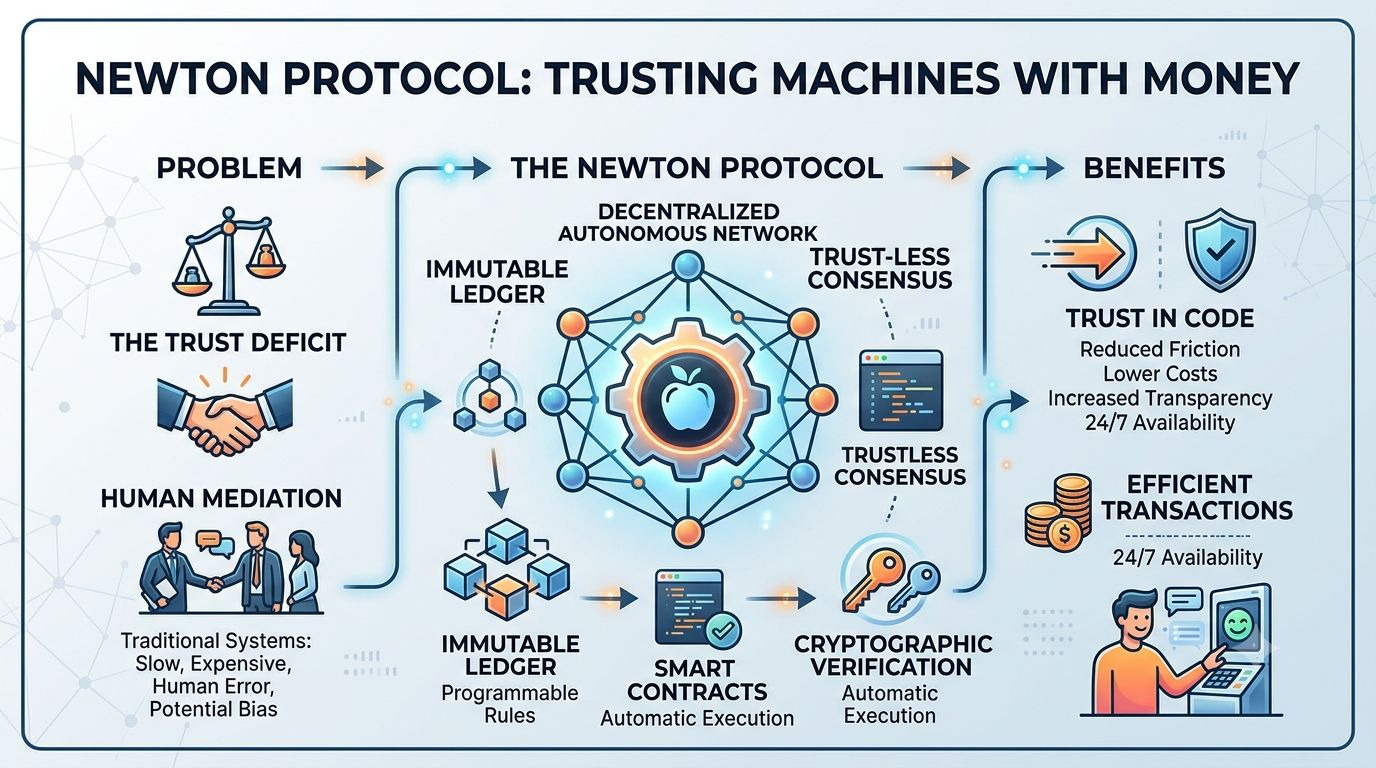
There's a specific kind of discomfort that comes from handing part of your financial life to something that isn't a person. Crypto has never really solved that. Not once. Bots have been running this show since the early days — arbitrage scripts, liquidation keepers, market makers humming along in the background of every exchange you've ever touched. But they operated in a black box. The "trust" you gave them was really just trust in whoever wrote the code and held the keys. That's it. That's all it ever was.
Newton Protocol shows up and makes a claim that sounds almost too neat: what if the leash itself was provable? Not "trust the team." Not "we got audited, we're fine." A live, checkable, cryptographic answer to one question — did this thing only do what it was allowed to do. That's the whole pitch. Everything else is scaffolding built to make that pitch real instead of just marketing copy.
Let's get into the mechanics, because the language around "AI plus blockchain" has gotten so mushy that words stop meaning anything. At the core is the Newton Keystore, a rollup — an L2, in the usual sense of batching computation off-chain and settling proofs back onto it. But here's the thing: most rollups try to be everything to everyone, general-purpose execution machines. This one doesn't. It has one job. Permissions. It's where the rules governing an AI agent, or a delegated bot, or a smart account actually live, and where they get updated when something changes. Pair that with ERC-4337 smart accounts — the standard that splits wallet authority into fine-grained pieces instead of an all-or-nothing key — and you get what they call zkPermissions. Rules like "only trade if volatility crosses X" or "cap daily spend at Y," enforced not by some script running on a guy's laptop but by a system that spits out a proof every single time it acts.
Now, the engineering underneath that layer is where things get more debatable. Newton leans on trusted execution environments — sealed hardware enclaves where computation happens out of public view — paired with zero-knowledge proofs that confirm, after the fact, the enclave did what it was supposed to. This isn't unique to Newton. It's becoming the standard playbook across the industry. But I want to be straight about what you're actually trading here. A TEE is a hardware trust assumption. You're not trusting a person anymore, or a company. You're trusting that a chip manufacturer's secure enclave hasn't been compromised, doesn't have some undisclosed flaw, hasn't been quietly backdoored by someone with the access and the motive. That's a different kind of faith than reading open-source code yourself. Smaller than the blind trust bots have always demanded, sure. But not zero.
My honest take? This is a bridge, not a destination. Fully verifiable machine learning, done entirely in zero-knowledge with no hardware assumption at all, is still too slow and too expensive for real-time trading decisions. TEEs get you something that actually works today. Whether Newton eventually walks away from that hardware dependency as zkML matures — which a lot of people in this space expect the whole category to do eventually — is one of the bigger open questions hanging over the long-term design. Nobody's answered it yet. Maybe nobody can, yet.
Then there's the Model Registry, and this is the piece aimed at builders rather than end users. Honestly? I think this is the part that decides whether Newton becomes real infrastructure or just another protocol nobody touches after the airdrop farmers leave. It's an on-chain marketplace where developers publish "agent models" — reusable chunks of trigger-and-action logic, basically smart contracts encoding a strategy, that anyone can activate or build on top of. Recurring buys with cryptographic proof of exact timing and price. Yield agents shifting capital across protocols as rates move. Vault managers watching collateral ratios, stepping in before a liquidation hits. Copy-trading setups that mirror another wallet while still respecting your own limits.
On paper, that's genuinely interesting. It's the difference between a protocol that just processes transactions and one where value actually compounds — developers building on each other's work instead of everyone reinventing the same rebalancing bot for the hundredth time. But look, marketplaces are brutal to bootstrap. You need enough builders publishing strategies worth using to pull in real users. And you need enough real users for publishing to be worth a developer's time in the first place. That chicken-and-egg problem has quietly killed more ambitious crypto marketplaces than any smart contract bug ever has. Does Newton's registry clear that bar? Or does it end up another mostly-empty directory with a few demo strategies gathering dust? I don't know. And I'd be suspicious of anyone who tells you they do, including, probably, the team building it.
Here's the tension I keep coming back to, and it's not just a Newton problem — it applies to everything chasing this same idea. Verifiability tells you an agent followed its rules. It says nothing about whether those rules were any good. If I write a permission that's too loose — a stop-loss with a blind spot, a volatility trigger that doesn't account for some specific kind of shock — the system will faithfully, provably execute exactly what I told it to do. And then hand me a cryptographic receipt proving it lost my money exactly the way I authorized. That's not a bug. It's baked into the entire concept of programmable automation. You can trace this straight back through every DeFi exploit that technically wasn't a hack at all — just code doing precisely what it was written to do, in a situation nobody thought to model. Newton protects you from a rogue agent going off-script. It cannot protect you from yourself writing a bad script in the first place. That distinction matters more than most of the "trustless automation" marketing language wants to admit.
On the token side: NEWT has a fixed supply, one billion total, with roughly sixty percent carved out for community stuff — staking rewards, grants — and the rest split between core contributors and early backers on multi-year vesting. At launch, only a small slice was actually circulating. The rest sits behind cliffs and linear unlocks stretched over three to four years, depending on the bucket. To its credit, the token isn't just a speculative chip sitting there for no reason. It does real work. It's gas for issuing and updating permissions. It's staked by validators securing the Keystore under a delegated proof-of-stake model with a two-week unstaking window. It's collateral posted by operators running agents, subject to slashing if those agents misbehave. And eventually, it's the tool for governance once that layer actually goes live.
None of that changes the calendar problem, though. A big chunk of total supply is still working its way out of lockup, and unlock schedules in this industry have a well-worn habit of triggering sell pressure that has nothing to do with how the product is actually doing. I've watched this movie enough times to be wary of reading too much into short-term price swings in either direction — bullish or bearish — while most of the float hasn't even hit the market yet.
The part of Newton's current pitch that I think is genuinely underrated — especially next to how much air the "AI agents" framing sucks up — is the compliance angle. The team's more recent messaging leans hard into compliance-as-code: builders write policies in something like Rego, a decentralized set of operators evaluate them inside that same TEE-secured environment, and anyone can verify the results through a public explorer instead of just trusting the process. Strip away the branding, and this is a real gap in the market. Institutions, stablecoin issuers, platforms dealing in tokenized real-world assets — they don't avoid on-chain automation because they hate efficiency. They avoid it because a compliance officer can't sign off on a system where enforcement is basically vibes and a Discord mod keeping an eye on things.
The real clincher here is this: if a protocol can turn "did this transaction meet our regulatory obligations" into something as checkable as "did this transaction settle" — the same way smart contracts made execution itself checkable over a decade ago — that's a meaningful unlock for the kind of capital that's mostly sat on the sidelines of DeFi. I wouldn't call this winner-take-all. And I wouldn't bet confidently that Newton specifically becomes the dominant neutral layer here, rather than one of several standards that end up coexisting. That's still being fought out through shipped code and actual adoption. Not whitepapers. Not announcements.
So where does that leave me? Somewhere between genuinely curious and deliberately unconvinced — which, honestly, is the only sane place to stand with infrastructure this young. The problem being solved is real. Offchain, unverifiable automation is a live liability across this whole industry, not something dreamed up to justify a token launch. The technical approach is reasonable, not just acronym soup dressed up to look smart, even if leaning on trusted hardware right now is a compromise I'd expect to soften as zero-knowledge machine learning gets cheaper and faster.
But the pieces of the roadmap that actually matter — a marketplace with real usage, a fully multichain permissions rollup, a validator set that's decentralized in practice and not just on paper — are still sitting in the "upcoming" column. Which means a good chunk of the current sentiment around this thing is a bet on future execution, not a reflection of activity that already exists. That doesn't make it a dead end. It doesn't make it a sure thing either. It makes it early, in that specific way infrastructure always looks early right up until the moment it suddenly isn't — and there's rarely a clean signal telling you which side of that line you're standing on while you're still standing on it.
This isn't financial advice, and given how young and thinly traded this token still is, I'd raise an eyebrow at anyone writing about it who claims otherwise. What's actually worth watching is the gap between what Newton already does and what it still just says it will do. Because that gap, like it usually is with projects like this, is where the real risk is quietly sitting. Waiting.
@NewtonProtocol #Newt #newt $NEWT
