
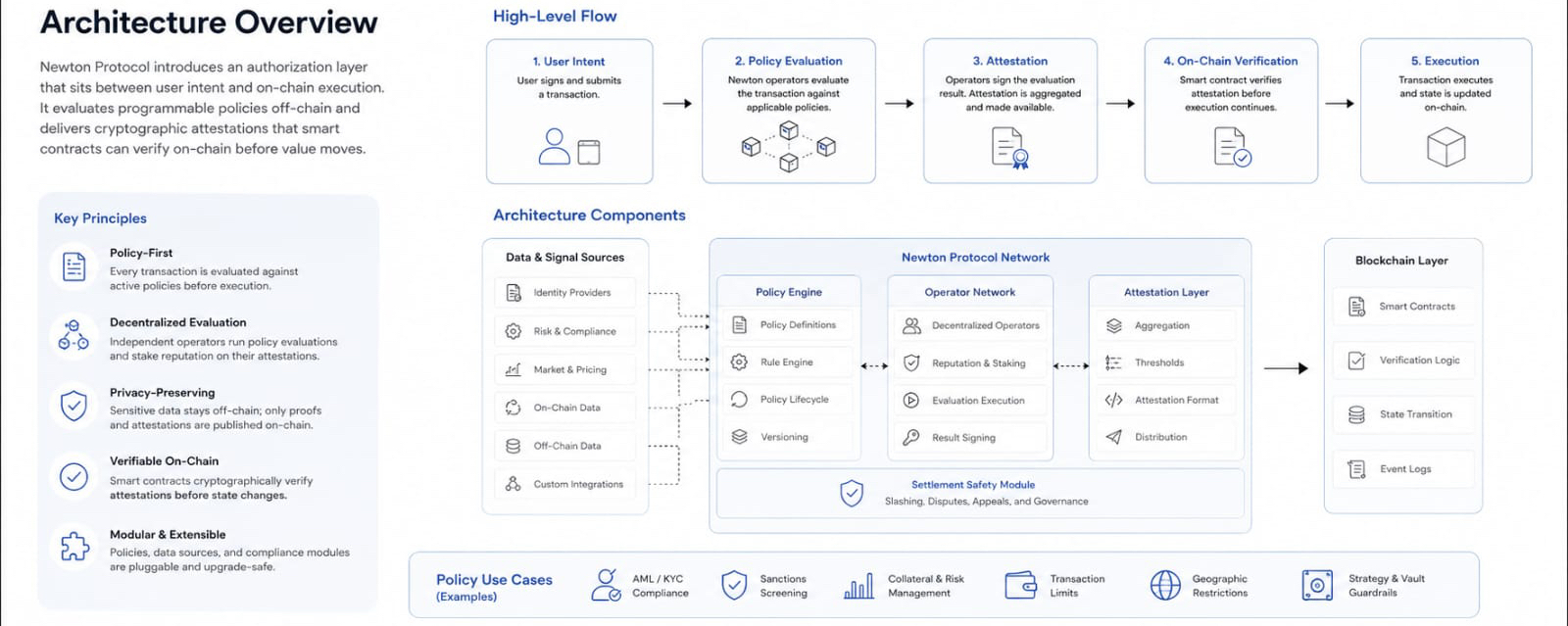
Newton Protocol made me notice something I had somehow ignored for years, and the strange part is that it wasn't hidden. It was sitting inside every onchain transaction the whole time. We spend endless hours talking about execution, settlement, gas optimization, and throughput, yet almost nobody stops to ask what happens just before value actually moves. That tiny moment felt insignificant to me at first. After reading Newton's architecture, I don't think it is anymore.
I kept asking myself a simple question. Why do we automatically assume that a transaction deserves to execute simply because a smart contract allows it? Those two ideas sound identical until you separate them. A transaction can be technically correct and still violate a vault's investment mandate. It can satisfy every line of code while ignoring compliance requirements, risk limits, or security policies that exist somewhere outside the blockchain. I realized I'd spent years treating execution and judgment as if they were the same thing, when they're really solving two completely different problems.
That's where Newton Protocol started making sense to me. Instead of waiting until after settlement to analyze what happened, it evaluates programmable policies before settlement ever begins. Developers can write policies that describe what should or shouldn't be allowed, and Newton's operator network evaluates those conditions before producing a cryptographic attestation. Smart contracts don't simply trust that the checks happened. They can verify that they happened before continuing. The transaction doesn't immediately become final. For a brief moment, it waits for permission.
The more I thought about that design, the more interesting it became. Newton isn't trying to put every piece of financial intelligence onto the blockchain. Identity checks, compliance signals, market risk, security analysis, and other sensitive information can remain where they belong, while the blockchain only receives proof that the required policies were satisfied. At first, I thought this was mainly about privacy. Now I think it's about something deeper. The chain doesn't need to know everything. It only needs confidence that the right questions were asked before value moved.
The part that really stayed with me wasn't technical at all. It was behavioral. Once developers know certain transactions will never satisfy policy, they naturally stop building around those possibilities. Risk managers begin relying less on manual reviews because policy enforcement becomes part of the infrastructure itself. Users slowly stop thinking about invisible checks because compliant behavior becomes the easiest path. Nobody wakes up one morning and decides to behave differently. The environment quietly changes their habits. That's usually how infrastructure succeeds. It doesn't constantly remind people that rules exist. It simply makes those rules feel normal.
I think that has consequences far beyond one protocol. As more institutions enter DeFi, and as stablecoins, tokenized real-world assets, and AI agents become part of everyday financial activity, execution alone probably won't be enough. Systems will increasingly need to explain not only how transactions execute, but why they were allowed to execute in the first place. If authorization becomes programmable, then trust gradually shifts away from internal processes and toward verifiable infrastructure. That's a much bigger change than adding another security feature.
Something else kept bothering me while I was reading. For years, crypto celebrated removing gatekeepers from finance, and I still believe that was one of blockchain's greatest achievements. But removing gatekeepers isn't the same as removing judgment. Every financial system has rules. The real question is whether those rules live inside closed organizations or inside open infrastructure that anyone can verify. Newton seems to be arguing for the second option, and I find that idea much more interesting than simply making transactions execute faster.
I'm still not sure whether authorization layers will become as fundamental as settlement layers over the next decade. Maybe they will. Maybe they won't. But after spending time understanding Newton Protocol, one assumption feels much weaker than it did before.
Maybe the future of DeFi won't be defined by how quickly transactions move across blockchains.
Maybe it'll be defined by how intelligently blockchains decide which transactions deserve to move at all.