
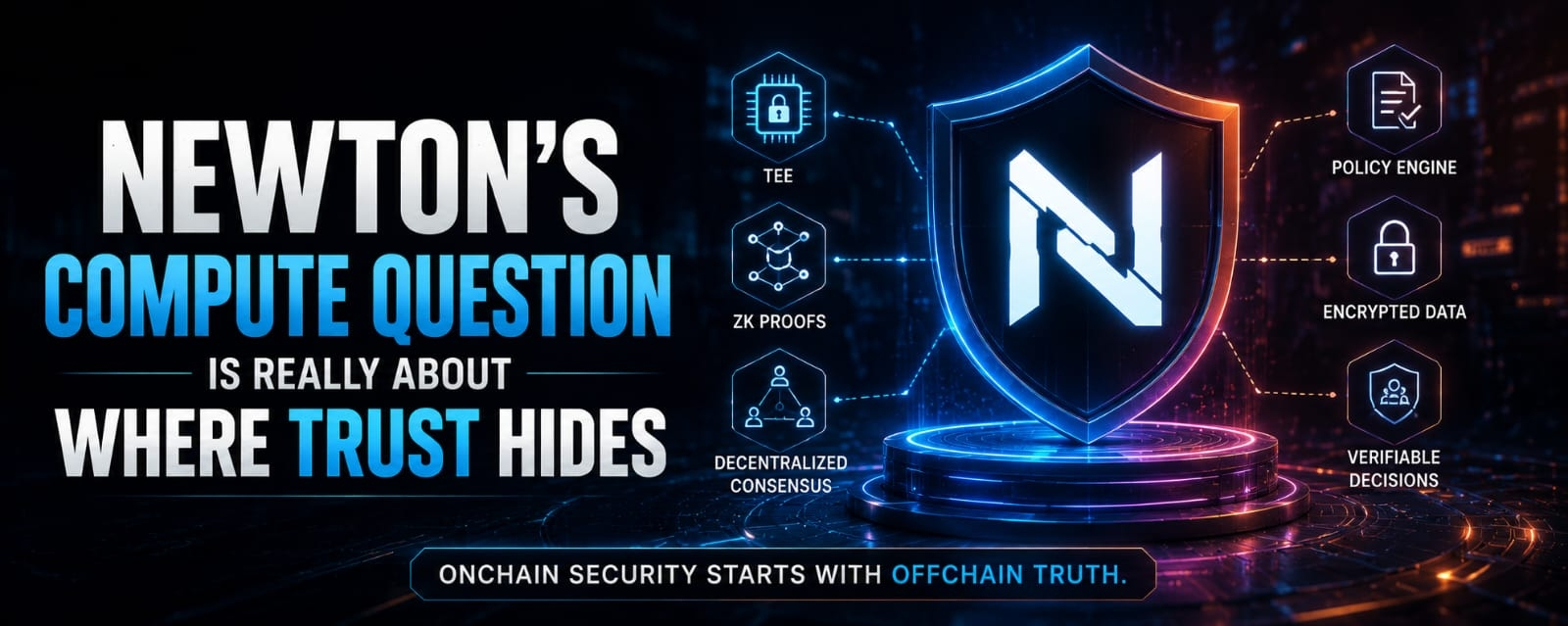
I’ve stopped being impressed by crypto buzzwords on their own.
TEE, ZK, AVS, rollup, coprocessor, oracle network. These words matter, but they can also become a distraction. Once people start arguing over the label, they often stop asking the question that actually matters.
What are we trusting?
That is the question I keep coming back to with Newton Protocol.
The older Newton story leaned more toward TEEs and ZKPs. That made sense. If AI agents are going to act for users, people want privacy, proofs, and some confidence that the machine did what it claimed.
But Newton’s current direction feels more practical. It looks less like “prove every computation perfectly” and more like “check the policy before capital moves.”
That difference matters.
Newton is not trying to put every decision fully onchain. It is not saying TEEs magically fix everything. It is not trying to make ZK proofs carry every piece of messy real-world logic.
Instead, it seems to be making a simpler bet:
Some decisions can happen offchain, as long as the result is checked, signed, challenged, and enforced before execution.
I actually think that is more realistic.
Onchain compute is transparent, but expensive. ZK proofs are powerful, but can be heavy. TEEs can protect secrets, but they bring hardware trust and attestation risk. Operator-based systems can spread trust, but they still depend on quorum rules, incentives, data quality, and dispute handling.
None of these approaches remove trust completely.
They just move it somewhere else.
That is the part crypto does not always like to admit.
A ZK system asks you to trust the circuit and assumptions around it. A TEE asks you to trust the hardware and runtime. A decentralized operator model asks you to trust incentives, diversity, and challenge mechanisms. Fully onchain logic asks you to accept cost, public data, and limited access to offchain context.
There is no free version of computation.
So the real Newton question is not “why not just use ZK?” or “why not just use TEEs?”
The better question is this:
What kind of trust is acceptable for an authorization decision?
For a vault guardrail, maybe you do not need to prove every tiny step in the data pipeline. You need to know whether an action should be blocked. For an AI agent with spending limits, maybe the important thing is not proving the full model logic. It is making sure the agent stays inside the limits the user gave it.
That is where Newton starts to make sense to me.
It treats offchain compute as part of a control layer. Operators evaluate context. Policies define boundaries. The contract does not need to understand the whole outside world. It only needs a verifiable decision before it allows execution.
I do not fully trust the model yet.
Operators can be weak. Data sources can overlap. Gateways can become more important than people admit. Privacy still has real assumptions. Policy code can be wrong. And an attestation does not mean absolute truth.
But I do like that the tradeoff is visible.
Newton’s strongest claim is not “we solved offchain compute.”
It is closer to:
We can make offchain policy decisions harder to fake and easier to enforce.
That is less flashy, but it is a better idea.
I’ve seen too many projects chase the purest architecture and forget the actual user problem. Automated capital does not always need the most elegant compute primitive. Sometimes it just needs a reliable stop sign.
Do not spend over this limit.
Do not rebalance into this risk.
Do not execute if the oracle looks stale.
Do not let this agent touch that contract.
Do not move funds if the credential check fails.
These are not glamorous decisions. But they matter when software starts acting on behalf of people.
That is why Newton’s place in the stack is interesting. It does not need to be the most private compute network. It does not need to be the most advanced ZK system. It does not need to become a full execution layer.
It needs to make policy-based authorization dependable enough that developers trust it around capital-moving automation.
That is still hard.
But at least it is a real problem.
My takeaway is simple.
Newton’s compute split should not be judged by which primitive sounds the most advanced.
It should be judged by whether the system makes its trust assumptions clear enough to manage.
Because in crypto, trust never disappears.
It just finds a new place to hide.