
Was doing a routine gas-fee check before a swap earlier, nothing dramatic, and got distracted reading through old wallet-drain post-mortems instead — the kind where someone signs something in a hurry and finds their assets gone twenty minutes later. Ended up down that hole for way longer than I meant to.
From there I somehow landed back on Newton Protocol, and this time the thing that actually stuck wasn't the AI-agent angle I kept reading about before — it was where the security actually sits in the transaction lifecycle.
Because here's what I realized I'd been assuming without ever really questioning it: when people say "security" in crypto, they almost always mean protecting the wallet or the private key. Better custody, better signing UX, hardware devices, seed phrase backups. The transaction itself — the actual action being taken — mostly just gets trusted once it's signed. Signing is treated as the finish line.
Turns out that's kind of the gap Newton's going after. Instead of only securing access to the keys, it evaluates the action itself against a rules engine before that action is allowed to settle, using cryptographic proofs run through secure hardware environments. So security isn't just "did the right person sign this," it's "does this specific action fall inside boundaries that were defined ahead of time." Those are honestly two different problems, and I hadn't separated them clearly before.
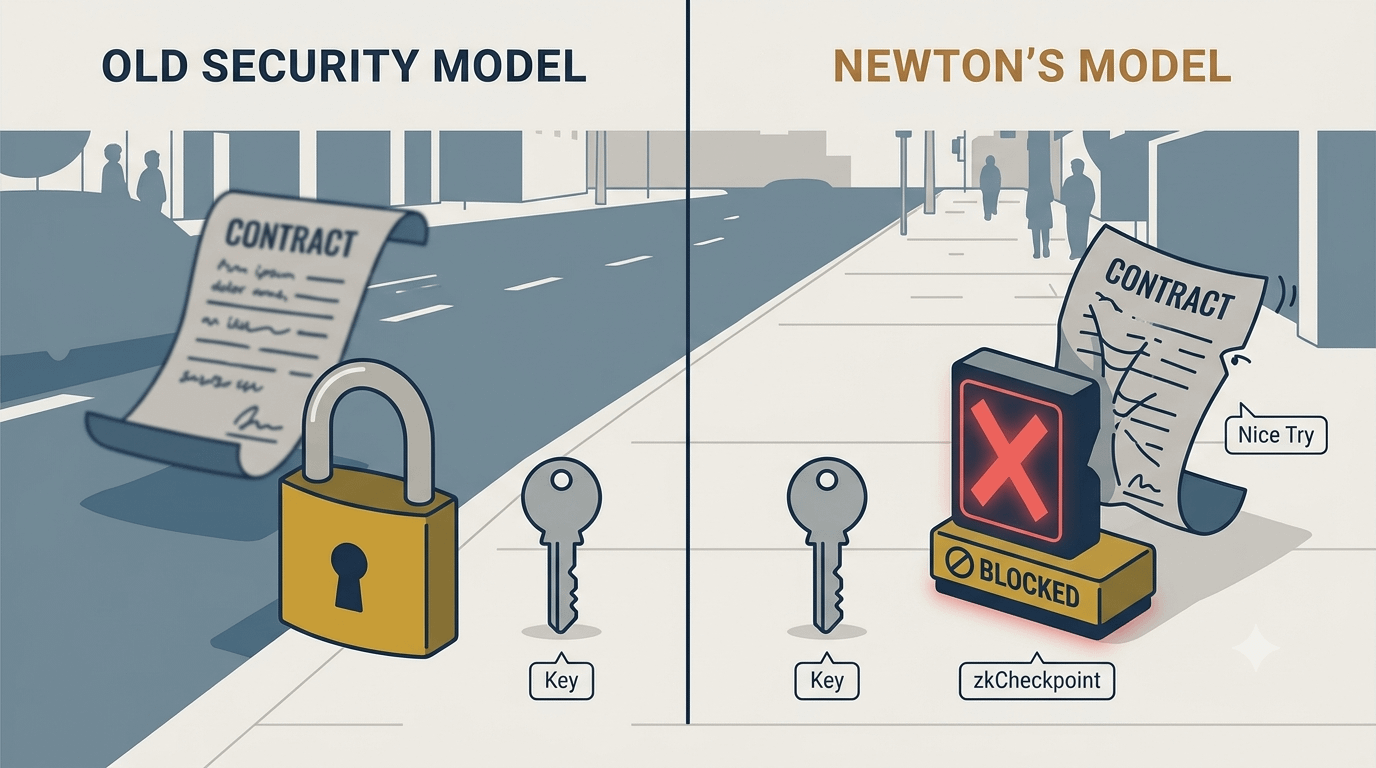
I thought at first this basically overlapped with multisig or spending limits, which most serious wallets already have. But actually — no, it's a bit different. Multisig protects who can authorize something. This is closer to protecting what gets authorized, checked automatically, with a cryptographic proof attached instead of just a policy sitting in some off-chain dashboard somewhere. The wallet-drain scenarios I was reading about earlier mostly weren't "wrong person signed" — they were "right person signed something they shouldn't have," usually a malicious approval buried in fine print. This model is aimed more at that second failure mode.
But here's the part that bothers me. Rules-based enforcement is only as good as the rules someone actually wrote, and writing good rules for something as messy and fast-moving as onchain activity feels genuinely hard. A phishing contract designed to look like a normal swap approval could still pass a policy check if the policy wasn't specifically written to catch that pattern. Security that depends on pre-defined boundaries is strong against the failure modes people already thought of, and much weaker against the ones nobody's written a rule for yet. That's basically every zero-day, in any system, ever — I don't think this one's magically exempt.
There's also a coverage question I keep circling back to. This kind of protection presumably only applies to activity that actually routes through Newton's enforcement layer. Plenty of transactions people sign happen through wallets, dApps, and bridges that have nothing to do with this system at all. So "better security" here isn't blanket protection across every action someone takes onchain — it's protection for the specific flows that are actually built on top of it. Worth being honest about that scope instead of treating it like a blanket fix.
Where I think this actually matters most is less the average retail swap and more the higher-stakes, higher-frequency stuff — treasuries, automated agents doing recurring actions, anything where one bad approval could cascade instead of just being a single unlucky mistake. For someone doing the occasional manual swap, the existing wallet warnings and slow-down-and-read-it habit still probably matter more than any policy engine sitting underneath.
Anyway, still thinking about that phishing-contract gap, haven't landed anywhere solid on it. Going to go actually finish that swap I was originally trying to do before I got distracted.