
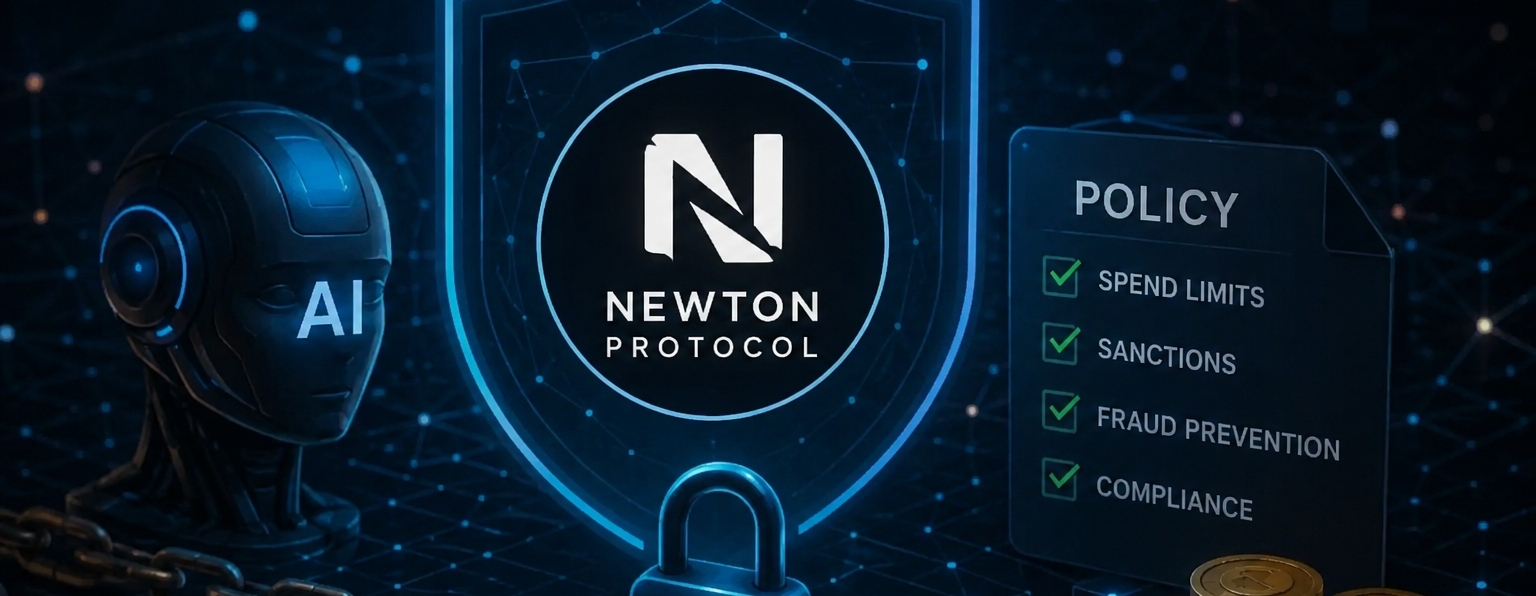
@NewtonProtocol I keep coming back to the same uneasy thought with Newton Protocol: maybe the real question is not whether AI trading can be made safe, but whether it can ever be made less careless than the rest of crypto. Newton describes itself as a decentralized policy engine for onchain transaction authorization, built as an EigenLayer AVS, with rules for spend limits, sanctions screening, fraud prevention, and other compliance controls. That is a serious framing, and honestly, it feels more grounded than most of the AI trading talk I’ve heard over the years.
I keep noticing that the project is not trying to sell intelligence as the answer. It is trying to put a hand on the brake. Its docs say every agent-initiated transaction is evaluated against policy before execution, with Rego-based guardrails that can limit what the agent can do, how much it can spend, and which contracts it can touch. That is the part that makes sense to me. I’ve seen too many systems where the agent is given the keys and everyone calls it progress until something goes wrong.
That said, I don’t fully trust the word “safe” in this context. In crypto, safety usually means someone $NEWT managed to move the failure point somewhere less visible. A policy engine can reduce damage, but it cannot remove the fact that the policy itself might be too loose, too strict, outdated, or written by someone who did not think through the edge cases. Newton’s own materials make clear that it is aiming at transaction controls, privacy-aware authorization, and verifiable enforcement, not at some magical removal of risk. That distinction matters more than people like to admit.
What makes Newton interesting to me is that it seems to start from a more honest assumption: agents will make mistakes, users will overreach, and markets will behave badly anyway. The system is built around checking before settlement, not explaining after the damage. That feels like a better instinct than the usual AI narrative, which tends to sound like confidence first and restraint later. I’ve heard that story before, and it usually ends with someone discovering that automation is only impressive until the permissions get too broad.
I also can’t ignore the fact that Newton is already part of the market machinery, not just an idea floating above it. Binance announced NEWT listings and related products in June 2025, including spot trading and Simple Earn support, and the token has already been treated like a tradable object by the market rather than just a protocol concept. Once that happens, the project stops being judged only on architecture and starts being judged on liquidity, narrative, and momentum, which is usually where things get noisy and less useful.
So I end up in a place that is more cautious than excited. I think Newton could make permissionless AI trading safer in a limited, practical sense. Safer than a raw agent with no meaningful guardrails. Safer than hoping intent is enough. Safer than pretending an autonomous system should be trusted just because it is autonomous. But I do not think it solves the deeper problem, which is that crypto keeps trying to turn judgment into code and then acts surprised when code still needs judgment around it. Newton feels different because it seems to accept that. It is not promising perfection. It is promising friction, and in this market, friction is often the closest thing to realism.
