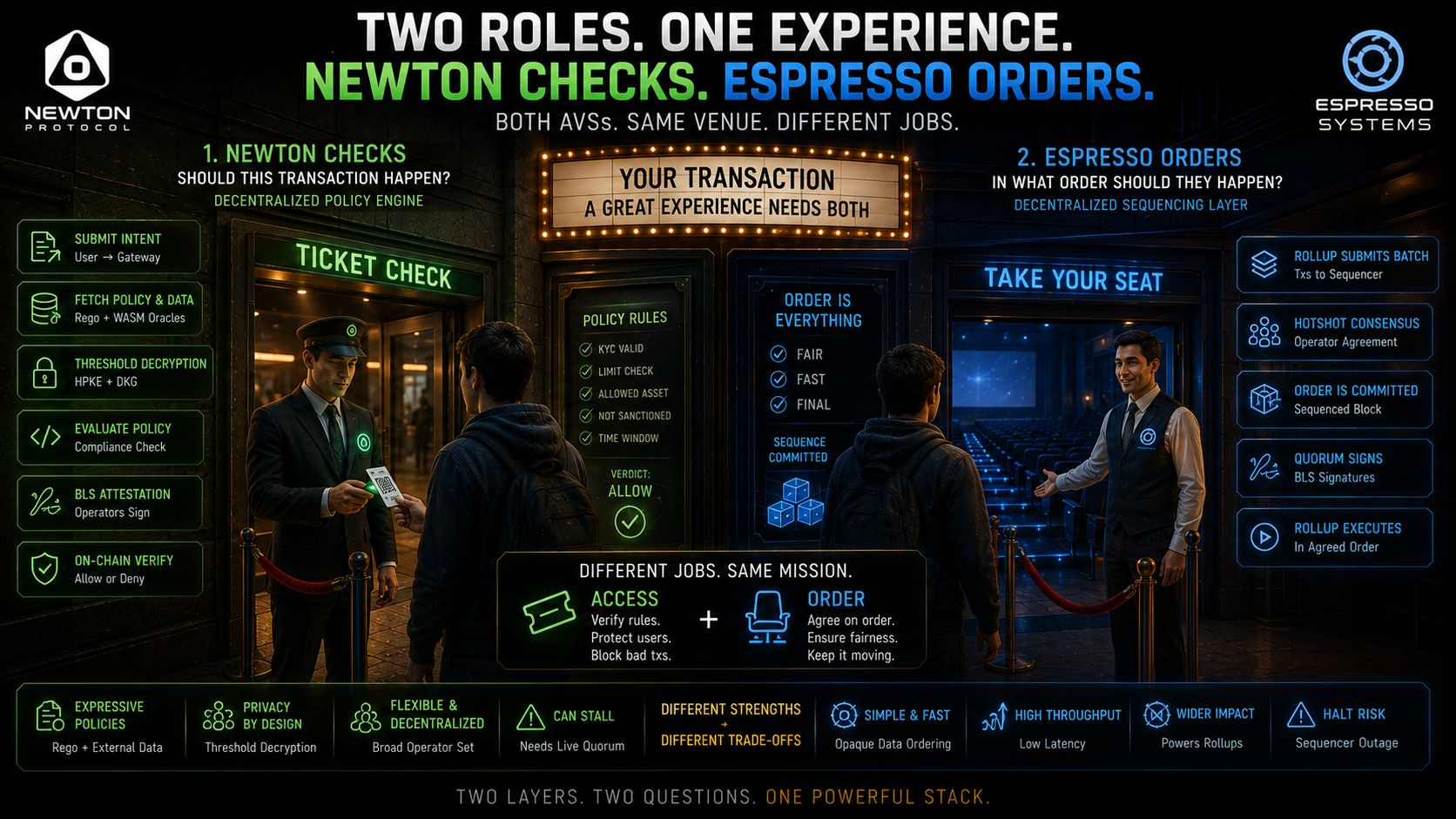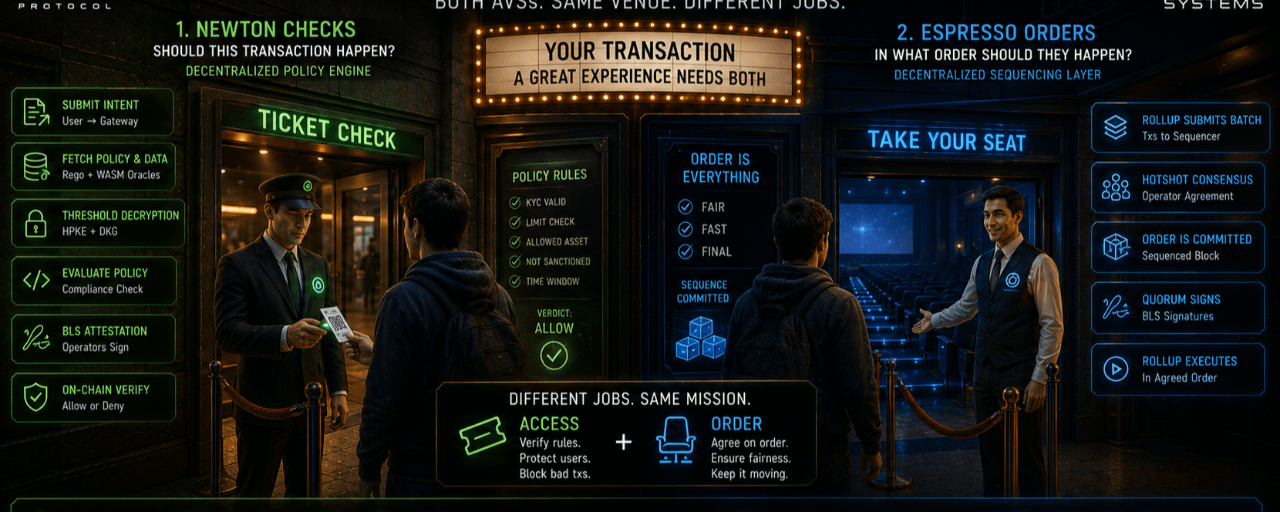
You walk into a movie theater. One staff member checks your ticket at the entrance, making sure you're allowed in. Another points you to screen four and tells you which row. The ticket checker doesn't care where you sit. The usher doesn't care what movie you're watching. Two completely different jobs, same venue, and you need both to have a good night.
That division of labor is exactly what I see when I put Newton and Espresso side by side. Both are AVSs on EigenLayer. Both run on a network of restaked operators. But the actual work they do splits along a line that feels fundamental, not cosmetic. Newton checks the ticket. Espresso shows you to the seat.
I've been sitting with the Newton docs for a while now. The core loop is straightforward once you trace it. A user submits an intent to the gateway. Operators pull the relevant Rego policy, optionally threshold-decrypt some sensitive data, evaluate whether the intent complies, and produce a BLS attestation. That attestation lands onchain, a smart contract verifies it, and the transaction either executes or gets blocked. The operators are a compliance committee. They answer one question: should this transaction happen?
Espresso doesn't touch that question at all. Its job is ordering. Rollups submit transaction batches, the HotShot consensus runs, and operators sign a block that commits to a sequence. No policy check, no identity verification, no decryption ceremony. Just an agreed order. The rollup uses that ordering commitment for execution. The question Espresso answers is: in what order should these transactions happen?
Right away I notice the difference in what gets verified. Newton verifies compliance with human-written rules. A policy might say "this address can transfer up to X per day, and only if its KYC status is valid." The operator fetches external data through a WASM oracle, decrypts sealed credentials, runs the Rego logic, and signs. The smart contract doesn't re-run the policy. It just checks the BLS signature. So the chain trusts the operator set to have evaluated correctly. The assumption is that enough operators are honest and that the policy execution is deterministic across a distributed set. If two operators query the same oracle at slightly different times, they might get different data, and the quorum could break. That's a real coordination challenge.
Espresso doesn't have that problem. The data being sequenced is opaque bytes. Determinism comes from the consensus algorithm. All honest nodes see the same mempool and can agree on an order algorithmically. No external data dependencies. No Rego runtime. That makes verification simpler: the rollup checks that the block is signed by the expected quorum. But simplicity here trades away expressiveness. Espresso can't enforce a spending limit or check a KYC status. It can only order what someone else already decided to include.
The failure modes split along these lines too. If Newton's threshold decryption stalls because too many operators are offline, policy evaluation stops. The chain itself keeps running, but the gated application freezes until operators recover. If Espresso's consensus halts, the rollup depending on it might stop producing blocks entirely, unless it has a fallback sequencer. Espresso's blast radius is wider, but recovery can be more mechanical: fall back to a centralized sequencer and move on. Newton's recovery might need human coordination to restart a DKG round or replace inactive operators. Different kinds of fragility.
Latency is another quiet tradeoff. Newton can tolerate a few seconds of evaluation time because compliance checks are expected to take a moment. Espresso needs sub-second sequencing to compete with centralized alternatives. That pushes Espresso toward a smaller, faster operator set. Newton, with looser time pressure, could run a larger and more decentralized one. The security budget per operator spreads differently: Newton bets on breadth, Espresso on speed.
What I find interesting is that these two could theoretically stack. A rollup could use Newton to filter transactions before they enter the mempool, then hand the surviving ones to Espresso for sequencing. The attestation from Newton would carry an expiration block, and the sequencer would have to include the transaction before that deadline. That integration isn't trivial, but it's logically coherent. Whether anyone builds it is another question. The two projects are solving different layers of the same stack, and right now they seem to be growing in parallel rather than converging.
I keep coming back to that movie theater. The ticket checker and the usher don't talk to each other. They don't need to. But if the ticket system goes down, the usher can still seat people, and the show goes on. If the usher calls in sick, ticket holders wander around confused. The failures are independent, but the experience depends on both. I'm not sure which role is harder to decentralize. But I suspect the ticket checker's job is the one that gets more complicated the closer you look. Verifying compliance with rules is messier than pointing at rows. One requires interpretation. The other just requires agreement. And interpretation, in a trust-minimized system, is the expensive thing.