while scanning the chain last night
While I was cross-referencing Newton Protocol's own documentation against what's actually running in production around midnight, something didn't line up the way I expected it to. Newton Protocol's mainnet beta went live on Base and Ethereum roughly two weeks ago, and the pitch is clean: a decentralized network of operators evaluating policy, reaching consensus, nobody trusting any single party. #Newt ,@newton_xyz — all the familiar signals were there in the announcement thread.
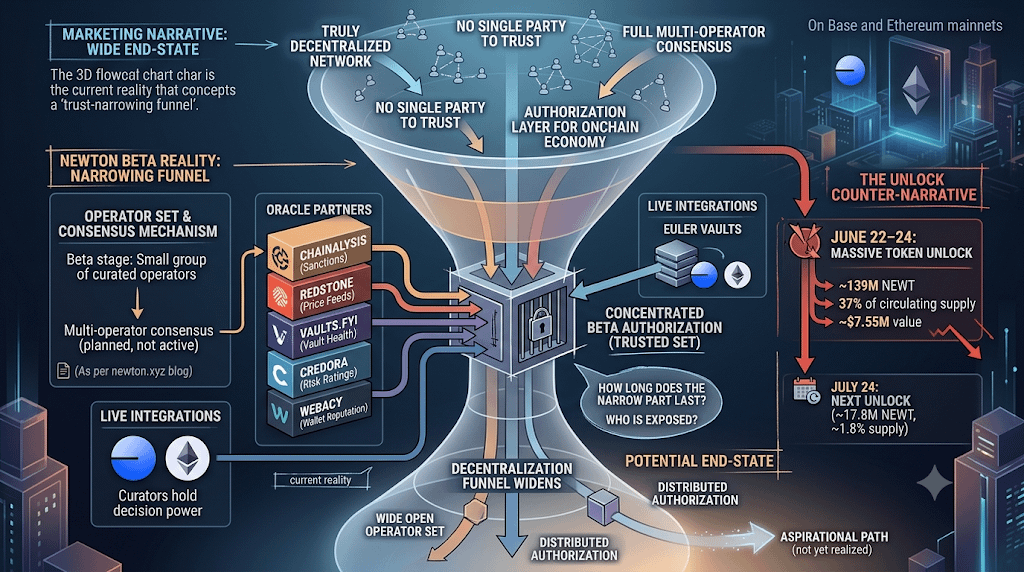
Here's the part that made me pause. The same week this "authorization layer for the onchain economy" narrative was being pushed hardest, roughly 139 million $NEWT — about 37% of circulating supply at the time, worth near $7.55M — unlocked and hit wallets on June 22–24. Two very different stories running in parallel: one about trustless enforcement, the other about a very traditional supply event.
Actionable insight upfront, because I don't want to bury it: if you're evaluating Newton right now, don't just read the operator-consensus documentation. Check who's actually running policy checks in beta, and check the unlock calendar before you check the roadmap. Those two things tell you more about present-day risk than the whitepaper does.
That's the contrast that kept me up later than planned — hyped decentralization vs. the on-chain reality of a beta that's still, structurally, closer to a small trusted set than a wide-open network.
the contrast that stuck with me
Newton's own writeup on how the authorization layer works is honest about this, actually — more honest than most projects are at this stage. It says plainly that broad multi-operator consensus applies once the protocol is out of beta. Out of beta. Present tense doesn't apply yet.
So right now, during beta, you have a smaller number of operators, a curated set of oracle partners handling risk monitoring, price feeds, vault health, and wallet reputation, and a handful of live integrations, notably Euler vaults on Base and Ethereum. That's not a criticism. Betas are supposed to look like this. But it does mean the "no single party to trust" framing is aspirational, not operational, today.
I found myself doing the thing I try not to do: skimming past the caveat because the architecture diagram was elegant. Had to stop, reread the consensus section twice. The zero-knowledge fraud proof and slashing mechanism are real and specific — an operator that signs off wrong can be challenged during a dispute window and loses part of its stake. That's a legitimate design. It's just not fully populated yet.
Here's a small anecdote, since it's relevant: a few months back I onboarded onto a different "decentralized" oracle network that turned out to be five known entities running infrastructure for the first year, with public commitments to widen the set later. It worked fine. Nobody got hurt. But I remember the gap between the deck and the deployment being wider than the deck let on — and Newton's beta gave me the same flicker of recognition.
The conceptual framework I keep coming back to is what I'd call the trust-narrowing funnel: a protocol markets itself at the widest, most decentralized end-state, but every early integration — the vault curator, the specific oracle list, the specific operator set — necessarily narrows that funnel down to something smaller and more concentrated, at least temporarily. The funnel widens again as adoption grows. The question is always how long the narrow part lasts, and who's exposed to it in the meantime.
hmm... this mechanic in practice
Two market examples worth sitting with. First: the Euler vault integration. Vault curators hold real power — they decide market allocation, which assets are enabled, how exposure gets managed — and historically that power ran on "the curator promises to follow the rules." Newton's pitch is to turn that promise into enforced policy, checked before execution rather than audited after the fact. In beta, with the current operator set, that enforcement exists — it's just enforcement by a smaller group than the eventual target state.
Second example, and this is the one I keep circling back to: the unlock itself. Just over a third of circulating supply moving in one week is not a rounding error, and it landed during the exact window meant to showcase mainnet credibility. I don't think that's malicious timing — vesting schedules are set well in advance and this one follows the Foundation's published transparency reporting. But it's a useful reminder that tokenomics mechanics run on their own clock, independent of protocol milestones, whether the timing looks convenient or not.
Honest skepticism, because I owe you that: I went in assuming "mainnet beta" meant something closer to full production decentralization, given how the term gets used loosely across this cycle. It doesn't, here — and to Newton's credit, their own documentation doesn't claim it does, if you read past the headline. I had to revise my initial read after actually sitting with the operator-consensus language rather than the summary of it.
There's also a smaller unlock scheduled for later this month, under 2% of supply this time, spread across the ecosystem fund, treasury, contributors, and backers. Worth watching not because of size, but because it's the next data point on whether unlock timing and adoption timing start to converge or keep drifting apart.
still pondering the ripple
Sitting with this a bit longer, what strikes me isn't that Newton is doing anything wrong. It's that the gap between "decentralized authorization layer" and "beta with a defined operator and oracle set" is completely normal — and almost never stated as plainly as Newton states it, buried in a technical explainer instead of the announcement post.
I think that's actually the more interesting story than either the launch or the unlock on their own. Most projects let the marketing outrun the mechanism and hope nobody checks the difference. Here the mechanism is documented well enough that you can catch the gap yourself, if you're willing to read the "how it works" post instead of just the "we launched" post.
What I'm still turning over: does the trust-narrowing funnel close faster when the documentation is this transparent about where the narrow part is? Or does clear documentation just make the gap easier to see without actually making it close any sooner?
A couple of forward-facing things I'll be watching rather than predicting. Whether the operator set actually widens on a visible schedule, not just a promised one. And whether vault-level integrations beyond Euler show up before the next major unlock, which would suggest usage growing into the token rather than supply growing ahead of usage.
Curious whether others digging into on-chain records this week are seeing the same operator concentration I am, or whether I'm reading the beta phase too literally — would genuinely like to compare notes.
What happens to a "trustless" narrative once you can actually name every party currently doing the trusting?