
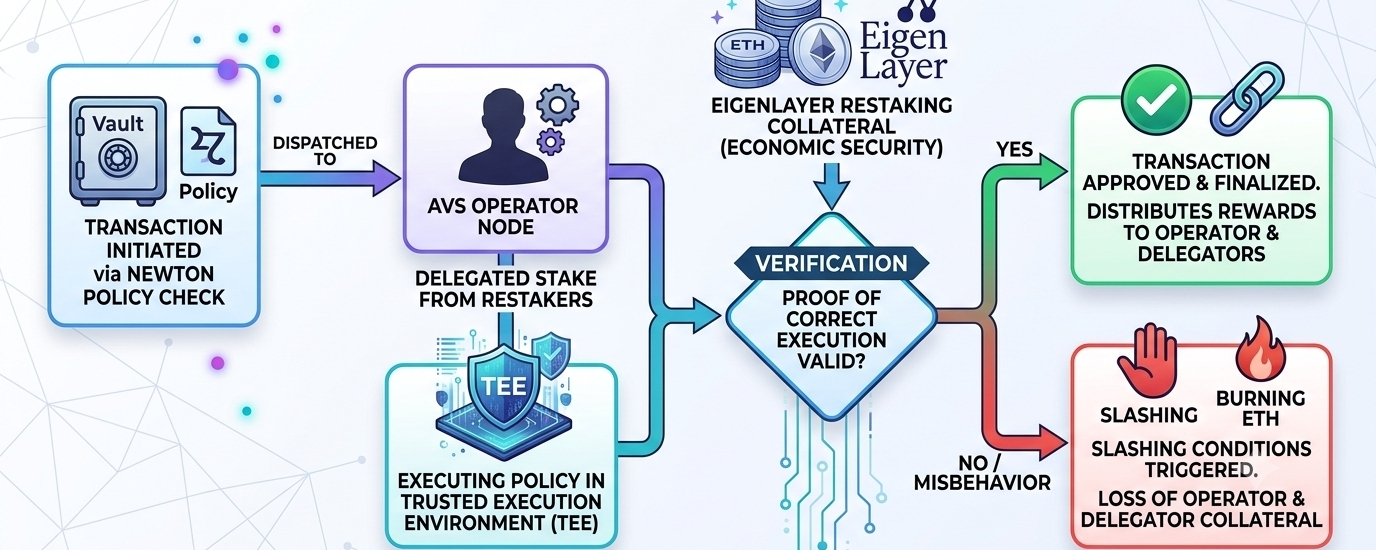

I went down a bit of a rabbit hole this week trying to understand what actually happens on the other side of a Newton policy check, not the user-facing part where a transaction gets approved or blocked, but the machinery underneath that produces that decision in the first place. I knew Newton ran as an AVS secured through EigenLayer restaking, I'd noted that much before, but I hadn't really sat with what that means operationally until I started reading about how the operator network itself functions. Operators are the entities actually running Newton's policy evaluation software, they register with EigenLayer, receive delegated stake from restakers, and in exchange take on the responsibility of executing the checks inside trusted execution environments and generating proofs that those checks were done honestly. I sometimes wonder how many people interacting with Newton's Vaults ever think about the fact that a human-run node somewhere is the thing actually deciding whether their transaction clears.
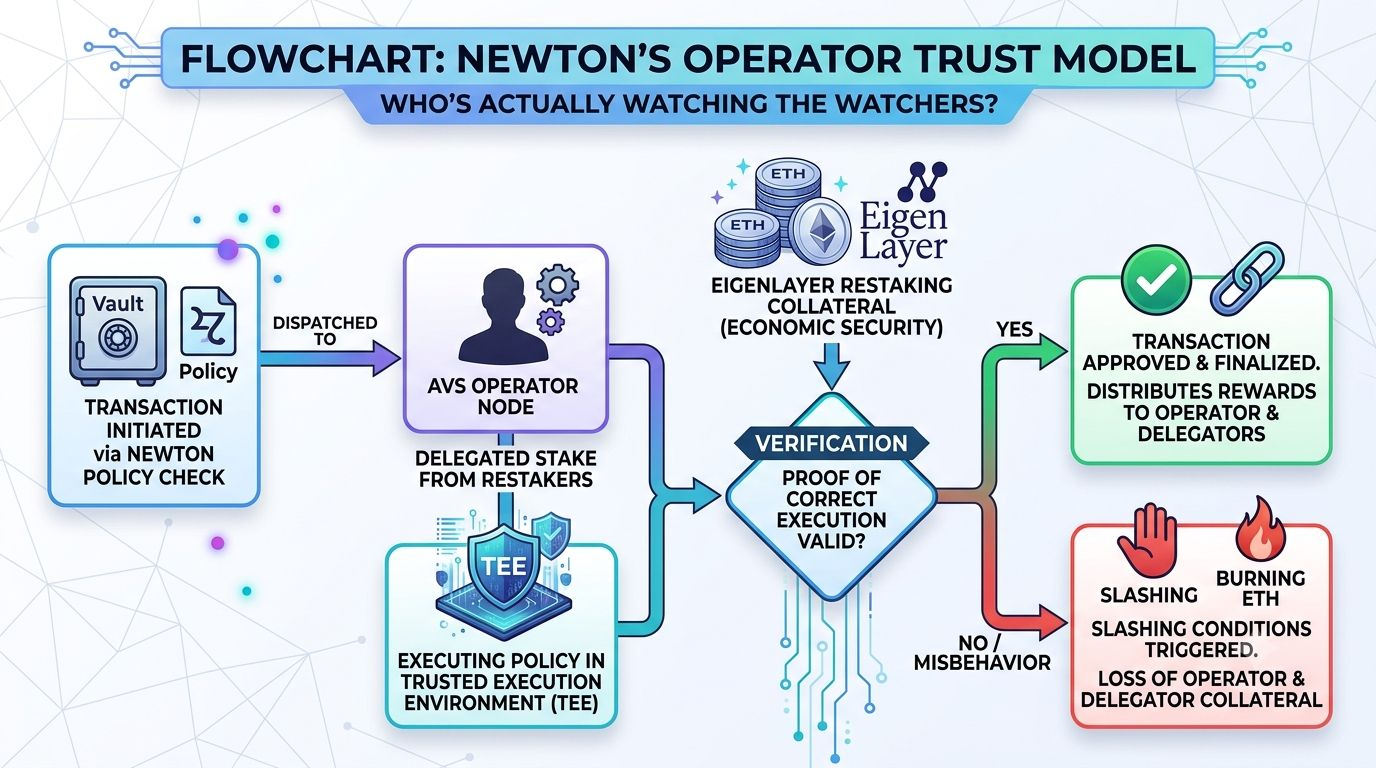
What seems interesting is how this setup tries to solve a trust problem without falling back on a single centralized authority. Instead of Newton running its own validator set from scratch, which would mean bootstrapping economic security entirely on its own, it borrows security from Ethereum through restaking, letting ETH and liquid staking tokens that are already committed elsewhere also back Newton's operator network. The idea is that if an operator behaves dishonestly, evaluates a policy incorrectly, or fails to produce a valid proof, their staked collateral is at risk of slashing. That's the mechanism that's supposed to make credible neutrality possible, operators have skin in the game tied to the same asset securing much of the rest of the ecosystem, rather than just being trusted because Newton says so. It's a fairly elegant piece of design on paper, and I can see why a compliance-focused protocol would want that kind of borrowed legitimacy rather than asking institutions to trust an entirely unproven validator set.
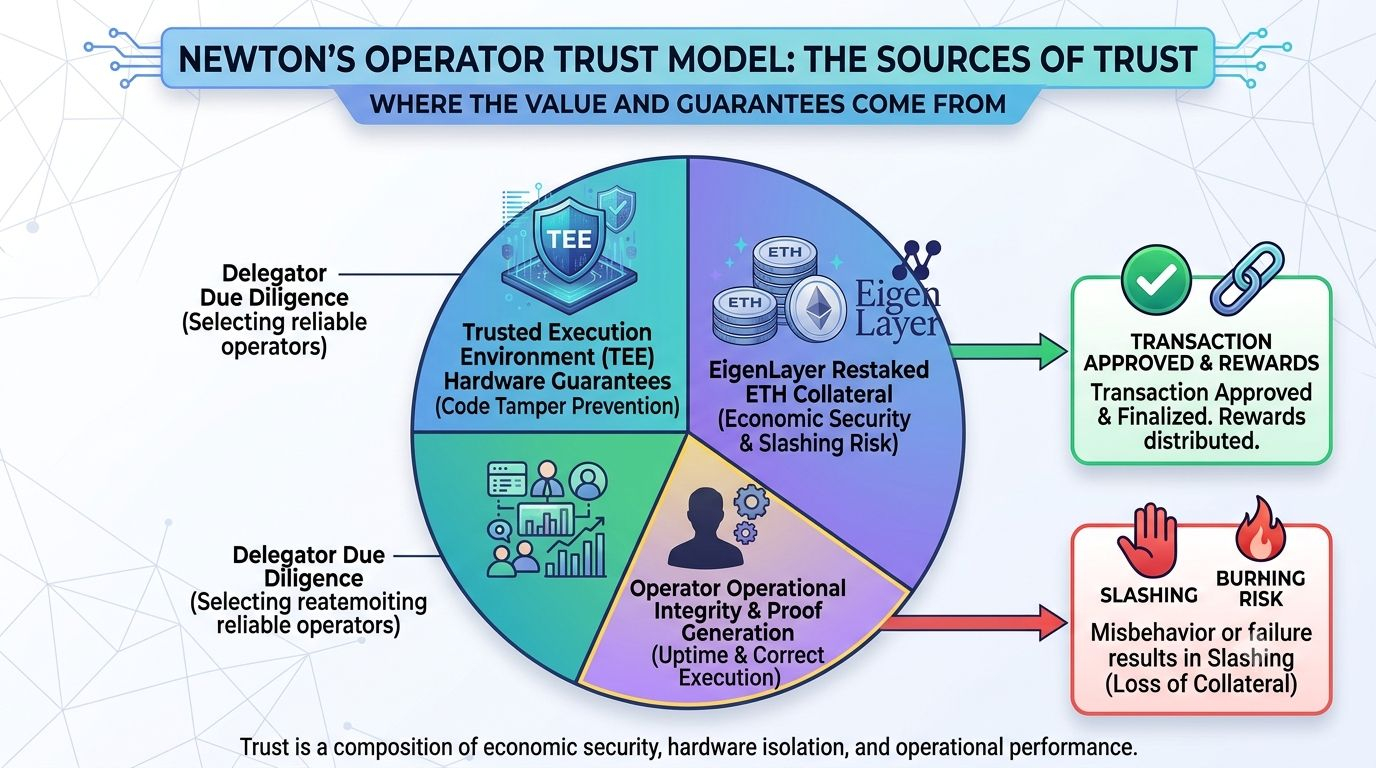
The part that gives me pause is thinking about how this plays out once slashing conditions actually get triggered in practice, since that risk moved from theoretical to live relatively recently across the EigenLayer ecosystem. Each AVS sets its own slashing conditions, and those conditions can differ meaningfully in how strict or forgiving they are, which means Newton's specific rules for what counts as operator misbehavior matter enormously to how reliable the whole system actually is. I don't know the details of Newton's particular slashing conditions well enough to say whether they're conservative or aggressive, and that feels like an important gap in my own understanding right now. There's also the question of delegation, most restakers don't run their own nodes, they delegate to operators they've chosen, which means an individual staker's actual exposure depends heavily on an operator's uptime, key management practices, and which other AVSs that same operator has opted into validating. If an operator is spread thin across several services, does that concentration of responsibility introduce fragility that isn't obvious from the outside looking at Newton in isolation?
Looking from the outside, I think this whole layer of infrastructure is easy to take for granted precisely because it's supposed to be invisible when it's working correctly. A user sees a transaction get approved or blocked and maybe glances at a signed attestation afterward, but the actual trust being extended runs through a chain of restaked capital, delegated operators, TEE attestations, and slashing conditions that most people, myself included until recently, never really examine closely. Whether that chain holds up under real adversarial pressure, a genuinely incentivized attempt to corrupt an operator or exploit a gap between TEE guarantees and actual behavior, is something that hasn't been meaningfully tested yet in Newton's case as far as I can tell. The mainnet beta phase presumably exists partly to surface exactly these kinds of stress points before the stakes get larger. Whether the operator network proves resilient once real value and real adversaries start probing it, or whether some weakness in the delegation and slashing design reveals itself under pressure, feels like one of those questions that only gets answered by actually living through it, anyway, time will tell👍
