I almost ignored Newton Protocol the first time I came across it. Not because it seemed unrealistic, but because I've reached the point where I'm more suspicious of clean narratives than complicated ones. Crypto has a way of making difficult problems sound temporarily manageable. Then the market reminds everyone that reality doesn't care much about elegant designs.
So I left it alone for a while.
Oddly enough, that didn't stop me from thinking about it.
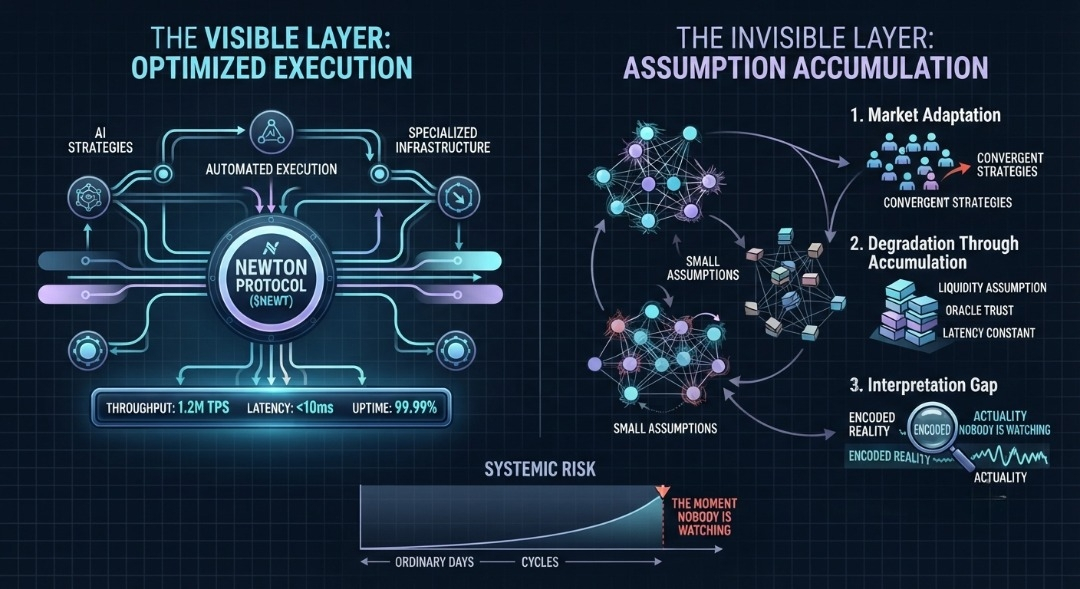
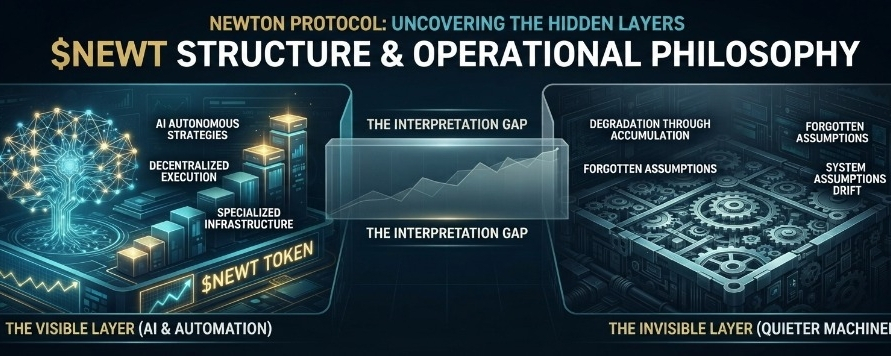
It's easy to get pulled into discussions about AI strategies, automated execution, or specialized infrastructure. Those are the visible parts. They're what people naturally focus on. But after watching enough protocols evolve, I've become more interested in the layers nobody likes talking about. The boring ones. The parts that spend years proving they deserve trust instead of asking for it.
That's where my attention keeps drifting.
I've never really believed that automation removes uncertainty. It changes its shape. Human hesitation gets replaced by system assumptions. Manual decisions become encoded decisions. Instead of asking whether someone made the right call, we begin asking whether the framework itself interpreted reality correctly.
That feels like a subtle difference until something unexpected happens.
And unexpected things always happen.
Markets don't simply fluctuate. Participants adapt. Incentives mutate. Strategies that worked for months suddenly become liabilities because everyone quietly arrived at similar conclusions. None of this usually appears in architecture diagrams. Those diagrams assume a world that behaves consistently enough to reward careful planning.
The real world has different habits.
Thinking about Newton Protocol brought me back to something I've noticed across several cycles. Infrastructure doesn't usually collapse because one component fails spectacularly. More often it degrades through accumulation. Small assumptions stack on top of one another until the overall system begins depending on conditions that no longer exist.
It's almost never dramatic at first.
Just slower responses here. Slightly altered incentives there. A few participants behaving differently because they discovered something the original design never anticipated.
AI doesn't seem immune to that process.
If anything autonomous strategies might amplify it. Models continuously adjusting to the same environment could unintentionally reinforce one another. Everyone talks about intelligence, but intelligence isn't necessarily diversity. Independent systems often end up learning similar behaviors when they're rewarded by the same conditions.
That possibility feels more significant than whether execution becomes faster.
I also find myself wondering about verification. We often say decentralized infrastructure reduces the need for trust, yet increasingly sophisticated AI introduces new questions about interpretation rather than execution. A result can be valid from the protocol's perspective while still reflecting assumptions that gradually drift away from reality.
That distinction seems easy to overlook.
I've noticed that crypto has a tendency to celebrate what can be measured immediately. Throughput. Activity. Adoption. Those things matter, obviously. But the qualities that determine whether infrastructure survives tend to emerge much later. Quiet consistency. Predictable behavior under pressure. The absence of surprises during periods when nobody is paying attention.
Those aren't particularly exciting metrics.
Maybe that's why they matter.
I'm still not sure what Newton Protocol eventually becomes. Maybe it will prove that AI and decentralized infrastructure can coexist more naturally than I expect. Maybe it will expose entirely new coordination problems that only become visible after enough autonomous systems begin interacting with one another.
Either way I suspect the real story won't be found in the intelligence itself.
It will probably emerge from the quieter machinery underneath the ordinary days, the forgotten assumptions and the moments when nobody is watching closely enough to notice that the system has started behaving just a little differently than it did before.