
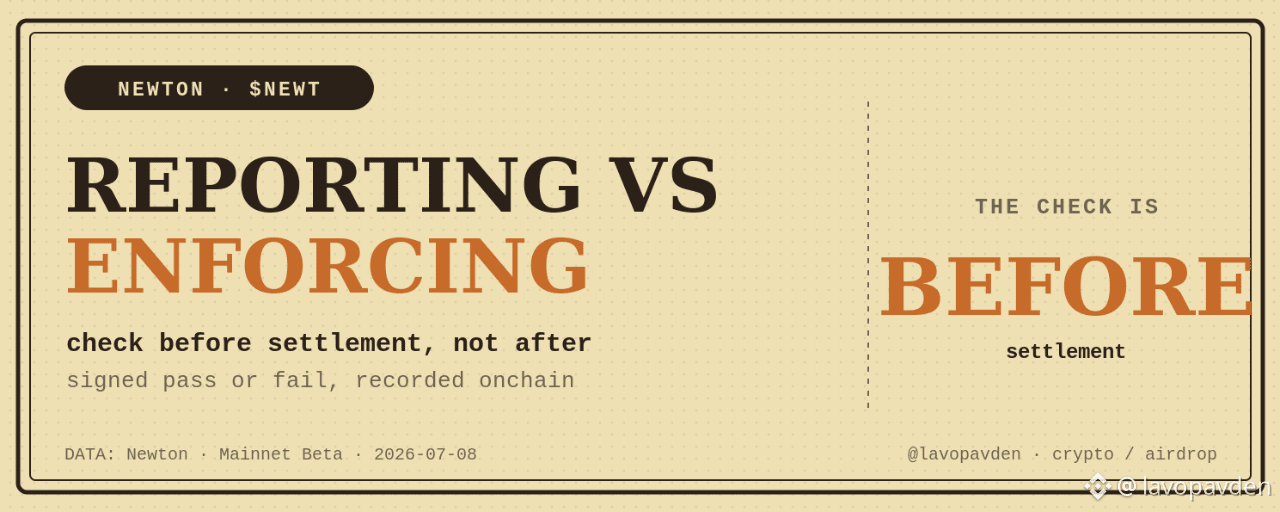
Most onchain security tools share one habit. They speak in the past tense. The alert fires, the log fills, the dashboard turns red. And by then the transaction has already settled. Newton Protocol is built to work in a different tense. It decides before the money moves.
That difference is the entire pitch. So it is worth pulling apart slowly.
The tools we have mostly report
Monitoring, analytics, alerting. These are the three shapes onchain security usually takes. All three are useful. None of them stop anything on their own.
A monitor watches your positions and tells you when something looks wrong. An analytics tool reconstructs what happened after a bad transaction lands. An alert pings your phone. Every one of these is a record of an event that already occurred.
That is fine for forensics. It is how teams trace an exploit after the fact. But there is a hard limit built into the design. You cannot report your way out of a loss that already happened. The block is confirmed. The funds are gone. The dashboard is describing a crime scene, not preventing one.
This is not a knock on those tools. Forensics matters. It is just a different job than enforcement, and the two keep getting confused.
Newton moves the check to before settlement
Here is the shift. Newton checks every transaction against an active policy before it settles. Then it returns a signed pass or fail attestation, recorded onchain.
Read that order again. The check comes first. The settlement comes second. A monitoring tool sees the transaction after it lands. Newton sees it while there is still time to say no.
The output is not a warning. It is an attestation. A signed, onchain receipt of a decision that was actually enforced, not a note about something that slipped through. When Newton passes a transaction, that pass is a fact you can point to later. When it fails one, the fail happened in time to matter.
That is the sentence I keep returning to. Other tools record what happened. Newton records what it enforced.
The Newton Mainnet Beta went live on June 23, 2026, with the Vault SDK and launch data partners including RedStone and Credora. The data feeding those policies is not an afterthought. Verified price and risk data is what lets a policy make a real decision instead of a guess.
What it means, and what it does not
Let me be careful here, because this space rewards overclaiming and punishes it later.
Moving the check before settlement does not make hacks impossible. It does not make anything one hundred percent safe. A policy still has to be written well. A badly written rule enforced perfectly is still a bad rule. Enforcement is a place to stand, not a magic shield.
What it does change is where the decision lives. Today, most risk limits for vaults and strategies sit offchain. Spreadsheets. Multisig conventions. Trust in a curator. Newton makes those rules enforceable at the moment they are needed, and it proves the enforcement onchain.
For a depositor, that is the difference between a promise and a gate. A promise says the curator will follow the rules. A gate checks the rule before your money moves and signs the result. You do not have to take anyone's word for it.
For an institution, it is the same logic in a stricter suit. Compliance and risk teams do not want a report that a rule was broken. They want the rule enforced before the breach, with a record they can audit. Pre-settlement enforcement is exactly that shape.
Takeaway: the useful question is not whether a tool can see a bad transaction. Almost all of them can, eventually. The question is whether it can act before the transaction settles. Reporting answers with a log. Newton answers with a gate and a signed receipt.
So next time a security tool shows you a red alert, ask it one thing. Could it have stopped the transaction, or is it just describing one? Where do you think enforcement should live, at the edge or after the fact?
Follow @NewtonProtocol to track how the Mainnet Beta grows.
Not financial advice. This is a paid campaign post about Newton Protocol. Do your own research before interacting with any protocol.
Source
https://newton.xyz
https://newton.xyz/whitepaper
https://blog.redstone.finance/2026/06/25/redstone-brings-verified-data-to-newtons-onchain-policy-enforcement/
https://docs.newton.xyz/developers/overview/about