

Introduction
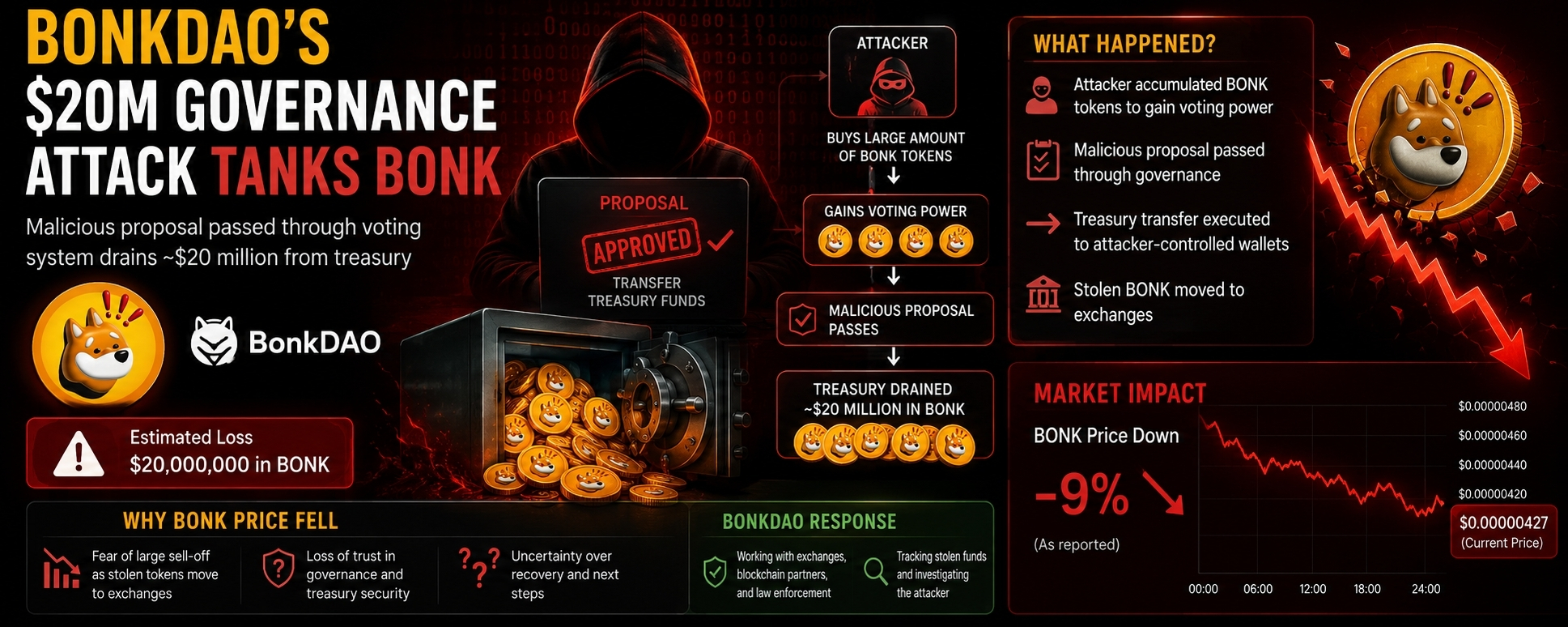
BonkDAO has been hit by a major governance attack that reportedly drained around $20 million worth of BONK from its treasury. The news quickly spread across the crypto market and pushed BONK lower as traders reacted to fears of stolen tokens being sold.
This was not a typical crypto hack where attackers break a smart contract. Instead, the attacker appears to have used BonkDAO’s own voting system to approve a harmful proposal. That makes the incident even more serious because it shows how weak governance can become a direct security risk.
What Happened?
BonkDAO is connected to the BONK ecosystem and helps manage community treasury decisions. Like many DAOs, it uses governance voting, where token holders can support or reject proposals.
In this case, a malicious proposal was reportedly passed through the governance system. Once approved, it allowed a large amount of BONK to be transferred out of the DAO treasury and into wallets controlled by the attacker.
The total loss is estimated at around $20 million.
Reports suggest the attacker may have bought a large amount of BONK before the vote to gain enough influence. After securing enough voting power, the attacker pushed the proposal through and used it to drain treasury funds.
Why This Was a Governance Attack
This attack is different from a normal exploit. The attacker did not simply find a bug and steal funds directly. Instead, they used the rules of the DAO against the project.
In token-based governance, more tokens usually mean more voting power. That system can work when the community is active and voting power is spread out. But it becomes risky when someone can quickly buy enough tokens to control an important vote.
That seems to be the main issue in the BonkDAO case. The governance system may have worked as designed, but the design was not strong enough to stop a hostile proposal.
Why BONK Dropped
BONK fell because the market saw several risks at the same time.
The biggest fear was that the attacker could sell the stolen BONK. When millions of dollars worth of tokens move into attacker-controlled wallets, traders often expect heavy selling pressure.
Another reason was the damage to trust. BONK depends heavily on community confidence. A treasury attack makes investors question whether the ecosystem is secure and whether the DAO can protect its remaining assets.
The third reason was uncertainty. After an attack like this, people want clear answers. They want to know where the stolen tokens went, whether exchanges can freeze them, and what steps the DAO will take next. Until those questions are answered, price pressure can continue.
What BonkDAO Is Doing Now
BonkDAO has reportedly been working with exchanges, blockchain partners, and law enforcement to track the stolen funds. Some platforms also took action to monitor or restrict suspicious BONK movements after the incident.
Recovery may be difficult, but it is not impossible. If stolen tokens reach centralized exchanges, there is a chance they can be frozen. However, if the attacker moves funds through multiple wallets, bridges, or decentralized platforms, recovery becomes much harder.
The next few days will be important for BonkDAO. The project needs to show that it can respond quickly, protect remaining assets, and rebuild confidence.
What This Means for BONK Holders
For BONK holders, the attack does not mean personal wallets were hacked. The reported loss came from the DAO treasury, not from individual users.
Still, the impact matters. A DAO treasury supports the project’s ecosystem, development, community programs, and long-term plans. When treasury funds are stolen, it can weaken confidence in the whole project.
BONK’s short-term price will likely depend on three things: whether the stolen tokens are sold, whether any funds are recovered, and whether BonkDAO announces stronger governance protections.
The Bigger Problem for DAOs
The BonkDAO attack is not just about one meme coin. It exposes a wider problem in decentralized governance.
Many DAOs rely on simple token voting. That sounds fair on the surface, but it can be dangerous when voting power can be bought quickly. If an attacker can spend a few million dollars to gain control of a vote and then steal much more from the treasury, the system becomes vulnerable.
This is why DAO security cannot only focus on smart contracts. Governance itself needs protection.
What Needs to Change
BonkDAO and other DAOs may need stronger rules for treasury decisions.
Large transfers should not happen immediately after a vote. There should be a delay so the community can review suspicious proposals before execution.
DAOs should also consider spending limits, stronger quorum requirements, emergency review systems, and multisig approvals for major treasury actions.
Another important change could be limiting the voting power of freshly bought tokens. This would make it harder for attackers to quickly buy influence and pass harmful proposals.
Final Thoughts
The BonkDAO governance attack is a serious warning for the crypto industry. It shows that a DAO can be vulnerable even when its code works properly.
The real weakness may be in the voting system, the treasury controls, or the lack of active participation from the community.
For BONK, the immediate challenge is to recover trust. For the wider DAO space, the message is simple: governance is not just administration. Governance is security.