The strange thing about crypto approvals is that we spend a lot of time deciding whether to grant them.
Almost no time deciding when they should stop existing.
That never felt like a serious design problem to me.
Until I started reading Newton Protocol.
Most on-chain systems quietly assume something that rarely gets questioned. Once authority is granted, it continues to exist until someone explicitly removes it. Whether that authority comes from a wallet approval, delegated execution, or an automation workflow, permanence is treated as the default state.
Newton Protocol seems to challenge that assumption.
The more I looked at its permission architecture, the more it felt like the protocol was designed around a completely different belief.
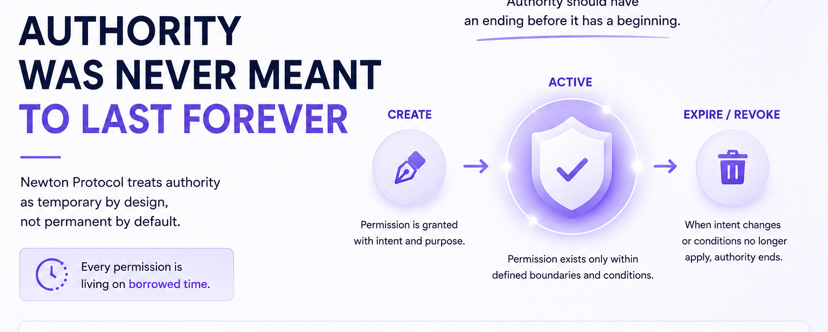
Authority should be temporary by design.
That is a subtle idea.
But it changes almost everything.
Most discussions around autonomous agents focus on how to safely give an AI permission to act.
Newton Protocol appears to ask a different question.
Why should the permission still exist tomorrow?
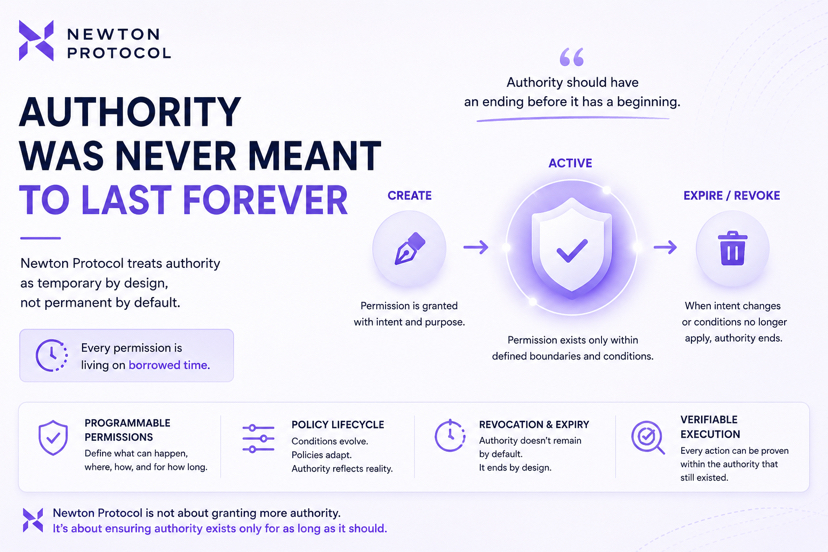
That question immediately shifts the architecture away from approval and toward lifecycle.
A permission is no longer a simple “yes.”
It becomes something that has to be created, constrained, monitored, and eventually reach an end.
That is why Programmable Permissions inside Newton Protocol feel less like access control and more like programmable authority.
The permission itself carries structure.
It defines what can happen.
Where it can happen.
Under which conditions it remains valid.
And, just as importantly, when it should no longer exist.
This is where I think many people misunderstand autonomous systems.
The hard problem is not teaching an agent how to execute.
The hard problem is making sure authority does not quietly outlive the user’s original intention.
Because intentions change.
Markets change.
Strategies change.
Risk tolerance changes.
A permission that made perfect sense two weeks ago may become completely inappropriate today.
Newton Protocol does not seem to treat that as user error.
It treats it as an architectural reality.
That is why permission lifecycle matters.
Authority should not simply remain active because nobody remembered to remove it.
It should exist only as long as the conditions that justified it are still true.
That philosophy also explains why execution inside Newton Protocol is tied to policy rather than trust alone.
Delegated Execution is meaningful because delegated authority is already bounded.
Programmable Permissions are meaningful because authority has defined limits instead of open-ended approval.
Verifiable Execution is meaningful because the protocol can demonstrate that every executed action remained inside the authority that still existed at that moment.
None of these components are isolated features.
Together they describe a different way of thinking about automation.
The protocol is not asking users to permanently trust an autonomous agent.
It is asking builders to define how long that trust should remain valid before the system requires it to be established again.
That is a much harder engineering problem.
Builders have to think about permission lifecycle, policy conditions, execution boundaries, and what should happen when authority reaches the end of its intended life.
Newton Protocol does not make automation simpler.
It makes automation expire.
And that may be one of the most overlooked ideas in the entire architecture.
After reading the project, I no longer think the most important question is:
“Should I approve this agent?”
I think the better question is:
“Why should this authority still exist after the reason for granting it has already disappeared?”
Maybe that is the deeper lesson behind Newton Protocol.
The future of autonomous infrastructure may not depend on how easily authority can be granted.
It may depend on how intentionally authority is allowed to end.