
AI keeps running into the same bottleneck.
Demand for compute and data is growing exponentially, but the infrastructure powering it remains expensive and concentrated in the hands of a few providers.
That gap is creating an opportunity for DePIN networks to offer an alternative, distributing supply across global contributors while reducing costs.
What's interesting isn't just the narrative. It's whether these networks can turn growing AI demand into sustainable usage and, eventually, value capture.
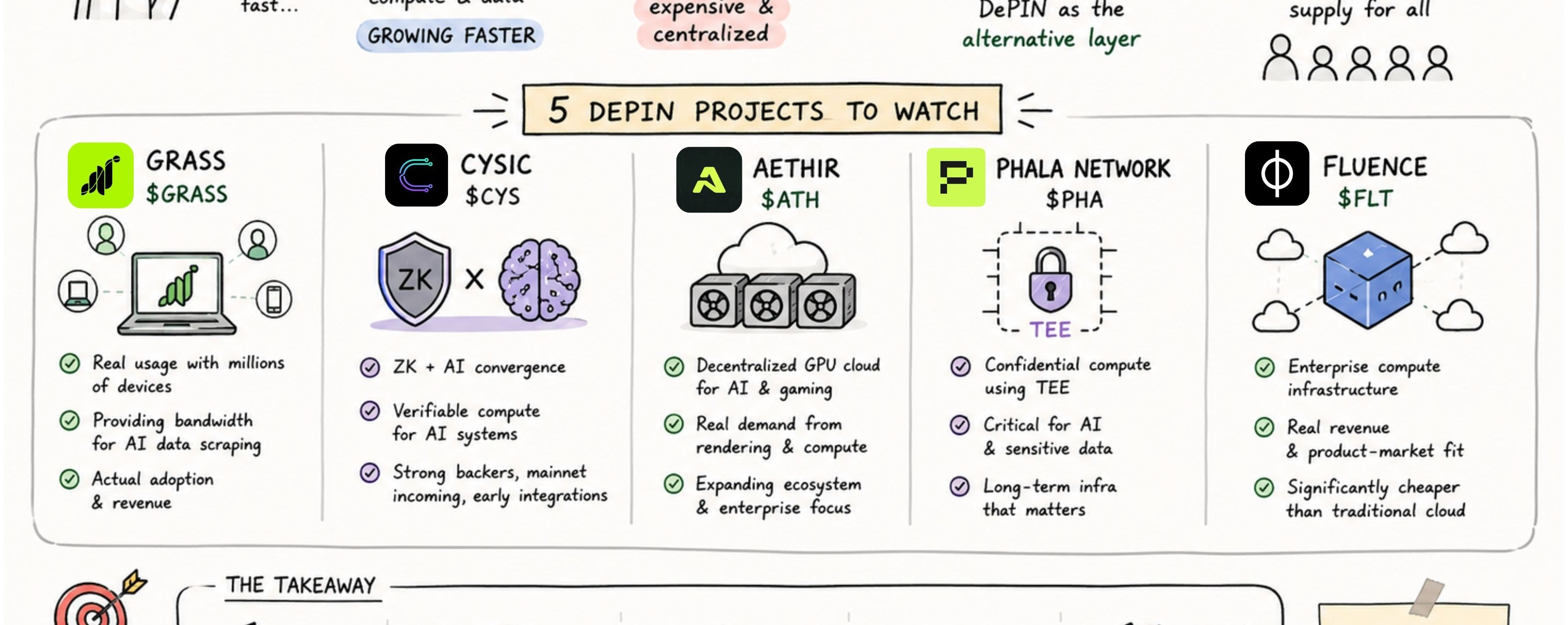
Grass is attacking the data layer, with millions of devices already contributing bandwidth for AI data collection. Unlike many projects still selling a vision, usage is already happening.
Cysic sits at the intersection of AI and zero knowledge proofs, focusing on verifiable compute.
As AI systems become more autonomous, proving that outputs were generated correctly could become just as important as generating them in the first place.
Aethir is targeting one of the most obvious shortages in the market, GPU access. Instead of building new demand, it's trying to serve demand that already exists across AI and gaming workloads.
Phala approaches the problem from a different angle. As AI starts processing more sensitive information,
confidential compute becomes increasingly important. Privacy isn't the most exciting narrative today, but it could become a requirement tomorrow.
Then there's @Fluence which is focused on enterprise compute and infrastructure efficiency. Rather than competing on hype, it's competing on economics, offering a lower cost alternative to traditional cloud providers while positioning itself for the growing AI compute market.
The bigger question isn't whether AI demand will grow. It already is. The question is which infrastructure networks can scale alongside it and convert that growth into durable adoption.
That's where the real opportunity, and the real risk, exists.